Paul,
What would be the sea level exhaust pressure just before the turbine
inlet in a turbocharged engine?
I'm guessing maybe 18 psi to account for a little bit of back pressure
due to the turbine?
Regards,
Gordon.
I don't have any data on that. I wish I did.
Paul Lamar ...No rotor no motor.
Back pressure is EXTREMELY dependent on exhaust manifold and turbine
configuration. There is NO typical value! Mistral has measured full-power
back pressures up to 1.8 bar (23-24 psi) which is unacceptable, resulting in
a significant loss of engine power, and as low as 1.2 bar (17 psi) which
does not optimize turbine efficiency. By changing manifold configurations
(pulse or constant-pressure system), turbine scroll (single or twin-scroll)
and turbine inlet configuration (A/R ratio), back pressure and turbine
efficiency can be adjusted to the desired compromise. Believe me, it ain't
trivial.
I recommend highly the following reading: Diesel Engine Reference Book,
Chapter 2, The Theory of Turbo charging, p. 28-71); it doesn't have to do
with diesel engines only and it is quite comprehensive.
Francois Badoux
It is possible to measure dynamic pressure and not static
pressure. This can be misleading If the pressure port faces
the the rotary engine exhaust port and the flow is coaxial
with the pressure port you will measures dynamic pressure and
not static pressure. Dynamic pressure can be much higher than
static pressure. Also there is an issue with pressure sensor
speed of response. Ideally you want a sensor fast enough to
measure pressure waves.
Paul Lamar ...No rotor no motor.
Absolutely correct Paul. We measure dynamic pressure with a 50kHz sensor
which gives extremely detailed pressure graphs. Sorry I cannot send you
oscilloscope pictures, the files are several Mo. Let's say that if the
turbo arrangement is unfavorable, peak back pressure from one rotor can be
as high as 3.6-3.8 bar and coincide with the other rotor's peak torque
timing, resulting in a big loss of power. Do you follow me?
Francois
Yes of course but I think Reeves is talking about static
pressure. Ideally I would like to see both. Overall static
pressure in the exhaust manifold and how it fluctuates
as the e-shaft rotates and dynamic pressure from the
exhaust ports that would tell us the velocity of the exhaust
gases directly. This would go a long way towards developing the
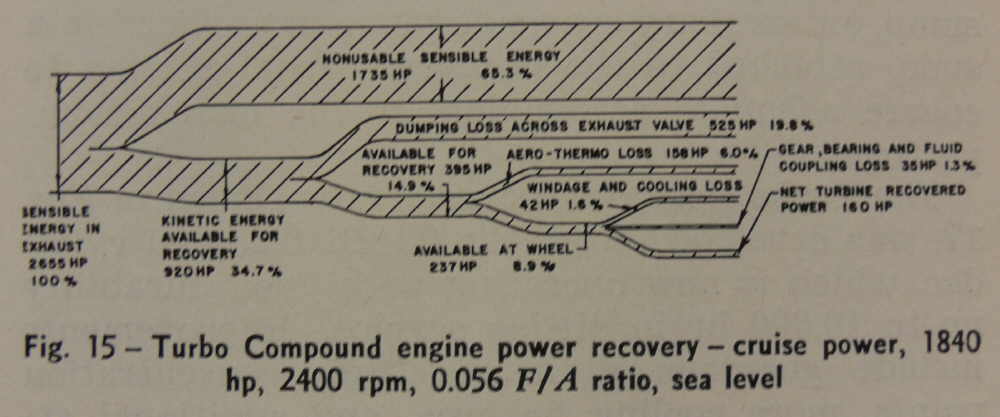
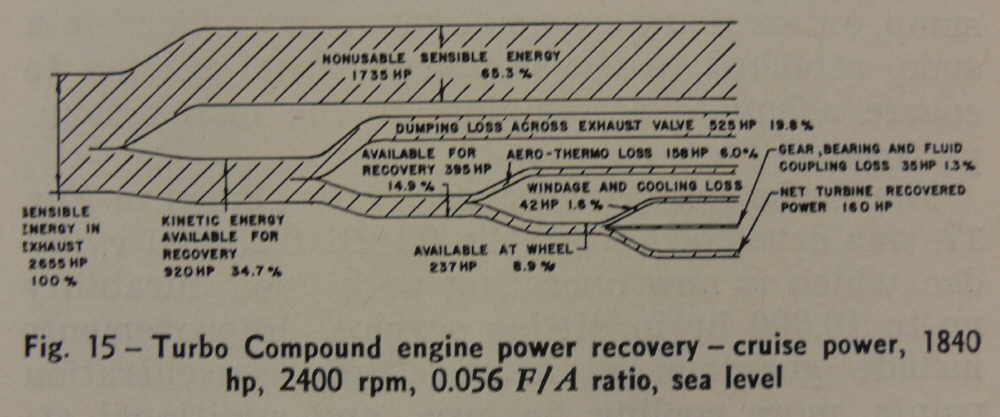
turbo compound rotary. As Curtiss-Wright put it in the 1954 SAE
paper Development of the Turbo Compound Engine, "Kinetic Energy".
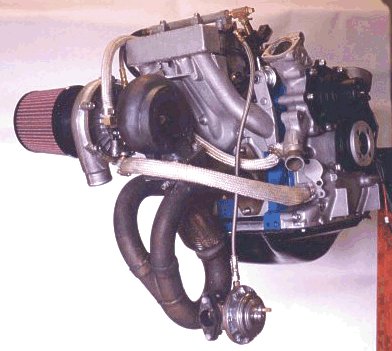
Several people have built turbo charger systems with individual
exhaust pipes and it did not seem to be a significant
advantage.
BTW Hard to argue with Reeves as he has a wonderful
track record developing turbo charger systems for several
well known manufacturers cars including Mazda that have been
produced and sold in significant quantities. The most famous
of which in my mind is the Callaway Corvette.
Also BTW I would still love to see those curves. Send away
as I have high speed connection. Up to 10 meg files are not
a problem.
Paul Lamar ...No rotor no motor.
The Rotary Engine NewsLetter. Powered by Linux.
ACRE NL web site.
http://www.rotaryeng.net
Copyright 1998-2006 All world wide rights reserved.