Very very simple compared to EFI.
--
Paul Lamar ...No rotor no motor.
Does sliding the throttle provide a valving effect on fuel flow? You
sent out a slightly more detailed depiction of the interface between
the
fuel line and the slide throttle, but it wasn't quite clear enough
for me..
Roughly what fuel pressure will be required to make this system work?
If you assumed a 0.5" fuel line, roughly how much pressure is required
to make 300hp, assuming the mixture valve is open (full rich)? If that
pressure is applied to this system, what keeps fuel from spurting out
the top when the throttle is closed?
Matt-
Yes.
The Teflon is a close fit inside the spacer. Any fuel
getting past the sliding seal will flow to the bottom of the slide
and out the slide drain back to the fuel tank unless it is
a high wing airplane. Then, ironically, you will need another
pump or let it drain over board. However if you close the
throttle you will probably pull the lean knob which will cut
off the fuel supply.
2 to 3 psi has been quoted but it will probably work
with gravity feed from a header tank according to Aerocarb.
12 inches of fuel is .34 psi.
Here is an Aerocarb plumbing diagram.
Here is the equation.
Q = AV
Q = The flow in cubic feet per second (ft3/sec).
A = The area of the orifice in square feet (ft2).
V = The velocity of the liquid in feet per second (ft/sec).
V = 8.02 times the square root of the head for water.
.387 hole A = .1179 square inches or .0008189.
V = 1 for a 12 inch head (water)
Therefor Q = .0008189 cubic feet per second. 1728 cubic inch
per cubic foot. 1.415 cubic inch per second. Fuel is 49 pounds per
cubic foot or flow is equal to .04 pounds per second or 2.4
pounds per minute or 144 pounds per hour or 24 gallons
per hour or more than enough :) Whew!
At .5 BSFC 144 pounds per hour is 288 HP so you might need
a larger line than 3/8th for 300 HP or a low pressure pump.
Check my arithmetic.
The C182 has 3/8 fuel lines but the head is more like 3
or four feet.
Paul Lamar ...No rotor no motor.
Okay thanks Paul.. Have you read either of the following?
http://www.ellison-fluid-systems.com/manual/section1.htm#4
http://www.ellison-fluid-systems.com/article/notaposa/notaposa.htm
I find it interesting that Ben Ellison talks about a demand regulator,
"Fuel is admitted to this metering tube by a demand regulator designed
to maintain a slightly negative fuel pressure. "
Your system sounds much simpler... More like the Aerocarb than the
Ellison..
I found this comment about the aerocarb, which I thought was
interesting:
"Mine was also easy to set, and works well. 25 hrs of run time
on it. The only interesting thing it does is run faster at idle
when the tank is full, versus when the tank is empty. which makes
sense since it would have different pressure at the carb. I just
set it at a happy medium. I also added a spring to pull the
throttle open if the cable should come loose. this also took
away the last little bit of stickiness that was left."
http://mylist.net/archives/corvaircraft/2003/002499.html
Paul, do you think the mixture in your system will be dependent
on fuel system pressure? If not, why?
Matt-
No it will be but with a low pressure regulator that should take
care of it.
----------------------------
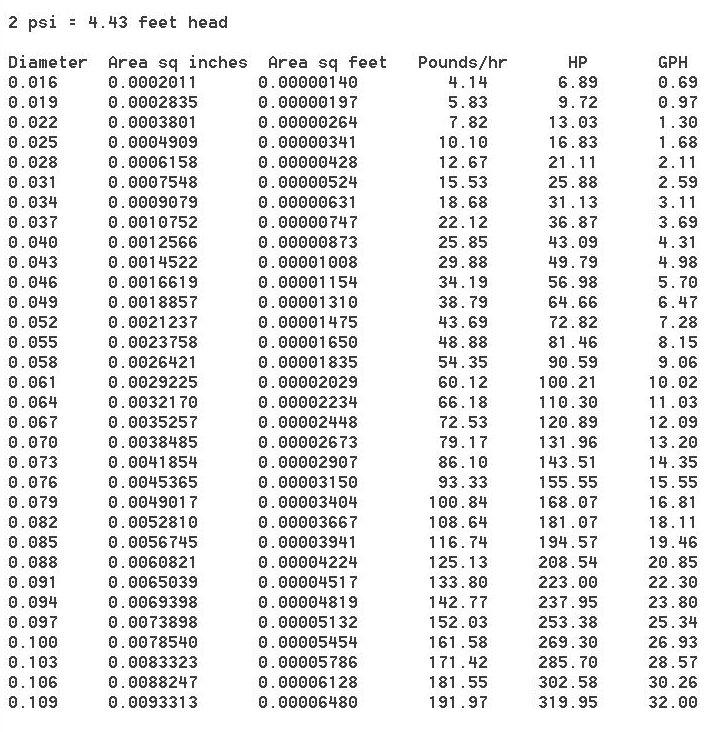
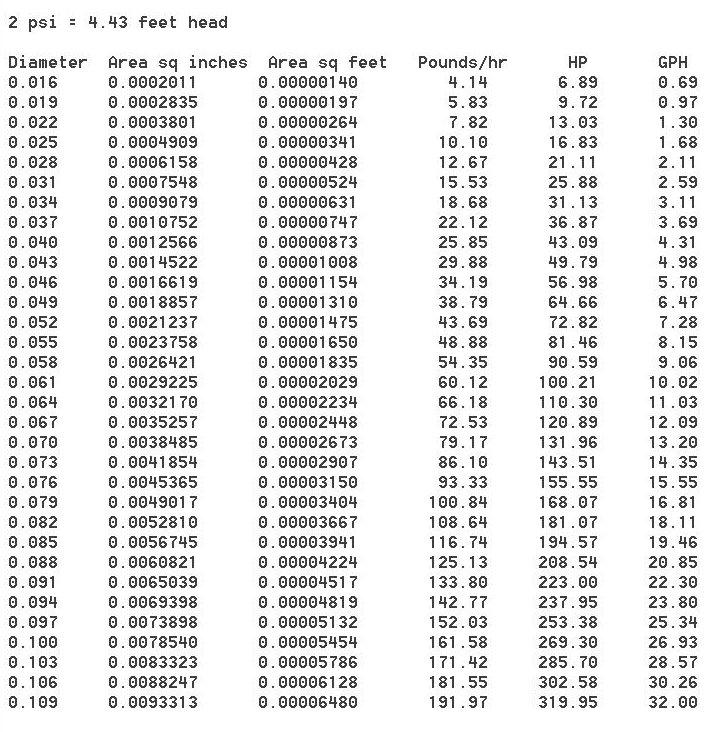
I was making some flow calculations based on 2 psi (4 foot head)
and I was amazed about the amount of fuel you can get through
a .016 orifice at 2 psi. Hard to find a 2 psi regulator these days
as everything is either a 800 HP carb for NASCAR or EFI.
Here is another company making low pressure mechanical fuel
injection.
http://www.kinsler.com/constantflow.htm
Here too are some of their tables.
Looks like I need to do a bit of experimenting with
some holes with a one foot head.... header tank.
I think a simple header tank with stand pipe and recirculating
fuel back to the fuel tank may be the way to go.
It is also becoming obvious the 1/4 pipe valve from
Home Depot is too large for the leaning valve. McMaster
Carr has some smaller 1/8th pipe valves that will probably work
better. Cost is about $11 :)
Here is some data from a 2 psi system.
Somebody PLEASE check my flow numbers.
-------------------------------------------------
OK the results of the program look more reasonable
when I add gallons per hour and HP.
HP is based on a .6 BSFC which is more like what you
will get running full power. You lean from there to
get down to .47 at cruise.
BTW McMaster Carr to the rescue. They have a little 1/8
pipe brass regulator with a tiny pressure gage on it
for $27 :) Put it on the floor after the low pressure
electric pump.
Paul Lamar ...No rotor no motor.
The Rotary Engine NewsLetter. Powered by Linux.
ACRE NL web site.
http://www.rotaryeng.net
Copyright 1998-2006 All world wide rights reserved.