Here is a photo of how the Solar T-62
turbine planetary is oiled. The ratio is 10:1 and it runs with
a pitch
line velocity around 12000 ft/min. The sun gear is not present, but
you can see the three brass tubes that squirt oil on the gears
just
before they mesh.
Aubrey
--------------------------------------------
Great picture Aubrey. Did you take it?
Good analysis. I am surprised T62 APU operates at that pitch
line velocity. I guess that is about right since it is rated at
60,000 RPM and the pinion gear is tiny. Around 3/4 inch
in diameter. Glorified turbo charger :)
In the case of the T62, the dwg of which I attached, the
shafts of the planet gears are fixed to the case so the
pitch line velocity is indeed 12,000 FPM.
The output shaft of the T62 rotates in the opposite
direction to that of the turbine/compressor shaft.
-----------------------------------------------
Aubrey, your mention of the T62 gave me an idea.
All we need do is marry a T62 without the burner
cans to a suitable large rotary engine such as
a three or four rotor and we have a cheap turbo compound
engine of around 500 HP or so with a BSFC of below .40.
Basically a T62 is a large turbo charger with gear box output.
The 10:1 gear ratio is perfect for a turbo compound
engine. I wish I had this idea before I spent
$7,000 on a small turbo compound gear box.
Do you know where I can download a dwg of the T62
with dimensions? I am working on a 3D.
I have a three rotor sitting in the hanger destined
to become a turbo compound three rotor :)
------------------------------------------
I think we lucked out. According to this picture
the T62 turbine/compressor rotates clockwise. The gear box
reverses that direction so looking at it from this
perspective the output shaft rotates counter clock
wise. Turning the T62 around 180 degrees and connecting
the T62 output directly to the nose of the three
rotor e-shaft will work perfectly. Perhaps with a
flexible rubber coupling. Looking at the Mazda rotary
from the front of the engine (car) it rotates clockwise.
Perfect!
For a tractor airplane there will be a S duct to route
the exhaust down and under the firewall.
This is a perfect low frontal area engine for a wing mounted
twin as the exhaust can go straight back. All we need do now is
fabricate the intake and exhaust plumbing to convert the T62
back to a BIG turbo charger.
-----------------------------------
It will be about the same diameter, length and not far off
the weight of a P&W PT6 with half the fuel burn. The
T62 APU weighs about 70 pounds with the burner cans and
the now unneeded starter and control box.
Retrofitted to a Beech King Air it will have about twice
the range.
--
Paul Lamar ...No rotor no motor.
Paul,
That's a great idea. You could get significant thrust from the
exhaust jet if it was pointed straight back, maybe 25 percent of
total thrust horsepower at altitude.
The T-62 is rated at about 70 shaft horsepower. It seems to be
about
the right size as a recovery turbine and compressor for a
3-rotor. I
would think that 70 hp is just about what you could recover
from the
turbine wheel of a 3-rotor.
Btw, there are two versions available with different reduction
gearing. One was used on the CH-47 and has a lower output speed of
6,000 rpm and turbine speed of 56,000 rpm.
The other one was used on the CH-54 and has an output speed of
8,000
rpm and turbine speed of 56,700 rpm. It's also quite a bit shorter,
as you can see from the specs.
The hard part is going to be the exhaust and intake plumbing.
Have a
look at the airflow diagram. Both the intake and exhaust follow a
convoluted course, because it is just a modified turbocharger, as
you pointed out.
You will have to modify that burner so the compressed air goes to
the engine and not the turbine. At the same time you have to route
the engine exhaust from the engine into the turbine wheel. It
doesn't look easy -- both exhaust and compressed air are in close
quarters there.
Regards,
Gordon.
One correction. Unfortunately the T62 turns the wrong
way. I have made this mistake before. It is going to need
a small spur gear box to reverse rotation. I agree on the
plumbing challenge. Fortunately I have a friend
here at SZP that has a T62 that I can play with.
More on this next week.
Paul Lamar ...No rotor no motor.
Here is a 3D for a three rotor version. I do not have
a good drawing with dimensions yet on the T62 so this is
approximate. The gearbox/accessory case could be redesigned
as much of it is not needed. Also the last half consisting
of the burner can will be removed.
Paul Lamar ...No rotor no motor.
Paul,
When you remove that burner can you will see that it's going to be a
real bear to plumb the exhaust and intake.
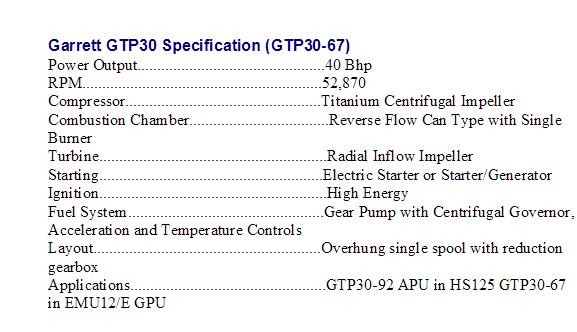
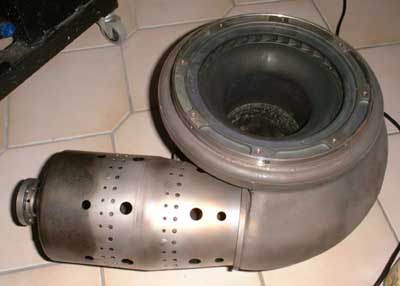
A better choice might be the Garrett GTP30, which is a little
smaller unit rated at 40 hp -- might be good for a two rotor.
But have a look at the turbine volute -- its a radial inlet; you can
just hook up your engine exhaust pipe to it. The compressed air does
come out into an annular ring, like on the T62, but at least the
exhaust is easy.
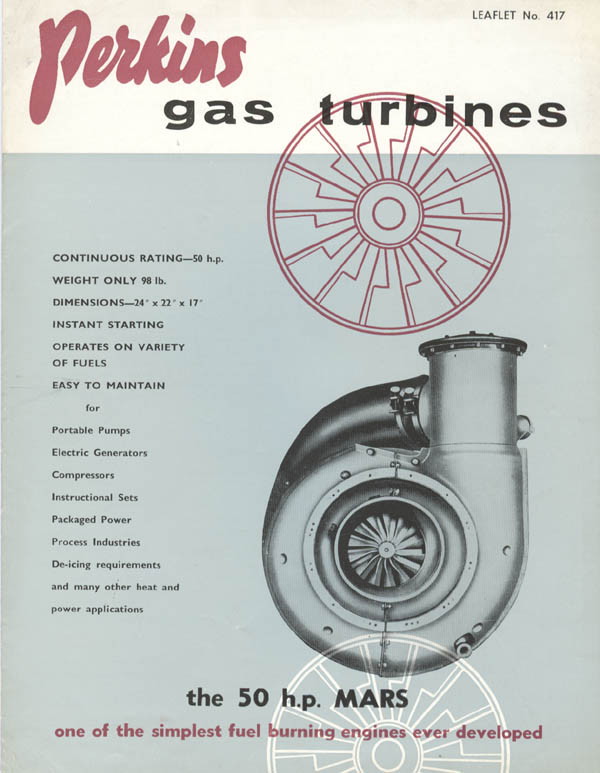
The easiest to plumb would be the T-41, which is just like a
turbocharger. You can see in the picture that there is simply a tube
from the compressor that goes to the tube going into the turbine --
and the burner is just a cylinder in that tube. Just remove the
burner and you have a turbocharger.
The problem with the T-41 is that its power takeoff is at a 90
degree angle, so the whole thing will be sitting sideways. Also, its
an old design and the turbine wheel aerodynamics are not that great.
Still it could be made to work if you used another gear to mount it
axially behind the engine. The plumbing would sure be simple.
Regards,
Gordon.
I think it might be easy to add a compressor volute
to the T62.
Paul Lamar
The Rotary Engine NewsLetter. Powered by Linux.
ACRE NL web site.
http://www.rotaryeng.net
Copyright 1998-2006 All world wide rights reserved.