Paul,
I wonder if you are focusing on the bearings in the planetary
shafts? Then
you would have a point. They would be doing elliptical loops around a
circle.
I'll go down to the office tomorrow and paint some white marks on the
different gears and take four or five pictures of what happens
during one
revolution of the sun gear. Like the rotary it was hard to get my head
around. This question is going to come up again and again so with Rolf's
explanations and picture proof it would make a good addition to your
website.
Meanwhile have a look at this NASA report on unducted fans. The last
part is
especially revealing about the issues that keep a 'good technology' from
coming to market. The author speaks about 'reverse salient issues'
Poignant info concerning the rotary and even the rotary turbo compound.
http://history.nasa.gov/SP-4219/Chapter14.html
DougFir
They underestimated the noise problem. Barely mentioned in this
paper. It was so bad that it affected the structure of the
airplane. GE felt they would have to add weight and cost to the
AC structure to counter the noise problem which off set the
20% fuel savings. BTW the fact that GE actually built
and flew the unducted fan full scale yet again proves private
innovation beats big gov bureaucracy every time.
Not really a good analogy with the turbo compound rotary.
There are no downsides to the turbo compound rotary compared
the smaller turbo prop engines. It has everything going for it with
the SAME noise. Less acquisition cost being a major advantage.
50% fuel savings being another. Only the weight issue is still
in question and the other shoe, namely the weight of an all
aluminum or some other alloy large rotary, has not dropped yet.
The real price of fuel over the years on average taking
into consideration inflation has remained pretty much the same.
What happened in 1973 as the price of fuel oil went up so did
everything else including wages. When I was a kid the cost of a loaf
of bread was about 20 cents, about the same as a gallon of fuel.
Now the cost of a loaf of bread is still about the same as
a gallon of fuel. If anything bread is now probably more
costly. Hybrid car sales are down if not dying.
I see no end to this cycle in our life time. Since Iraq is sitting
on the worlds second largest known reserves of crude oil
when they finally get finished killing each other off and this
huge source of crude is fully developed the real price will
drop yet again. IMHO a major factor, frequently not mentioned
in the sectarian war, is who gets to control the Iraq oil.
Waiting in the wings when crude oil pumped from the ground actually
(if ever) becomes a reduced source (hasn't happened yet) is the
Alberta, Utah, Wyoming tar sands.
Paul Lamar
Doug,
Thanks for pointing to that article -- this effort to create a
fuel-efficient turboprop engine bore great fruit. There is much
useful info to be gleaned on propulsive efficiency. Here is a link
to the NASA technical report that gives a good summary of the project:
*http://tinyurl.com/yku34e*
They managed to achieve prop efficiency of just under 80 percent at
0.8 mach. That is very very good -- probably close to what the
Russians were getting with their Bear long-range bombers and some of
their civil transport aircraft.
Interesting to note also that GE, which was not part of the
NASA-industry consortium developed their own prop-fan concept that
used a different approach. The NASA-industry team went with a geared
down large diameter, single-rotation prop in the tractor
configuration. GE went with two direct-drive (ungeared)
counter-rotating small-diameter fans in pusher configuration, as you
can see in the attached picture.
Interestingly, the small-diameter fans were as efficient as the big
ones. It turns out that prop swirl is a big factor in reducing
efficiency -- it accounts for about 8 points of efficiency at the
mach 0.8 design point. So even though, the propulsive efficiency of
a small streamtube can never match that of a large streamtube,
eliminating the swirl losses more than makes up for it.
The NASA technical paper mentioned above gives more detail on the GE
approach.
In flight tests in the late 1980s, the fuel efficiency improvement
was shown to be in the 20 to 30 percent range over turbofan airplane
engines. You would think that this would have been enough to get the
airlines to switch over, but this did not happen. As it is prop-fan
technology is nothing more than a historical footnote. (Although the
technology is still very viable for light planes in the execuitve
transport and commuter roles.)
The article you pointed to has a very good discussion on the
socio-political aspects of jet versus propeller. The fact is that
people's perceptions of props as old-technology was just too
powerful to overcome. We see this even in the light aircraft space.
Look at the excitement over the new small jets, even though they
cost a lot and burn a lot of fuel.
A great turboprop airplane is the Piaggio Avanti, which cruises at
400 knots, has a six-foot wide cabin and burns just a little over
half the fuel of a comparable size bizjet. Yet people are still
paying a whole lot more for bizjets that don't go any faster and
have smaller cabin size. Why?
It's all about perception. True turbofans are inherently quieter and
smoother, but the NASA project tacked both those problems with great
success. So it comes down to the fact that props just have a very
passe image that just cannot compete with the cachet of jet engine
airplanes.
Regards,
Gordon.
Yes but GE built the full size article and tested it
on an airliner. Something NASA did not do. So typical of NASA.
Paper studies are them. That is what they do. Like the Russian
Bear the GE was way too noisy. Hardly mentioned at all in that paper.
Some Russian airmen that flew on the Bear had permanent hearing
damage. US jet pilots that intercepted the Bear said it was
the only airplane they could ever hear other than the one
they were in.
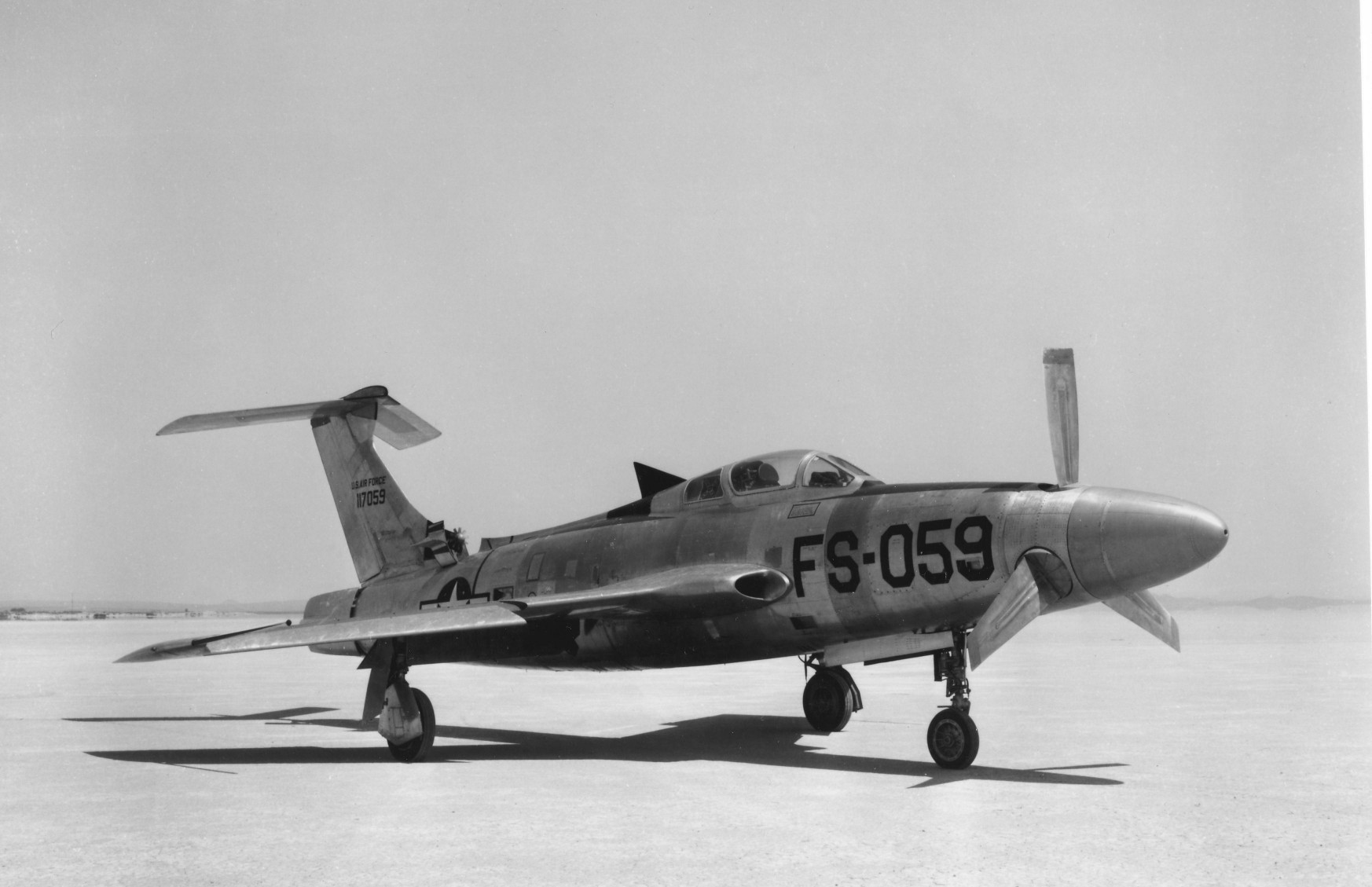
There was an earlier attempt at a high speed
prop. I think it was called the Republic Thunder Streak some
such based on the F84. Nick named the Thunder Screech :)
See below.
The fact of the matter is air becomes concrete when you impact
it a supersonic velocities :) Props are good for less than about
500 MPH and that is it. The forward speed vector adds to the tip speed
vector and approaches the speed of sound. It is like expecting super sonic
airplanes NOT to make sonic booms. Don't hold your breath.
This is when the duct (as in ducted fan) becomes mandatory to diffuse
the forward speed into internal duct pressure by slowing down the air.
BTW the beginnings of a ram jet. Adding a duct added drag but there was
no other choice if you wanted reasonable noise. There went your 20%
efficiency.
Paul Lamar
-----------------------------------------------------------------------
http://www.abc.net.au/science/k2/moments/s934718.htm
"Maybe, they thought, if you put a propeller on the front of jet
fighter, you could get both acceleration and top speed. So the
engineers heavily modified a Republic F-84 Thunderjet.
They removed its single powerful J35 jet engine and replaced
it with a pair of Allison T38 jet [prop] engines - which they called
the T40. In the mid-1950s, the T40 was the most powerful jet
[prop] engine on the whole planet, generating up to 7,400 Shaft Horse
Power. Of course, they had to widen the body to stuff it in.
Each jet engine sent its power to the front of the XF-84H by
two 6 meter long drive shafts. Now putting that much power
through a drive shaft would make the stiff steel as floppy
as well-boiled pasta - so the drive shafts had to be
tightly-supported along their entire length by many bearings.
Of course, the failure of a single bearing would crash the plane,
so each bearing had to be monitored for temperature and vibration.
And of course, each bearing needed its own oil supply.
At the very front, the twin drive shafts went into a single gearbox,
which drove a single propeller. The Republic Company asked three
propeller manufacturers to submit a propeller, but only one did.
It was a stubby variable-pitch propeller, with each blade being
only about four times longer than it was wide.
Only two of these modified F-84s were built, and the plane
was called the XF-84H.
The plane was a dog."
"There was another problem with the XF-84H. Even at idle, the outer
tips of the small propeller were traveling faster than the speed of sound,
so they made a horrendous racket. It was the loudest plane ever built.
There was no chance of secret testing.
The Thunderjet was so loud that it could be easily heard about 35
kilometers away. On one occasion, they powered up the engines of the
XF-84H on a runway, while what they thought was an empty C-47 transport
plane was parked on a nearby runway. This C-47 was side-on to the propeller
of the XF-84H, where the noise was loudest. When they shut down the engine,
they heard banging noises from the C-47. An engineer had been doing maintenance
inside, and the incredibly loud banshee-like noise had thrown him into
an epileptic fit. The banging noise was the flailing of his limbs. And yes,
he did recover after a few days."
The Rotary Engine NewsLetter. Powered by Linux.
ACRE NL web site.
http://www.rotaryeng.net
Copyright 1998-2006 All world wide rights reserved.