> > >>>> Applying today's technologies might be
> > interesting
> > >>>
> > >>> to
> > >>>
> > >>>> see what happens...
> > >>>>
> > >>>> 1. Scitimar props are available now.
> > >>>> 2. Carbon fiber has certainly reduced the
> > weight
> > >>>> 3. Six, seven and even nine blade props can
> be
> > >>>
> > >>> found
> > >>>
> > >>>> Note: Seven blade is the quietest of all
> > >>>
> > >>> combinations
> > >>>
> > >>>>
> > >>>> David Mathes
> > >>>
> > >>>
> > >>> Sounds interesting, any ideas of any to see ?
> > >>>
> > >>> jofarr, soddy tn
> > >>
> > >>
> > >>
> > >>
> > >> For COTS,
http://www.warpdriveprops.com/
> > >>
> >
>
www.aircraftspruce.com/catalog/appages/warpdrive.php
<http://www.aircraftspruce.com/catalog/appages/warpdrive.php>
> > >>
> > >> Prop adjustment
> > >>
http://www.ivoprop.com/inflightmagnumodel.htm
> > >>
> > >> For custom, Dowty Propellers is the leader.
> > >>
> > >>
> >
>
www.smiths-aerospace.com/Systems---/Propellers/index.asp
<http://www.smiths-aerospace.com/Systems---/Propellers/index.asp>
> > >>
> > >> Picture of SAAB 2000 attached
> > >> The six-bladed propellers are constant speed
> with
> > >> auto-feathering and reverse pitch.
> > >>
> > >> David Mathes
> > >>
> > >
> > >
> > > David,
> > >
> > >
> > > I've seen these multi scimitar type props mostly
> > on turbines. Would
> > > there
> > > be any advantage to using them with prop output
> > speeds of 2000 rpm
> > > driven by
> > > a rotary wankel engine?
> > >
> > >
> > > Doug
> >
> > Ive been watching the development of the carter
> > copter for a few years-
> > fascinating stuff. They have also been working on
> a
> > scimitar prop
> > prototype that looks very promising at
> >
http://www.cartercopters.com/propeller_system.html
> >
> > Mike Parker
>
>
> Mike
>
> Carter appears to be on an amazing journey where a
> propeller driven plane COULD fly at 500 mph, based
> on
> the use of scimitar technology.
>
> >From the site...
>
> "At a μ of 1 the forward speed of the aircraft
> and the tip speed of the retreating blade are equal,
> therefore, the air velocity at the tip of the
> retreating blade is zero and there is reversed
> airflow
> over the entire length of the blade."
>
> "Carter technology should allow flight speeds up to
> a
> ratio of μ=5 (where the aircraft is traveling
> at
> speeds up to 500 mph and the tip speed of the
> advancing rotor blade remains under mach 0.9)."
>
> David
>
>
> I'll believe it when I see it. They have been
> fooling
> around and crashing for years. The Carter style
> props
> were tried by the Horten brother pre WW II. Klaus
> also
> tried one a few years ago. Apparently the air is
> confused
> around the root or has low energy so having a wide
> cord
> with a lot of camber in that area does not pay off.
> Unless of course your cooling scoops are right
> behind
> that area of the prop. In that case cuffs also work.
>
> If you are stuck with high RPM and two blades a wide
> cord is necessary to absorb the engine HP.
>
> If there was real merit, as far as prop eff. was
> concerned,
> there would be more of them around by now.
>
> Paul Lamar ...No rotor no motor.
Paul
I agree. The proof is when it flies...
Earlier attempts were with heavier blades, blades that
suffered torqueing when the angle was adjusted, and
parasistic drag that just kills an attempt at any prop
driven plane approaching even 400 mph.
However, these are composite blades made of carbon
fiber which are lightweight. The blades are stiff and
don't torque unlike earlier attempts. The scitimar
blades allow for subsonic blade tips at much higher
linear speed although this requires. The current wide
blades are experimental to get their processes down.
They may shift to thinner and more blades as time goes
on.
My reference point is what Dowty (under Smith Bros)
has been doing for commercial and military craft. I
flew in a Dashair in Colorado that had no problem
sustaining a long climb out at elevation (5000 to
20000 f msl) with those six blade carbon fiber props.
Eight blade props are being used on C-130s and some
commercial craft.
David Mathes
The dash8's (400q) have 4600hp per side.. No problem climbing.
http://www1.airliners.net/info/stats.main?id=122
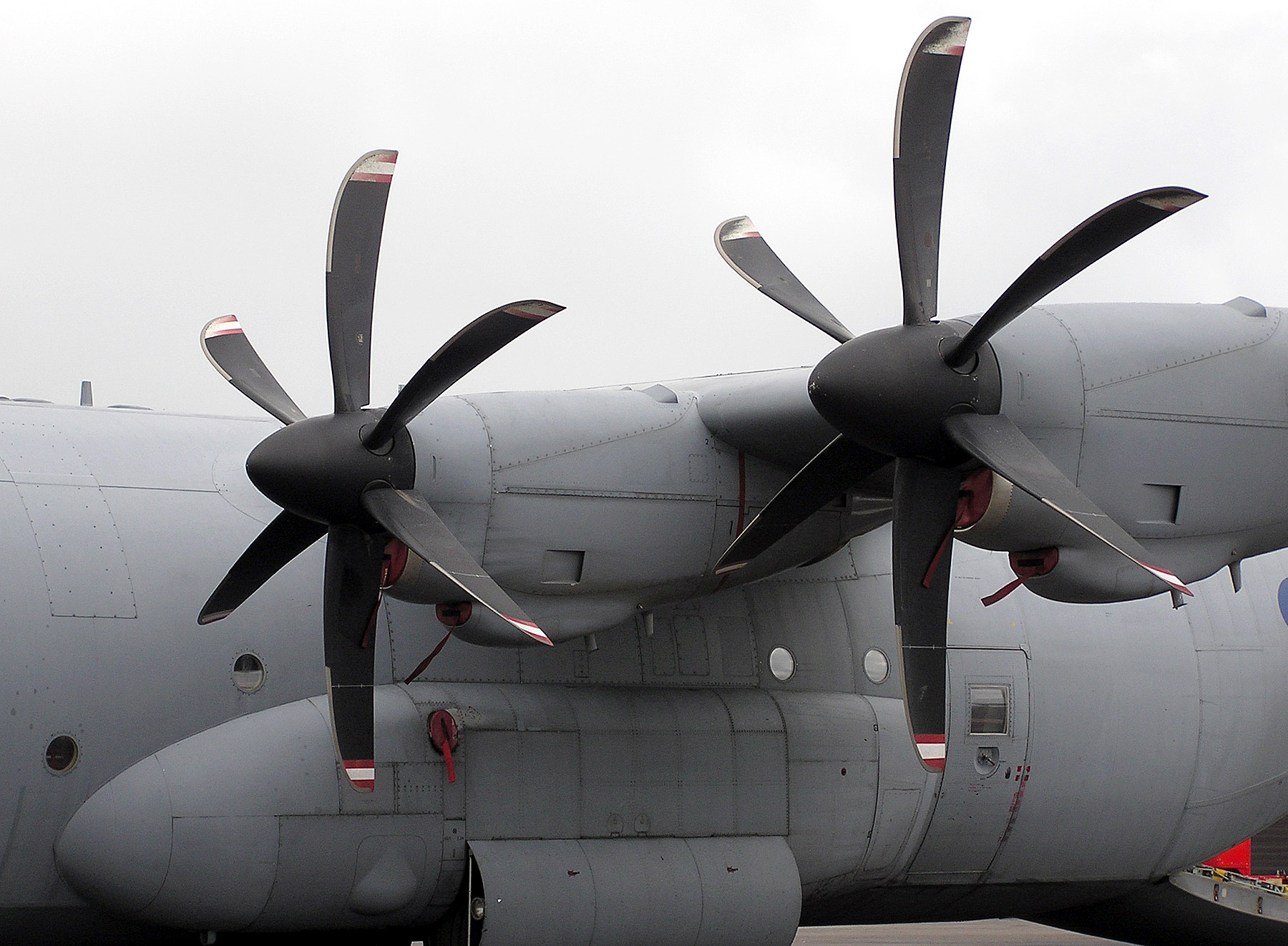
I think the C130J variant has the most blades - 6.
http://upload.wikimedia.org/wikipedia/commons/c/c3/Hercules.propeller.arp.jpg
Matt-
So, what is driving the interest in these high-buck carbon-fiber wonders
for our purposes? Is it a quest for incrementally enhanced performance
compared to a conventional prop? Or is it a desire to find a way to
eliminate the PSRU by going to a smaller-diameter, more highly-loaded disk?
If eliminating the PSRU is the goal, then I can see where it might be
worth the trouble. Still, there's no getting around the limit of an approx
24" max diameter if we want to be able to use engine speeds up to 8000 RPM
and stay below the sonic limit (remember--speed of sound decreases at lower
temps. It is 1100 fps only at STP) Remove the ineffective area near the
hub and you've got even smaller area to produce thrust. Then, to get the
most out of this, I think you'd need an acft design that minimizes fuselage
wetted area/drag in the area subject to this high-intensity prop blast.
("Super"Mini-IMP?)
Maybe I'll just plan to stick with the PSRU.
Mark
I think what is driving this for turbo props is they
can't get a two blade wide enough to absorb the
extremely high power. Two blades have always been more
efficient than three or four blades except perhaps in climb.
Paul Lamar
The Rotary Engine NewsLetter. Powered by Linux.
ACRE NL web site.
http://www.rotaryeng.net
Copyright 1998-2006 All world wide rights reserved.