Paul,
In our recent discussion of exhaust pressure, the subject of
turbocharger sizing came up and it was noted that aircraft engines
require much bigger turbines and compressors for the power they
produce -- compared to cars -- because they operate at altitudes
where the air is thin.
I thought I?d look into this a little and try to figure out just how
big a turbocharger might be appropriate for a rotary aircraft
engine. The turbocharger manufacturers provide compressor maps that
we can use to pick a turbo. Unfortunately those compressor maps give
their flow value -- the horizontal axis -- in mass flow, not
/volume/ flow.
The compressor does not know or care about the mass of the air it is
pumping -- it flows the same volume of air, regardless of the air?s
density. We know that as we go higher the air is less dense, so in
order to flow a given mass of air, we need a compressor that is able
too move more volume.
How much more volume, that is the question? We can figure this out
quite easily using the ideal gas law. We can then solve for our
corrected mass flow and use the compressor maps to choose a
compressor intelligently.
Let?s say we have a two-rotor engine that is peripheral-ported and
makes a conservative 230 horsepower at sea level ? the same as a
Turbo Skylane. Let?s say we want to maintain that power level to 20,
000 feet -- the service ceiling for the Turbo Skylane. This is a
reasonable altitude limit for an unpressurized plane and private
pilot. While planes like the Columbia 400 and the turbocharged
Mooneys boast a ceiling of 25,000 feet, I really doubt that a lot of
owner-pilots fly at these heights on a regular basis.
For the most part, we will be using our turbocharged airplane to fly
in the mid to low teens, where no oxygen or perhaps a cannula is all
that is required. At 18,000 feet we need a full mask according to
regulations.
The main thing we need to figure out is how big a compressor we will
need. The turbine is really a subject unto itself, especially for
the rotary engine, which has a very high-energy exhaust. So I will
leave out the turbine discussion for now -- but once we know a
suitable compressor size, at least we will be in the ballpark for
turbine size too.
The first thing we need to know is how much air our engine is
moving. The 13B displaces 605 cubic centimetres per rotor for at
total of 1310 cc, or 80 cubic inches. It?s
/effective/ displacement
is twice that because each rotor has a combustion event for every
revolution of the engine shaft, unlike a piston engine where each
cylinder has a combustion event only every other revolution.
To figure out flow in cubic feet per minute we multiply displacement
by rpm and divide by 1728, because that?s how many cubic inches are
in a cubic foot. So:
Flow = 80 ci * 7500 rpm / 1728 = 347 cfm
This is assuming a volumetric efficiency of 100 percent, which is
probably what a P-port will deliver.
Since we have a turbocharger on this engine, let?s say we will run a
little bit of boost even at sea level, to overcome the engine?s
pumping losses and make the engine a little more efficient. So let?s
say we set our takeoff power at 35 inches of mercury on our manifold
pressure gauge. This is 17.2 pounds per square inch, about 2.5 psi
above sea level pressure of 14.7 psi.
The atmospheric pressure on a standard day at 20,000 feet is only
6.76 psi, so in order to carry a manifold pressure of 35 inches
mercury (17.2 psi) at that altitude we need to add 10.4 psi of
boost. (17.2 - 6.76 = 10.4)
This level of boost will heat up our intake charge somewhat, so in
order to figure out our mass flow, we need to first figure out the
charge temperature. We do this using the equation:
Tout = Tin + {Tin * [-1 + (Pout / Pin)^0.263] / Efficiency}
Where: Tin is air temperature entering the compressor
(448 R)
Tout is air temperature exiting the
compressor (?)
Pin is the ambient pressure (6.76 psi)
Pout is the pressure exiting the compressor
(17.2 psi)
Efficiency is the thermal efficiency of the
compressor. (0.74)
Pin/Pout is the compression ratio (2.54)
Rankine = Temperature in F + 460
Today?s compressors have pretty good thermal efficiency as we can
see from compressor maps, so let?s say our efficiency is 70 percent.
So we get: Tout = 448 + {448 * [-1 + (17.2 / 6.76)^0.263] /
0.70}
Tout = 626 R = 166 F
Our charge temperature is a relatively cool 166 F at 100 percent
power at 20,000 feet. This is a maximum and we will not likely be
using 100 percent engine power very much at this altitude, so our
cruise charge temperatures will be quite a bit lower. We can see
that there is no need for an intercooler, which will only add
complexity, cost and probably cost a pressure drop of a couple of
psi between the compressor outlet and the intake manifold. We can
also count on a little bit of evaporative cooling from our fuel
being evaporated at the intake port as well -- a temperature drop in
the fuel-air charge up to 40 F for gasoline. (I will cover this in
another post).
Now that we know the amount of boost we are running at altitude and
the charge temperature, we have everything we need in order to
calculate the mass flow, in pounds of air, that our engine needs in
order to make the required boost.
We use the ideal gas law: PV = nRT
Where: P is the absolute pressure
V is the volume or
air flow
n is the mass in
lbs. / mole
R is the gas
constant (10.73)
T is the absolute
temperature in R
To get pounds of air, we rearrange the equation: n = PV / RT
A mole of air is 29 lbs, so in order to get mass flow in pounds per
minute:
n (lbs/min) = P (psi) * V (cu-ft/min) * 29 / 10.73 * T (deg R)
n = 17.2 * 347 * 29 / 10.73 * 626 = 25.75 lbs/min
This is the actual mass flow our 2-rotor engine needs at 35 inches
of manifold pressure (17.2 psi) at 20,000 feet: 25.75 pounds per minute.
If we simply take that 25.75 lbs/min and look at compressor maps we
will end up choosing one that is too small because those maps are
using mass flow at sea level and at a particular temperature. In
order to flow 25 pounds of air at 20,000 feet is going to take much
more air volume going through the compressor -- so a large
compressor is needed.
What we need to do is correct our mass flow to the altitude we are
interested in. We do that using the formula:
Corrected Flow = Actual Flow * (Tin / Tmap)^0.5 / Pin / Psl
Where: Tmap is the temperature used in the compressor map in R
Let?s assume the turbo manufacturer has used 85 F as the reference
temperature for the map, so we add 85 to 460 to get 545 R. (Turbo
makers usually use a hotter day temperature in these maps so as to
be on the safe side in terms of flow -- the hotter day will result
in lower air density).
So we get:
Corrected Flow = 25.75 * (448 / 545 )^0.5 / (6.76 / 14.7) = 50.76
Our mass flow corrected for altitude and temperature is nearly
double our actual mass flow -- 50.76 pounds per minute. To be
precise, 50.76 pounds would be the sea level mass of the
/volume/ of
air we are moving through the compressor at 20,000 ft. It sounds
confusing, because turbochargers pump volume not mass, so we must go
through these calculations to use those compressor maps.
So the bottom line is that we need a pretty big compressor to move
50 pounds of air per minute, double the size that we would choose
for the same engine if we were using it in a car.
If we look at a couple of compressor maps, we see that the Garrett
T04E with 40 trim is nowhere near big enough -- the most it can
handle is only about 35 lbs/min. The biggest in this series, T04E
with 60 trim is barely marginal. At 50 lbs/min and 2.5 pressure
ratio, we would be to the right of the choke line. Still, since
we?re not going to run the engine at 100 percent at our service
ceiling, this compressor might do the job.
A better choice would be the T04B series. The T04B 60-1 trim looks
pretty good, as does the T04B H-3 trim. Another good choice would be
the T61.
I don?t know what the stock Mazda turbo map looks like, but I would
guess it is designed for a mass flow of about 20 lbs/min which is
way too small. It should never even be attempted in aircraft use.
I?ve also included a map for the Rotrex centrifugal supercharger
model C30-94, which Doug Fir is using. The flow is given in metric
units, kilograms per second -- our 50.76 lbs/min equals 0.383
kg/sec. We can see that this is a good size for the two-rotor engine
and will give 75 percent efficiency at our compression ratio of 2.5.
Good choice Doug.
Now all we have to do is choose the right turbine?
Regards,
Gordon.
Ah so that is the hard part. Boost at altitude has not
been a problem with the 2nd gen stock turbo. The problem with the
stock turbo is over speed. As soon as you remove the car exhaust
system back pressure you pick up several psi of boost at SL to about 8.
So the manifold pressure is now about 46 inch of HG at SL. The stock
turbine
has more than enough HP to do this. The stock compressor is also
big enough to do this. Hugh Macinnis has a simple formula
in his book Turbo Chargers in the chapter on altitude performance.
A turbo charger will gain RPM at the rate of 2% per 1000 feet.
So far the guys have been unable to increase the waste gate
flow enough to prevent the turbo charger from over speeding
at full throttle at altitude. Obviously if no exhaust gas was
getting to the turbine this would not be happening.
The flapper valve is restricted from opening more than
about 20 degrees due to the interference with the back cover.
Dave Leonard has removed the flapper valve entirely and
the stock turbo is still generating too much boost and over
speeding. There is a lot of kinetic energy in the rotary
exhaust. Others have opened up the hole with a slot
between the two stock waste gate holes.
Nobody to my knowledge has removed
the flapper valve AND greatly increased the area of
the by pass passage at the same time. Also nobody to
my knowledge has installed a turbo tachometer to know
precisely what RPM the turbo is actually achieving.
If you don't know that you are just fooling around
in the dark.
Evidence from the failed turbines suggest over speeding.
Basically what is happening is the A/R of the turbine
scroll is too small. It is somewhat less than one. What
that means is the nozzle area squirting exhaust gas at the
turbine is too small and it is speeding up the exhaust gas
velocity too much. The turbine is spinning too fast with
more than enough torque and HP to spin the compressor.
Changing out the turbo for a larger turbo has its drawbacks.
The TO4 does not have a built in waste gate. That means you
have to buy one and find an exhaust manifold that will accommodate
it. Then too the stock turbo is water cooled and the plumbing is
there. Nice to have a water cooled turbo. This is an extra cost
option on the TO4. The other thing is the oil supply and drain
back plumbing would have to be redone if a TO4 was installed.
Another nice feature of the stock turbo charger is a very
compact installation.
What appears to work is a larger compressor that gives
the same boost at a lower turbine RPM and with less throttle
opening.
The problem boils down to improving the stock waste gate.
IMHO what needs to be done is further improvement to the stock
waste gate aerodynamics which IMHO will solve the problem. It is
the cheapest solution to the problem and you can still have your
boost when you need it.
I'll upload a bunch of pictures with the next message.
--
Here they are.
Paul Lamar ...No rotor no motor.
Paul,
What you are describing with the stock turbo is not a good scenario.
Of course those small turbines are going to overspeed -- even just
taking the muffler off causes a problem.
What happens as you climb higher is that the pressure delta gets
bigger between the intake manifold and the turbine outlet, which is
ambient pressure and it goes down with altitude. This is what makes
the turbine spin faster and faster.
You still have the same or even bigger manifold pressure as the
turbine spins up, but the turbine outlet pressure gets smaller and
smaller as you climb. Hence you have a big pressure drop across the
turbine. Your pressure head into the turbine is therefore increasing
as you climb up. The turbine nozzle turns pressure head into
velocity head and your turbine wheel spins way too fast.
This is a recipe for disaster. Making more exhaust go out the
waste gate is a band aid solution.
What is needed is a big turbine wheel and a big nozzle area (big A/R
ratio). That way your turbine is not going to spin very fast at sea
level. Since the big turbine is not spinning very fast, you're not
making much boost either. With the high ambient pressure the
pressure at the turbine outlet the drop across the turbine is low
and the turbine does not spin fast. You shouldn't even have to open
the waste gate at sea level.
As you climb the pressure delta between manifold and turbine outlet
increases, the pressure head builds and your turbine starts spooling
up just when you want it to make the extra boost you need at
altitude. The rotary exhaust is very energetic so as you go higher,
you may notice your manifold pressure going up higher as the turbine
spins up and makes boost. You can use a manual cable control to
limit your manifold pressure at altitude.
From the pilot's perspective this means you only need to worry
about fiddling with the waste gate once you reach your cruise
altitude and are backing off from climb power. Not while you are
climbing, or worse, descending or other times in the flight when you
have other stuff to think about.
Now look what happens when you have the stock car turbo. That turbo
is designed to make power at high rpm at sea level. You mentioned 46
inches of mercury, which is 8 psi right at takeoff power.
As soon as you begin to climb out that turbo is in danger of
over speeding. The fact that you can't get the waste gate to divert
enough flow is proof that this turbo is too small.
So you have to be managing the waste gate right from takeoff. And as
you climb and your pressure head builds, you have to divert even
more through the waste gate. You basically need a full time flight
engineer just to manage the waste gate, manifold pressure and turbine
speed.
Yes, the bigger turbos don't have an integral waste gate, so that
involves a little more fabrication work and expense. I understand
that saving a few bucks by going with a stock turbo may sound
appealing. But this is false economy. Ending up with a plane that is
difficult to impossible to fly is not a very good bargain at any price.
Regards,
Gordon.
Hang on Gordon. I have a simple solution to the
waste gate problem.
---------------------------------------------
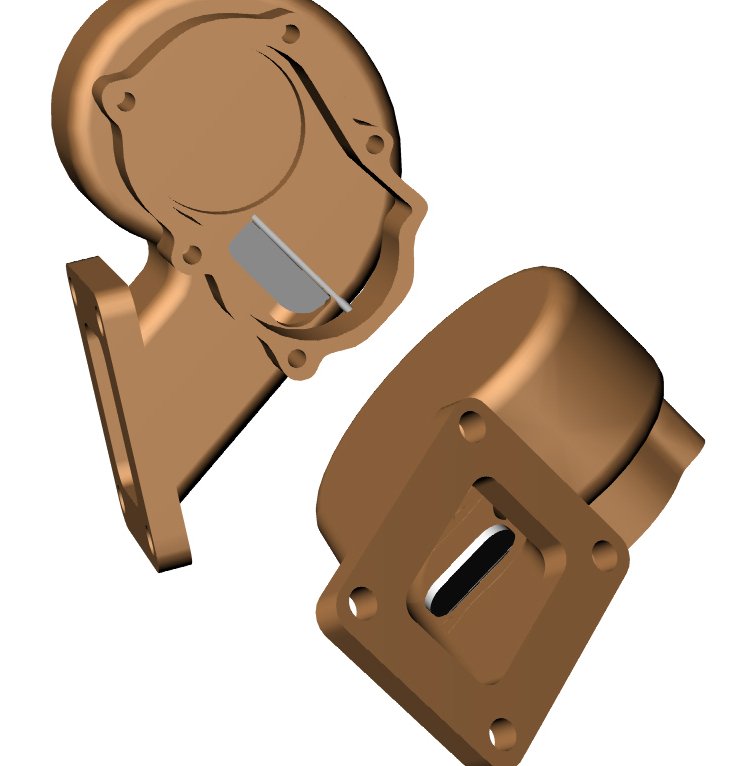
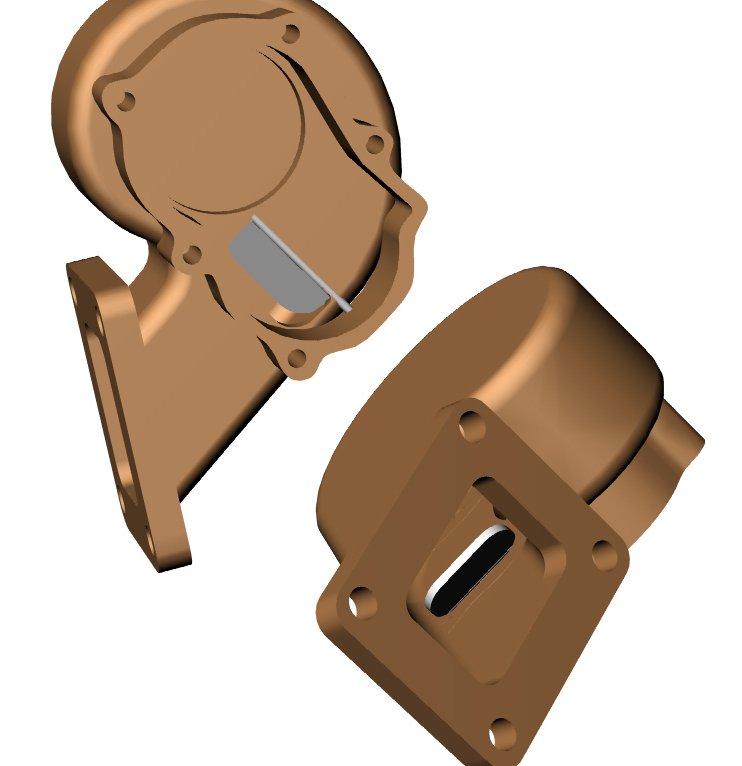
Here it is. Have the flapper move into the exhaust passage
diverting the gases directly to the down pipe bypassing
the turbine. A larger hole is cut in the separating
wall to accommodate the larger flapper.
No modifications to the back cover required.
The dimensions here are rough as I don't have a real
accurate model of the turbine housing.
As a start one could use something like a 1/2 thick
steel plate. Inconel would be better.
Paul Lamar ...No rotor no motor.
The Rotary Engine NewsLetter. Powered by Linux.
ACRE NL web site.
http://www.rotaryeng.net
Copyright 1998-2006 All world wide rights reserved.