Placing the throttle close to the rotor housings on the p-port
engine reduces this effect as less exhaust gas is stored.
This is nothing new. The p-port NSU Wankel Spyder had this
feature in 1965 or there abouts.
The draw back to any butterfly in the intake runner
is; it cuts down on the amount of air getting in the
engine and therefore the amount of power generated.
It also causes a slight increase in pumping losses
which increases the fuel burn slightly for a given
power level.
That is why slide throttles are used on high power
rotary engine as well as a lot of piston engines.
Mazda wanted to get the best BSFC possible for
the Lemans engine because the rules specified
a maximum of fuel that could be burned during
the race. That is one reason the Lemans engine
had p-ports. The BSFC was better than anything
we have seen so far with side ports.
To answer your question... yes a butterfly will work
located in the plenum but the p-port engine will
idle like crap :)
Paul,
I thought the idea shown in the diagram of the NSU solution was
appealing.
They had the primary peripheral port higher on the housing sidewall
than the
secondary so the rotor at idle would have relatively more time to
expel that
potentially charge-contaminating exhaust. Then, when the intake
velocity is
stronger at higher RPM, the secondary opens up to provide more fuel.
Any idea how it well it worked? Did you ever hear an NSU at idle?
It's the same kind of idea as the guys who have proposed making a
side port
intake for low speed and a peripheral port for high speed. I'm sure
Mazda
must have tried that. Did they ever talk about it with you?
Barry Gardner
Wheaton, IL
As I recall you could not tell it was running :)
I drove an NSU RO 80 in Germany seven years ago with a similar
system and I was astounded how well it pulled away from a dead
stop. Not quickly but very smoothly. The RO80 TX did have a
a very inefficient torque converter. The owner of the car was
totally unaware that there were any problems with p-ports what
so ever. The RO 80 engine is larger displacement than
the Mazda but the rotor width was only 67 mm instead
of 80 mm however the rotors where much larger in diameter.
It was equivalent to about 4 liters in a piston engine I think.
Torque was a modest 117 foot pounds at 4,500 RPM and max HP
was 136 at 5,500 indicating it was severely breathing limited.
The intake runners were very long. My guess is close to 30 inches.
The RO 80 is not a small car and we had about 500 pounds
of passenger weight in the car. Both Juergen and I are
big people. The empty weight was 3000 pounds same as the RX8
without all the crash structural weight the smaller RX8 has.
Not much for such a large car.
Paul Lamar ...No rotor no motor.
Der RO80 war das erste Serienauto von NSU mit einem
Zweischeiben-Wankelmotor. Das Kammervolumen des Motors beträgt 2 x
498ccm. Die Motorleistung betrug 84,6 kW (115Ps).bei 5500 Upm und einem
max. Drehmoment von 162 Nm bei 4500Upm. Dieser Ro80 ist einer der
letzten 1977 ausgelieferten Exemplare.
The above text is out of the Wankel web site:
http://www.der-wankelmotor.de/Fahrzeuge/NSU-AUDI/NSU-RO80/nsu-ro80.html
It says: The RO80 was the first mass production car made by NSU with a
Two-Rotor Wankel engine. The chamber volume of the engine is 2 x 498 cc.
Engine power was 84.6 kW (115 PS) at 5500 rpm with a maximum torque of
162 Nm at 4500 rpm. The car shown is one of the last ones delivered in
1977.
Note that the PS number is in German PS of 735 Watts. Motor dimensions:
E = 14 mm, R = 102 mm, b = 67 mm, V chamber = 497.15. The equivalent
displacement was just under 2 Liter, not 4 Liter. Engine breathing was
good. It ought to be with PP's. 168 Nm is 124 ft lbs. As far as I
remember idling was good.
Rolf
Yes and the engine displacement of the 13B is 1.3 liters.
Both engines are equivalent to 2.6 L and 4.0 L piston
engines respectively. In other words a 13B pumps the same amount
air as a 2.6 L piston engine both at 100% VE.
Read the attachments from Ansdale's book
The Wankel RC Engine.
We got 200 ft pounds of torque with a 13B P-port engine.
The breathing problem (torque problem) with the RO80 is the rotor
is only 67 mm (b) wide while the 13B rotor is 80 mm wide.
That means the 13B p-port runner can be larger in diameter
and the area of the p-port runner is proportional to the
square of its radius.
For an example; lets keep the p-port hole dia. only 80% of
the rotor width so the apex seal is not swallowed.
.8 time 67mm is 53.6 mm... r squared is 718
.8 times 80mm is 64 mm... r squared is 1025
So the p-port area of the 13B is 142% greater than the
p-port area of the RO80 while the 13B has only 65% as much
displacement. Smaller engine.. MUCH more port area.
Excellent breathing.
The 16B with a 100 mm rotor width is going to be better yet.
Displacement will be 3.2 L equivalent and port area will be
1600 or 156% greater than the 13B and the displacement will
only be 123% greater. The power per cubic inch and the power
to weight ratio of the p-port 16B will be awesome!
Paul Lamar ...No rotor no motor.
Hello Paul,
With all due respect, I believe the equivalent displacement of
the RO80 was 2 Liters, not 4.
Unlike the Japanese people, the Germans did not use only half of the
displacement as Mazda did for advertising reasons or whatever.
Here are the dimensions again:
RO80 E = 14 mm, R = 102 mm, b = 67 mm, Chamber displacement = 27^.5 * 14
* 102 * 67 = 497.15, rounded up to 498 cc, R/E= 7.29.
RX7-8 E = 15 mm, R = 105 mm, b = 80 mm, Chamber displacement = 27^.5 *
15 * 105 * 80 = 654.72, rounded down to 654 cc. R/E= 7.0.
Mazda called theirs 2 * 650 cc = 1.3 liter, which displaces 2.6 liter at
two shaft rotations.
NSU used the displacement at two shaft rotations right away, namely 4*
498 cc or a 2 Liter engine.
Besides, I was there and worked on it, often I had to carry the housings
around the forearm slung through the housing. Myself together with a
friend, we tried at the time to fit a steel band into the trochaics
housing. We could not get sufficient bonding and the bands came loose.
And then there were competition too and not enough time, of course.
The last generation was the EA 871 its dimensions were as follows:
EA 871: E = 17.3 mm, R = 120.5 mm, b = 69 mm, Chamber displacement = =
27^.5 * 17.3 * 120.5 * 69 = 746.6, or ~ just under 750 cc.
The two rotor engine was 4 * 750 cc or a 3 liter engine. R/E = 6.97.
The width was just 2 mm more than that of the RO80. The reason was to
minimize the surface area of the combustion chamber as much as possible.
Looking at the equivalent stroke to piston area we see that the Wankel
engine is an extreme short stroke engine.
When converting the rectangular piston area into a circular shape and
using that diameter, one can compare it with a reciprocating engine.
RPE's range from 0.4 S/D for Formula 1 race engines to S/D of 2.5 for
large ships Diesel that have 50% fuel efficiency. F1 manges about 4
miles per gallon. Car engines are mostly around 0.9 but range from 0.8
to just over 1.0 to perhaps 1.1.
The German RO80 has a stroke of 3*14 = 42 mm and an equivalent piston
diameter of 122.8 mm, an S/D ratio of .342.
The Mazda RX8: stroke = 45 mm, equivalent piston diameter of 136.1 mm,
an S/D ratio of .33.
The NSU EA871: stroke = 51.9, equivalent piston diameter of 135.4 mm, an
S/D ratio of ..383.
The lower the R/E ratio and the narrower the piston, the higher the S/D
ratio becomes.
It was for this reason that the piston width was kept narrow. And it
showed, fuel consumption figures were the lowest for the EA 871.
When Mazda goes to 100 mm wide pistons, the S/D will drop to .296 or
~.30. In view of economy Mazda is going the wrong direction.
With regards to sufficient diameter of the P-port, I can assure you it
was adequate for breathing and for the 110 HP the RO80 produced at 5500
rpm.
The mep at 110 HP was .93 for a throughput of 124 l/s.
Using a modest velocity of 60 m/s, the area required is 20.7 cm2, or a
diameter of 5.1 cm.
Maximum torque of the RO80 is 162 Nm which relates to a mep of 1.024 or
148 psi.
The RX8 has some 160 ft lbs of torque which is equal to 150 psi. Very
close the same. With a wider piston of 100 mm this number will drop.
Just an additional note, if the displacement of the RO80 would be 4
liters, its mep would be only half or 74 psi. For sure, it was not that
bad an engine.
Rolf
OK Sorry. I did not know that about the German rating system.
You are right about the displacement. In Japanese terms the RO80
is a one liter. Smaller than a 12 A with a 74 mm wide rotor.
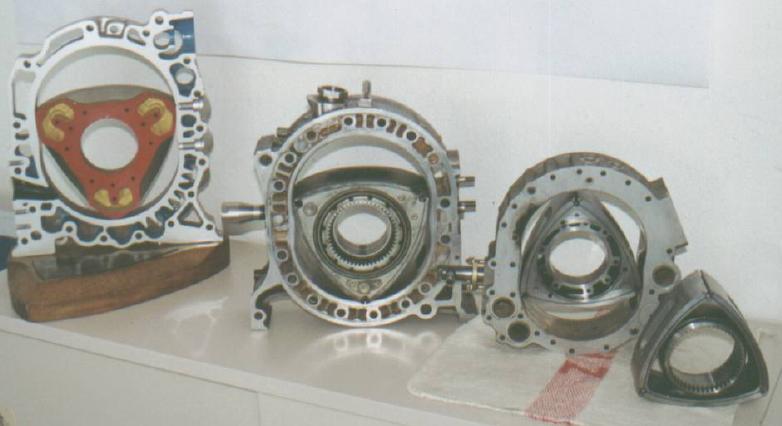
Here is a shot of an RO80 rotor housing (I think) and 12A
rotor housing. Does that look like a RO80 rotor housing on
the left?
"The lower the R/E ratio and the narrower the piston, the higher the S/D
ratio becomes. It was for this reason that the piston width was kept
narrow. And it showed, fuel consumption figures were the lowest for
the EA 871."When Mazda goes to 100 mm wide pistons, the S/D will drop
to .296 or ~.30. In view of economy Mazda is going the wrong direction."
I agree with your numbers but I don't agree with your conclusion.
The BSFC numbers I have for the RO80 from Norbye's book are no
better than the 13B. I think the 16B's better combustion chamber
shape will pay off. Time will tell.. that is if we ever get a chance
to measure it. There is also a question of how it was measured.
With "accessories" the RO80 engine was worse than the Mazda BSFC
wise by about .03. Namely .50 for the RO80 and .47 for the 13B.
"Maximum torque of the RO80 is 162 Nm which relates to a mep of
1.024 or 148 psi. The RX8 has some 160 ft lbs of torque which is
equal to 150 psi. Very close the same."
Here you are comparing apples with oranges. The RO80 is a p-port
engine and the RX8 engine is a side port engine. The 13B P-PORT
engine shows 200 foot pounds of torque.
"With a wider piston of 100 mm this number will drop."
I agree with this as the 100 mm wide rotor 16B side port area will
be the same as the 80 mm wide rotor RX8 side port area
despite an increase in torque. However that will definitely NOT be
the case with the 16B P-PORT engine. My guess is we will see
something like 300 foot pounds from the P-port 16B with a 3 inch
OD P-port runner.
We will probably also be able to work inside the engine without
taking it apart :)
BTW The EA 871 was not mentioned in the Norbye book. All NSU
engine numbers started with KKM. The RO 80 engine
was a KKM 612. The book was published in 1971. What years
were you there?
Also BTW It just dawned on me why Mazda did not do a turbo version
of the RX8. IMHO they are looking ahead to the 16B. Why spend the
money on a turbo when you will get the same performance
from a larger cheaper engine?
Paul Lamar ...No rotor no motor.
The Rotary Engine NewsLetter. Powered by Linux.
ACRE NL web site.
http://www.rotaryeng.net
Copyright 1998-2006 All world wide rights reserved.