>>> Do you think the Kinsler nozzles would work in the RX8 intake
>> manifold
>>> injector holes or do they have to be in the main air stream?
> Karibian
>>>
>>>
>>> I think they have to be in the air stream.
>>>
>>> Paul Lamar ...No rotor no motor.
>>
>> Perhaps an e-mail or call to them would be beneficial.
>> They have been very good at problem solving for our
>> race engines, without a sales pitch. Every system sent
>> to them for rework and calibration, has come back so
>> well set up that we hardly turned a screw upon installing.
>> Archie
>>
>>
>> Karibian,
>>
>> I would suggest downloading the catalog and looking at the various
>> nozzles shapes and sizes they offer. If you can find a shape and
>> size similar to the EFI nozzle on the RX8 engine, I don't see why it
>> should not work.
>>
>> The key thing is that it should spray fuel into the runner the same
>> way the stock nozzle does -- not spray it onto the runner wall
>> because it's too short or whatever.
>>
>> The other thing is how you will thread it in. It may not be the same
>> size hole or thread. If the existing hole is smaller you may be able
>> to enlarge it and rethread it so the Kinsler nozzle will fit.
>>
>> Regards,
>>
>> Gordon.
>>
>
> Gordon,
>
> If the nozzle is constantly spraying then at low idling speeds some
> fuel is
> getting sucked out with the exhaust during over lap. I can imagine
> that at
> higher speeds this is not happening perhaps as much if at all. What
> do you
> think the BSFC will be compared to EFI in light of the fact Mazda
> choose the
> later in Lemans. They were concerned to get the best BSFC since
it is an
> endurance race. Mistral and Tracy both say that timing of the
> injection is
> critical for good BSFC.
>
> In either case I want the injector right on the housings so maybe
> this isn't
> an issue. I am trying to design a way I could test both systems
> using the
> same injector boss.
>
>
> Doug
>
> Doug,
>
> Mounting the injector right on the housing sounds like a good idea.
> It will maximize the evaporative cooling effect of the fuel on the
> air charge. I guess you will attach the bosses to the p-port tubes
> that go in the housing?
>
> About the BSFC, off the top of my head I don't see why the constant
> flow nozzles should be at a disadvantage. Maybe at idle, like you
> say but how much time do you spend at idle?
>
> I could be wrong. Maybe the rotary has some peculiarities that could
> make timed injection better. But at a steady rpm and power output I
> don't see any advantages with timed injection.
>
> If we think about the flow in the intake manifold, it is pulsed not
> steady, coinciding with the rhythm of the intake cycle. So the flow
> coming out of the nozzle will be pulsed also, becasue the air
> flowing across the nozzle pulls the fuel through the nozzle. As the
> air mass flowing across the nozzle slows down, the flow from the
> nozzle will slow down. As it accelerates, the flow from the nozzle
> will accelerate.
>
> So even though fuel is flowing constantly, the amount of fuel flow
> coming out of the nozzle will vary with the pressure pulses in the
> manifold.
>
> Of course only testing will give you the real answer.
>
>
> Regards,
>
> Gordon.
>
>
> Doug,
>
> I found a needle valve that should work nicely. It is made by
> Swagelok and smallest size is 1/8 NPT which should be good. Orifice
> size is 0.08".
>
> it uses a toggle handle to pull the needle out and open the valve,
> but we can toss that handle and attach a cable right to the needle.
> As you pull the cable the needle comes out and flow increases. This
> is perfect because increasing the flow on the return line makes the
> mixture leaner.
>
> So pulling the calbe makes the mixture leaner, just as it should be.
> If you have a nice Vernier cable, you can make very fine adjustments.
>
>
> Regards,
>
> Gordon.
>
>
>
>
> Regards,
>
> Gordon.
>
> Interesting idea.
>
> The only problem I see Gordon is it does not have a long needle.
> Hard to tune with something that moves only a fraction of an
> inch from full off to full open even with a vernier.
>
>
> Paul Lamar ...No rotor no motor.
Gordon,
Yes we use Swaglok stainless fittings throughout our equipment. It is a
beautiful valve you have shown. Only one small problem. It is not a
metering valve. It is designed to open the flow rapidly and is basically
an on/off type of valve. The design point is based on convenience of
opening it and flow characteristics. A very common type.
Needle valves are short and the fuel moves perpendicular to the axis
of the
needle movement. The total travel from slightly open to full open is a
function of the fuel port size. The diameter of the needle is larger
then
the port size.
Paul you can make the needle 10 inches long and it is not going to
change
these characteristics:) Excuse me but you are trying to redesign the
horse
to fit the cart.
Think how an idling needle is used to fine tune the air flow in a carb.
Sort of similar but the ratio of the intake throat diameter compared
to the
idling needle is huge. In a metering valve the needle and the throat
(port) are closer to the same.
Adjusting a needle valve works very Vernier like. On your console
just use
a cable designed to transmit torsional movement. Sure there will be
a little
flex depending on the quality of the cable you choose and the
resistance of
the O-ring in the valve, but that flex is a constant that the pilot can
compensate for it.
For an illustration of how they work go here.
http://www.hoke.com/products/valves/meter/v_meter.htmBTW
Click on catalogs and download the PDF on the 1600 series. On the second
page is a good illustration. Sorry I have downloaded the PDF file
but I was
not able to capture that illustration.
This particular company's products are not hoke despite the name:)
They are very expensive but very accurate. Do a google search on needle
valves and you will find many companies out there.
Cheers
Doug
I understand how they work. Our leaning cable moves rapidly
from one end to the other three inches away just like the throttle
cable. Making the needle the same length means we can make gross
adjustments rapidly from full off to full on and fine adjustments
with the vernier. The leaning cable knob has a button on it. You
push and hold the button in to release the vernier and make the
gross adjustment. Release the button and then the vernier works
again. I have one on my C182. Next time you are in the states
flying around rent a Cessna with a vernier knob instead of flying
your C150 or stop by my hangar :)
Paul Lamar ...No rotor no motor.
Doug,
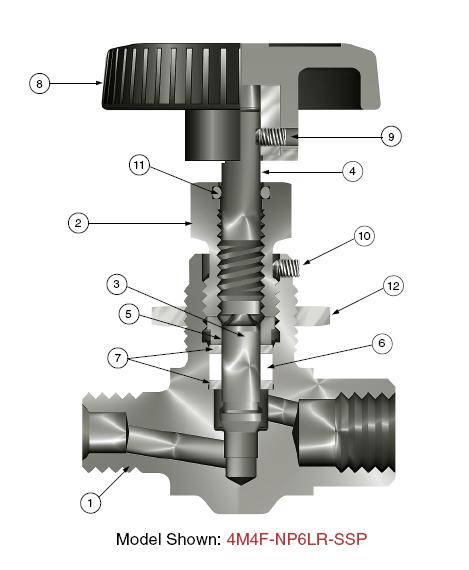
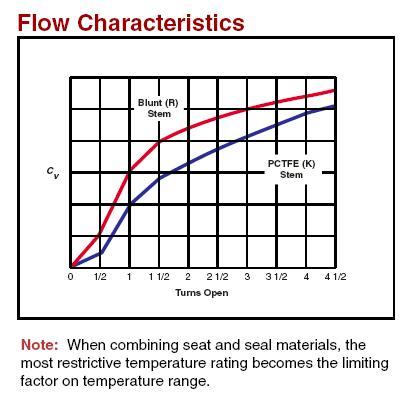
What about this? This is a true needle valve from Parker. The graph
showing flow looks very linear.
The only thing with this valve is it adjusts by turning, so you
would have to have a cable that works by turning not push-pull.
Nothing wrong with this approach.
An ideal valve would be this but with a quarter turn lever, but
there does not appear to be such an animal in existence.
I still think that Swaglok valve might work. True, it's meant for
quick opening, but it's still a needle valve. If that pin is lifted
up a little at a time, the flow increase should be linear. It looks
pretty much the same as the Parker valve in cutaway.
The only thing is you would have to replace that Nylon lever with a
metal lever so you can hook up your Vernier cable.
Regards,
Gordon.
The Rotary Engine NewsLetter. Powered by Linux.
ACRE NL web site.
http://www.rotaryeng.net
Copyright 1998-2006 All world wide rights reserved.