> Hi Paul, Gordon, int.al.
> Why is the lever action so important? How often are we likely to
> adjust
> the mixture? Mount the valve on the engine side of the firewall
> with
> the shaft coming thru into the cockpit with an extension to the
> inst.
> panel and adjust the mixture with the knob. I suspect the reason we
> have mixture 'levers', is because that is the type of control on
> Lycosaurus carbs. If we retain the screw knob, it is "vernier"
> adjustment already.
>
> BR, Dave McC
>
>
>
> You mean a solid shaft extension right? That would be better than a
> cable because it would eliminate any potential slop. It wouldn't
> need to be that long to reach from fiewall to instrument panel.
> This
> should work well.
>
> Regards,
>
> Gordon.
Yes, I think you mean rigid; a tubular shaft, say, a 1/4"
aluminum tube.
I have a selector knob on my Stinson panel connected to the fuel
selector valve on the firewall by a 5/16 tube and it works fine; for
the last 48 years anyways.
BR, Dave McC
Yes, rigid is the right word. It doesn't have to be solid rod. The
aluminum tube you describe sounds perfect.
I've seen these extensions on remote fuel selector valves and they
work just fine, like you say. In fact the small metering valve
we're talking about would have insignificant twisting on the
extension, compared to fuel selector valve.
Problem solved as far as I'm concerned. With a bigger knob you can
have very fine mixture adjustments. Look at the flow graph. There
are 4.5 turns from closed to open.
Paul,
Nothing wrong with your idea, but who is going to make that for you?
You have to pay someone to machine the needle and other parts. It's
easier -- and maybe cheaper -- to just buy a valve off the shelf.
Parker is part of Parker Hannifin which makes a lot of aircraft
parts, so getting one is easy. (I don't think think this valve is
meant for aircraft use though, but it is high quality.)
http://www.parker.com/ead/cm2.asp?cmid=3092
Regards,
Gordon.
Yes but nothing I have seen off the shelf so far is near
as workable as this design. The cost is cheap. I'll front
a bunch of SS needles made on an NC lath. Cost probably
less than $5 each. Or people with lathes can make them
themselves.
The rest of it is made from SS tube and SS 37 degree flare 1/8th
JIC fittings.
There are no pivots or levers to add backlash or slop.
Paul Lamar ...No rotor no motor.
Paul,
There is no slop or levers with the extension rod either. You just
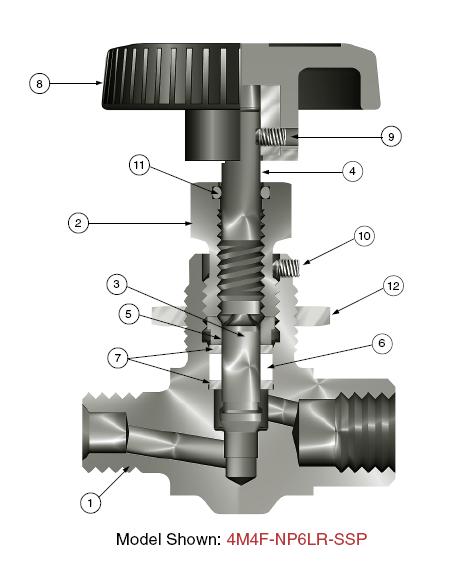
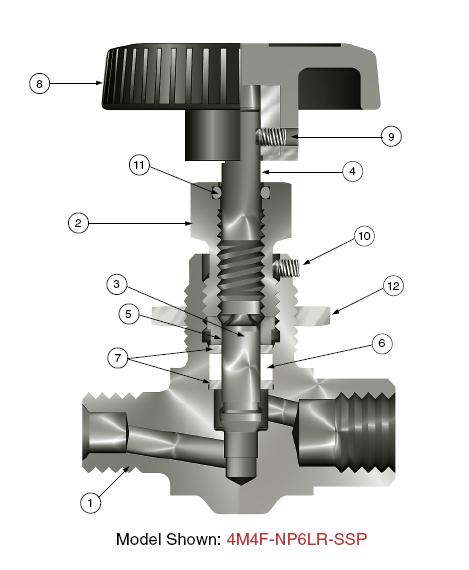
have a knob you turn for leaning. The Parker valve even has a panel
nut -- you just drill a hole in the firewall, take off the knob and
attach the valve to the firewall with the panel nut. Run the
extension to the instrument panel and reattach the knob there. Done.
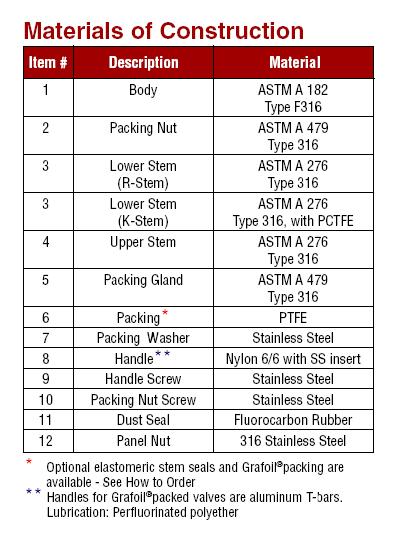
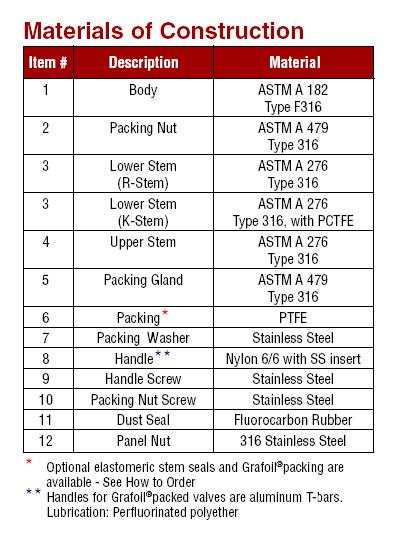
How would you seal your needle valve? You have to have some way to
keep fuel under pressure from squirting out the needle tube. Look at
the drawing of the Parker valve -- it uses a packing gland, a
packing washer and PTFE packing to accomplish the sealing. It would
cost more than $5 to replicate all that from scratch.
Regards,
Gordon.
O rings.
Paul Lamar ...No rotor no motor.
The Rotary Engine NewsLetter. Powered by Linux.
ACRE NL web site.
http://www.rotaryeng.net
Copyright 1998-2006 All world wide rights reserved.