> Gordon
>
> Yep, Parker is another good company. That should work.
>
> Doug
>
> What do you guys have against this idea? What is wrong
> with it?
>
> Paul Lamar
Hi Paul,
there is nothing wrong with it per se : but using your reasoning...
What do you have against the Parker valve? What feature is missing that
we need? What is wrong with it?
For: It is well made, it has the known flow characteristics ,easy
to mount, easy to operate, vernier adjustment, and readily
available.
Using the Parker valve makes the Slide throttle a lot simpler, in that
the leaning feature is remote from the moving slide.
And if you must mess with the needle on your lathe/ mill, then you can
simply dismantle the valve for easy access.
Against: Its mode of operation is not like that on a "Cessna spam can"
???
Dave McC
Where do I begin?
The long needle valve is also remote from the moving slide.
However you want to keep it as close as possible so
vapor is not made in the fuel line from the valve
to the slide throttle by engine heat.
Anything that you have to twist remotely means
you need a torsionally stiff shaft. That rules out the stock
off the shelf leaning cable with vernier as it's shaft is only about
.1 inches in diameter. It must be that small so the valve
can be out of axial and lateral alignment with the twisting
knob three feet away on the instrument panel. If there is any
wind up in the shaft it makes fine adjustment difficult. It also
must accommodate movement by the engine in it rubber mounts. Sure
a 1/2 inch aluminum tube could be used if you mounted it on the
firewall. Now you have at least two couplings to deal with
and a new knob. Mounting the whole valve on the instrument
panel means you have a longer fuel line to the slide throttle
with more opportunity for fuel vapor accumulation.
The second major problem is it takes too much time to open
fully or close fully. That is a major feature on the long needle
valve. You need to open the valve completely to prime
the engine for starting and close it quickly for shutting off
the engine.
Third, the long needle valves position is obvious from
a glance at the knob sticking out of the instrument panel.
No need to read a small rotating scale.
Forth, pilots don't need to be retrained. Anybody flying a
Cessna "spam can" (I represent that crack :)) will know exactly
how and why it is used.
Paul Lamar ...No rotor no motor.
Paul,
I'll start with the disadvantages of your needle valve:
1. Its action is in the wrong direction, so if you want to pull out
for leaning you have to mount a lever that will reverse the needle
travel. You were just railing against levers as prone to slop...
2. Those O-rings will leak if you try to run any more than a few
pounds of pressure, so the valve is not usable on the constant flow
injection system. It would probably work ok with the slide throttle
carb.
Now the stuff you mentioned against the Parker valve:
1. Yes, it is a different "interface" than the standard pull out for
leaning mixture control. Okay, but what is the alternative? EFI with
no mixture control at all? Or a little knob to control an
after market EFI system? Compared to this, I'll take the manual twist
knob.
2. There can be no windup and hence no slop with an aluminum tube
extension like Dave suggested. All you add is an aluminum tube. You
use the same knob that comes with the valve.
Regards,
Gordon.
---------------------------------------------
I am only concerned with the low pressure 2 psi fuel system.
You high pressure mechanical system guys are on your own :).
Too expensive for me. Requires a high pressure pump.
Colin Smith came up with a simple variation that changes the direction.
I like his idea better than mine as it has the potential for
a more positive shut off feature. I am working on a 3D.
Paul Lamar ...No rotor no motor.
-----------------------------
Paul,
I agree your slide throttle carb is an attractive way to go at very
low cost. Just a little elbow grease to make one. (Okay, maybe more
than a little...)
But you still need a mechanical pump even at low pressure, unless
you have high wing tanks. Maybe the stock diaphragm pump could work,
but those diaphragm pumps are more prone to vapor lock. (I don't
want to open that debate again; I know you can keep the fuel lines
cool with a blast tube, routing away from hot spots etc...)
If you decide to use a positive displacement mechanical pump like
the Kinsler pump, are already half way to spending what it costs for
the full mechanical injection. The pump is the biggest expense in
the whole constant flow system.
The only other things you would need are the barrel valve and two
nozzles (for a P-port; more for more runners). Here is a Kinsler
single-port barrel valve. You can run that to an AN Tee
fitting that will split a fuel line to each runner.
You would have to weld a nozzle boss on each runner, and make up
some AN fuel lines and fittings. You would use the Parker valve and
panel adjustable twist knob for leaning.
Throttle would be with your slide throttle. The whole thing would
probably cost less than an Ellison carb. Because of the higher
pressure it would be much less susceptible to vapor lock than an
Ellison. It also would not need carb heat.
So compared to an Ellison carb it's a great deal. If you want to use
a turbo or supercharger, it is a perfect way to go. Even for a
normally aspirated engine it's a great way to go.
Compared to EFI it's an even better deal. Even with stock EFI you
need at least two high pressure electric pumps. They aren't cheap.
And then what about an after market controller, like Tracy's unit or
some others. These cost about $1,000 I believe.
Then you've got your injectors, etc.
And after all that money spent you're 100 percent dependent on
electrical just to keep your engine running. If your juice stops
flowing, you are coming down. This does not sound like a good deal
to me.
So while the constant flow injection is a little more expensive than
the slide throttle carb, it is still a very good option when
everything is considered.
Regards,
Gordon.
I think you are going to run into trouble if you try to limit the output
of a positive displacement mechanical pump with a needle valve. In
car racing
they could care less about leaning for cruise. In aircraft we need
full power
for take off and super lean for cruise. In car racing they need full
power....
PERIOD :) Race cars also don't idle. Do you have any 800 HP sprint
car racing
up there?
Doug, next time you come to my house I'll take you to the sprint
car races and into the pits after the race so you can see some of
these systems. I can hear them from here every Saturday night :)
Fuel delivery in these race car systems is only a function of RPM.
You can not get more fuel out of a positive displacement pump if you
lower the pressure on the output side. If you restrict the output
with a needle valve no telling what happens. It will probably overheat
the pump and the fuel.
In mine, Ellison, Aerocarb, Revmaster, etc., etc., fuel delivery is
tied to
throttle opening and intake manifold vacuum.
The diaphragm pump won't work as they are designed to work off a
cam shaft. A mechanical pump driven off the e-shaft will work
with my system as well. All it need do is fill a small header tank
equipped
with a stand pipe. If it pumps too much fuel it just goes back to
the fuel tank through the stand pipe. No back pressure to speak of
on a positive displacement mechanical pump.
Paul Lamar ...No rotor no motor.
Paul,
The mechanical injection will idle just fine.
Fuel Delivery is tied to throttle opening -- it is not just a
function of pump output with rpm.
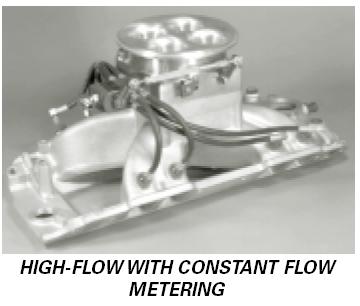
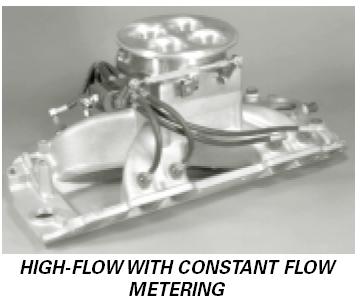
The barrel valve controls how much fuel goes to the nozzles. It is
linked directly to the throttle. As the throttle is opened the
barrel valve turns to allow more fuel to go to the nozzles. You can
see the linkage in the photo.
There are several other features of the system that allow very
precise fuel delivery at all engine oeprating conditions.
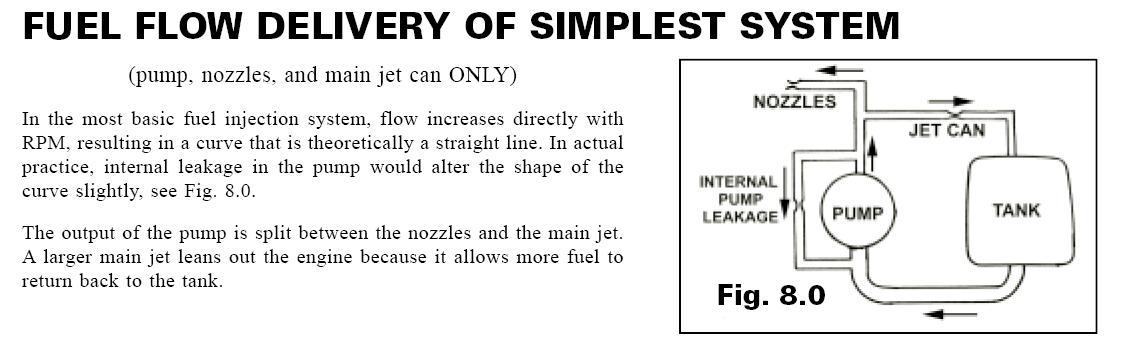
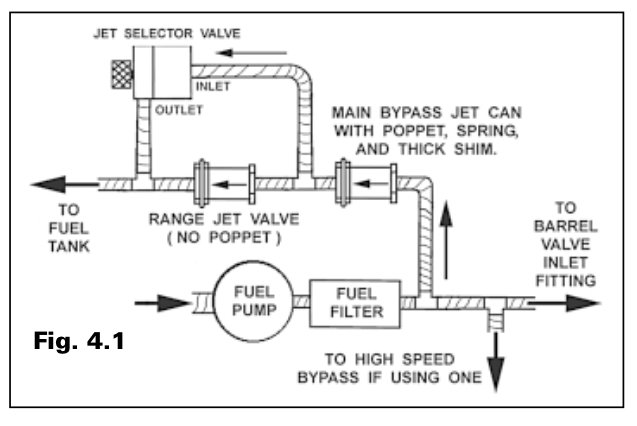
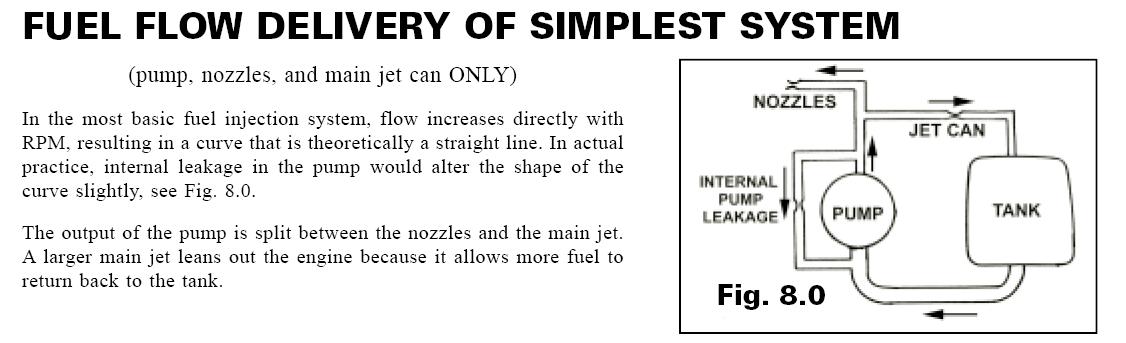
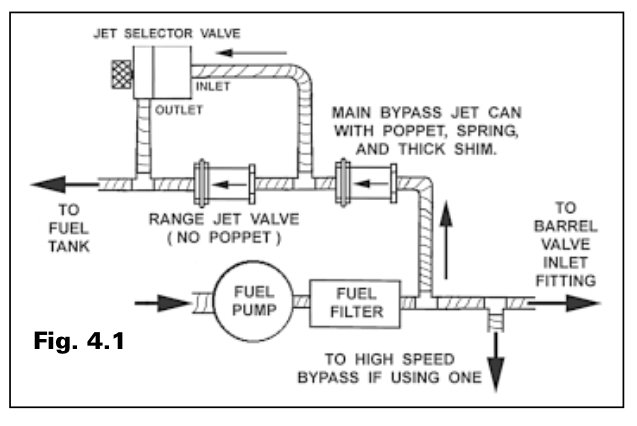
Have a look at the basic schematic. See where it says jet can?
That's where we put the needle valve for leaning. The more we open
the leaning valve the greater the return to the tank and the less
fuel flowing to the nozzles.
So we are not leaning by restricting flow -- we are leaning by
increasing flow to the return. This is the key concept.
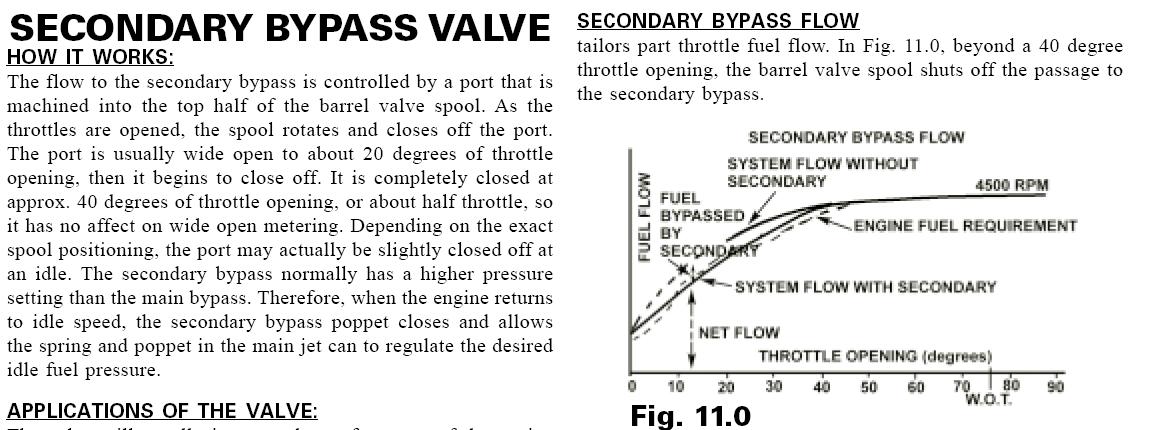
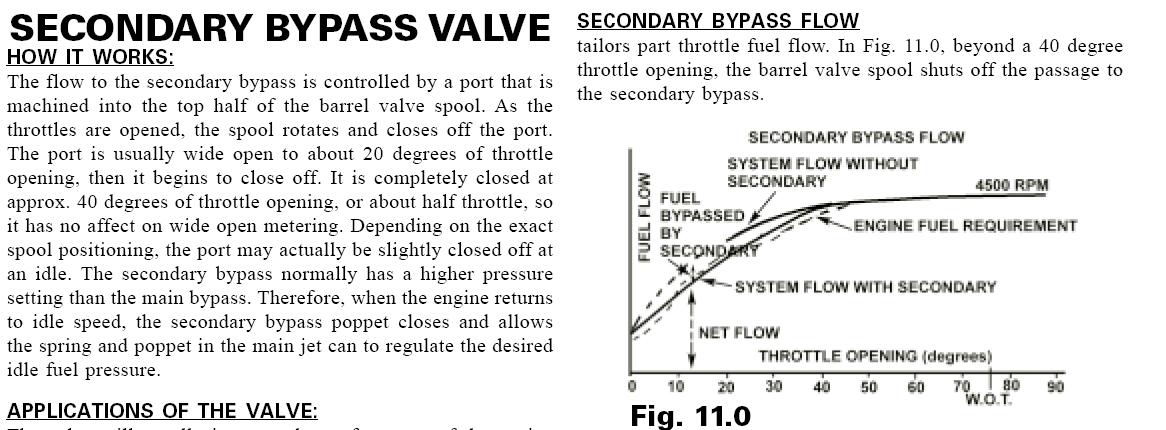
There are also other subleties to the system. The barrel valve
diverts some additional flow at low throttle opening. This is the
socondary bypass valve. Have a look at the photo and the explanation.
This system will work like a charm for an aircraft engine. We will
have precise fuel metering throughout the operating range, very
precise leaning -- and best of all great reliability. As long as the
engine is turning we will have fuel delivery.
Regards,
Gordon
What does all this cost? Most people installing the
rotary are driven by cost.
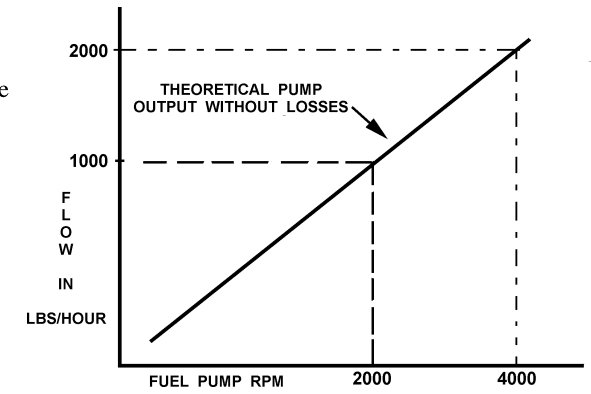
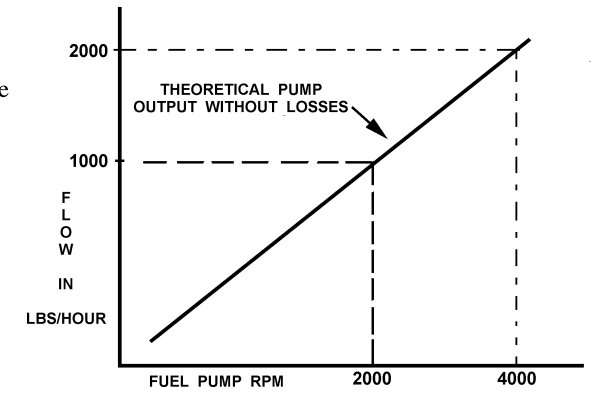
The Kinsler pump puts out 1000 pounds
per hour at 2000 RPM. We are running our engines
at 7000 RPM and we need 30 pounds per hour max.
10 gallons an hour at cruise.
We would then have to run the pump at 30/1000 or 60 RPM.
If we had a two inch pulley on the e-shaft the pulley
on the pump would have to be 7000/60 x 2 or 233 inches
in diameter!!!! :)
These low RPM 800 HP mechanical fuel injection systems seems
impractical for a high RPM 250 HP rotary.
Paul Lamar ...No rotor no motor.
The Rotary Engine NewsLetter. Powered by Linux.
ACRE NL web site.
http://www.rotaryeng.net
Copyright 1998-2006 All world wide rights reserved.