Good luck on the turbo charging. A lot of people have
blown up a lot of Mazda rotaries by screwing up the turbo charging.
Mazda thought the 2nd gen Turbo II RX7 needed an inter cooler with
only 5 psi boost. They put a detonation sensor on there as well.
150 F is getting in the detonation range.
My RX2 had an electric pump.
Paul Lamar
Paul,
Five psi boost at sea level will make hotter air than 8 psi at
20,000 feet where air is much colder.
Also the 150 F temp is before evaporative cooling at the port. This
will drop the temp to about 110 F. This is downright chilly. Even
150 is fine. I've never heard of 150 causing detonation.
Btw, the new Garrett catalog has a turbo that should work just about
right for a turbonormalized 2-rotor.
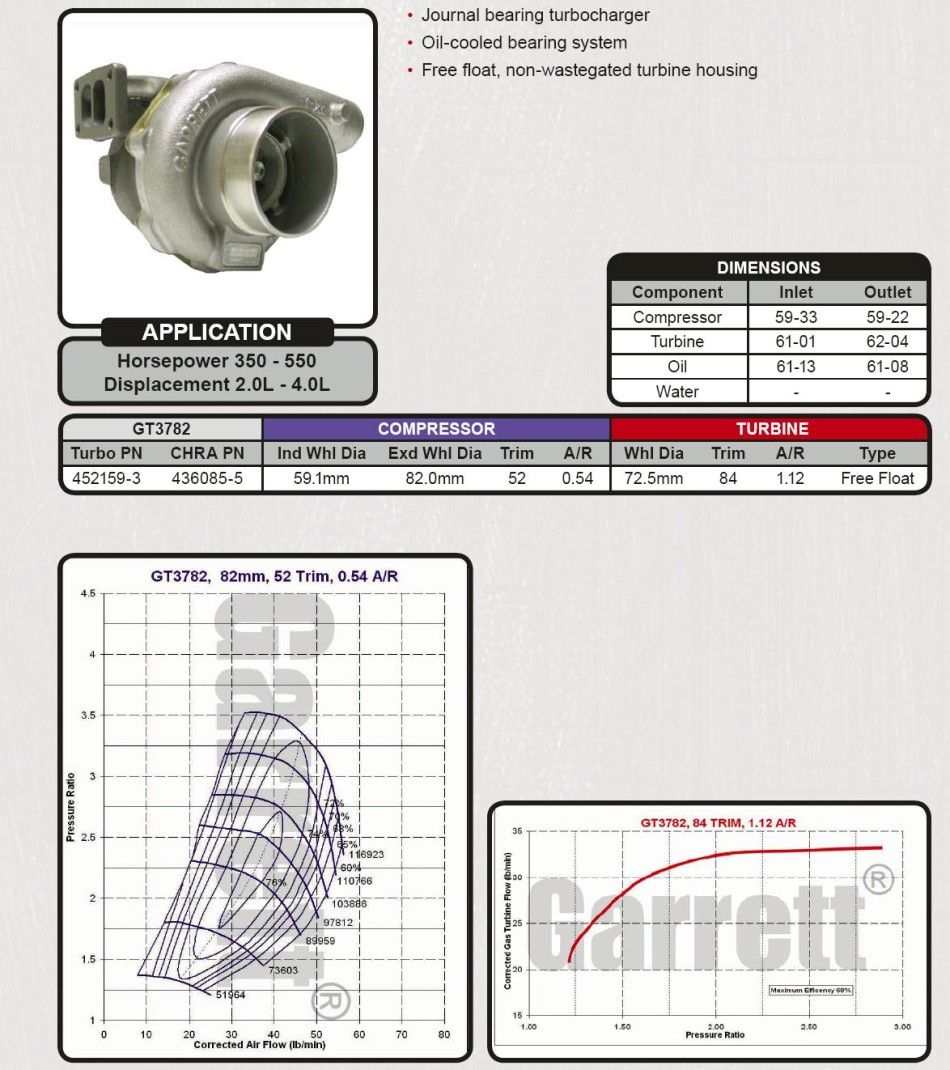
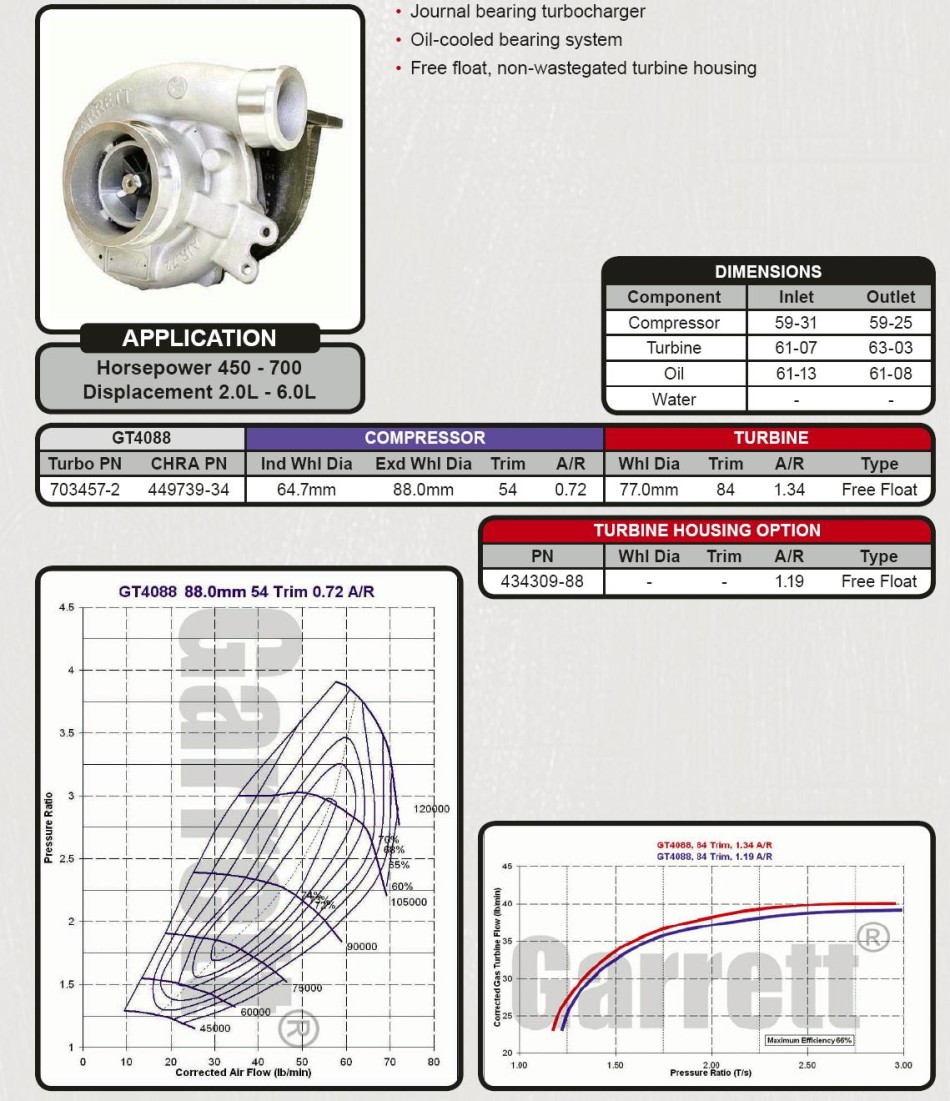
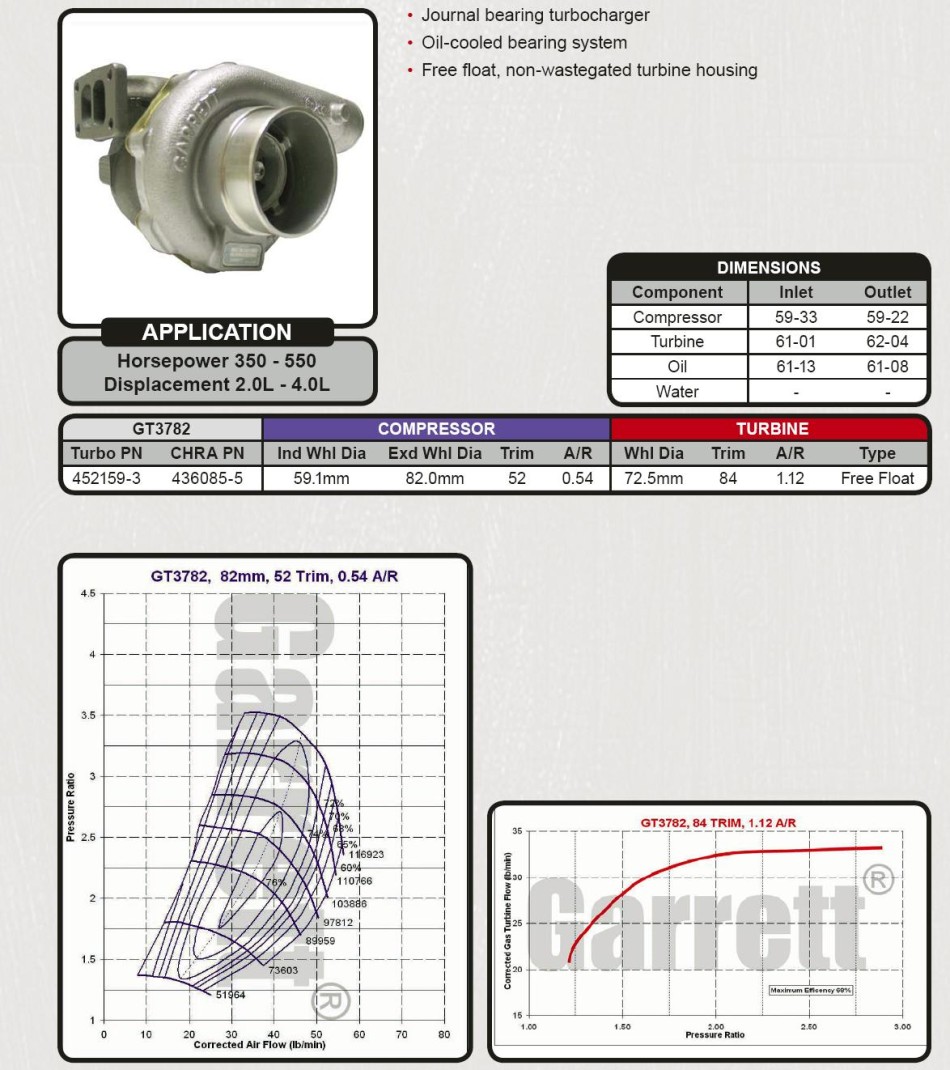
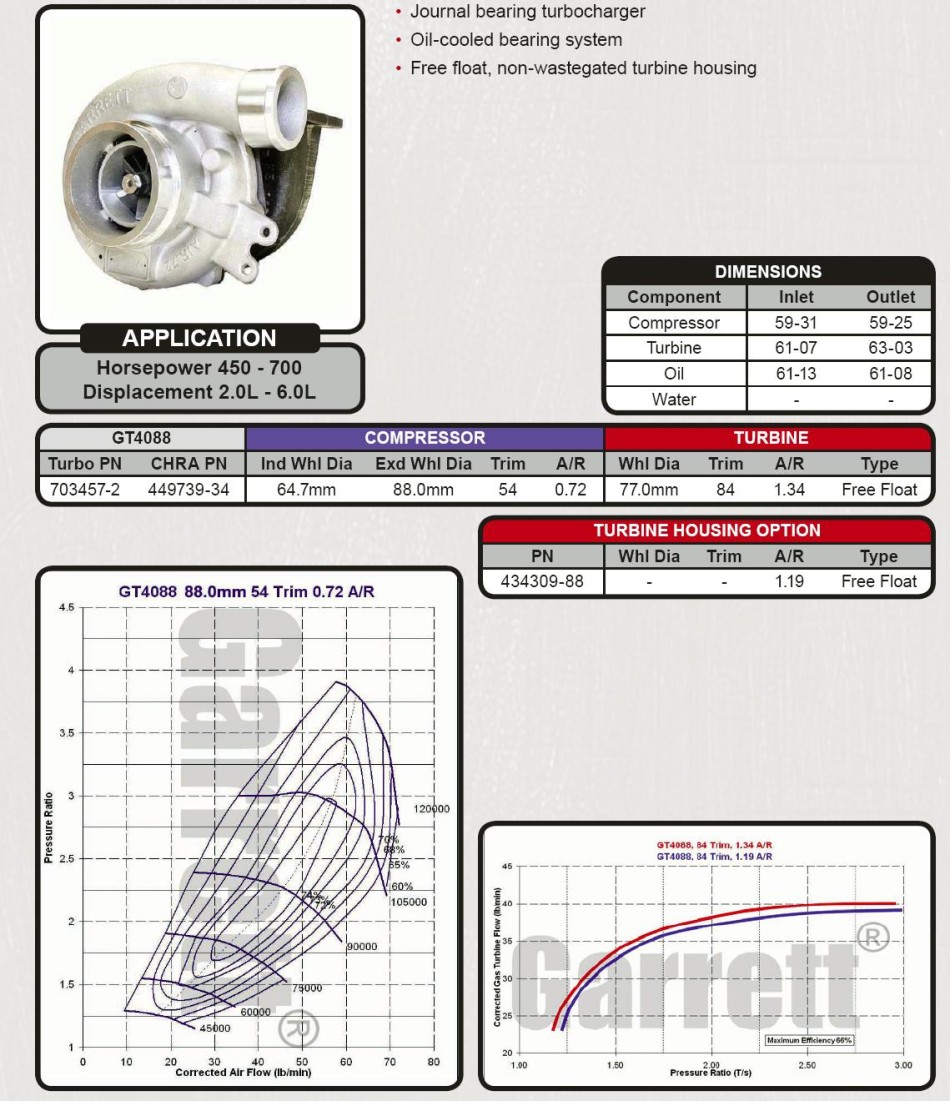
Use the compressor from the GT3782 and the turbine from the GT4088.
Here are the catalog pages for both.
Notice the large 1.34 trim on the larger one? That's why the turbine
flow keeps building until 2.5 pressure ratio. This is just what we
need at 20,000 feet, where we need just under 2.5 to get sea level MAP.
So that curve will give us increasing boost all the way up to our
service ceiling. The smaller one would work too, but its curve
flattens out at 2 to 1 compression. Not ideal. It would work well to
about 15,000 feet.
The compressor on the smaller one is just right though.
If I were building a turbonormalized 2-rotor, this is what I would
use. You wouldn't even need a wastegate. No way you are going to
spin that big turbine up into trouble territory unless you go much
over FL200.
Regards,
Gordon.
Sounds like an extensive R&D program due to the total
lack of info on the HP available from specific turbines and the HP
consumption of specific compressors. Until the turbo charger
guys wake up and start publishing dyno HP numbers it will
remain difficult to come up with a simple design process.
Apparently a lot of first hand experience counts for a lot.
I did a bit of this R&D with Garrett back in 1980.
"The Effects of Turbocharger Design and Installation on
Gasoline Vehicle Transient Response.
David Elpern. Garrett Automotive Products Co.
SAE 821149 Use of the Lamar Instrument test
equipment to develop turbocharger design."
Even Borg Warner teamed up with Porsche to develop an application.
So far nobody has been able to hit the happy combination out of the
gate without some trial an error. Then you have the extra exhaust
heat of a rotary to contend with. We really know next to nothing
about the rotary exhaust. We do know there is a lot of kinetic
energy in there due to the ear piercing noise they make and we
do know they run 1700 to 1800 F. That is about it.
Your talking big bucks for the R&D. The number of people interested
in this are few and far between. It will be years before
many high buck people are going to install a rotary. Years
before the rotary will be recognized as worth the extra trouble
by the mainstream aviation community. Much easier to buy an
aircraft engine off the shelf if money is not that important.
After all an aircraft engine will last 20 years at 100 hours
per year. In the mean time more and more guys looking to
save a buck will be installing rotaries. We owe a lot to
the few guys that have persevered so far on the turbo chargers
like Tom Parkes, Dave Leonard and John Slade.
The turbo compound rotary may change the dynamics but only if
the fuel price doubles or aircraft range becomes more of an issue.
BTW I like the Borg Warner variable A/R. Much easier
to match and they have been cheaper in the past
than Garrett.
--
Paul Lamar ...No rotor no motor.
The Rotary Engine NewsLetter. Powered by Linux.
ACRE NL web site.
http://www.rotaryeng.net
Copyright 1998-2006 All world wide rights reserved.