It seems to me that the prop reduction options we're seeing are
unnecessarily complex.
If I wanted complexity for the sake of complexity, I'd just run a
reciprosaur!
A 2-gear reduction would be lighter and simpler than the Ford planetary
units. For that matter a Notax C box only weighs 18 lbs and might be a
good solution for 1-rotor setups.
To build your own reduction, gears are readily available from a number
of sources. The engine-mount side would be an aluminum plate, that
would not only attach to the engine but also mount the gears.
A lightweight gear housing (and contour fills around the output shaft of
the engine) can be made of fiberglass or carbon fiber. Lubrication
would be simple -- tap off a small line from the flow back from the oil
cooler, squirt it at the gears where they mesh, and drain that to the
oil sump.
With a little design work, you can also scrap the flywheel and starter
ring, hooking the starter up to the larger gear and getting even more
weight reduction.
Has anyone tried this, or did they just jump to the planetary systems?
Keith Wood
Planetary's have a higher strength to weight ratio than
any other type of gearing. For that reason alone they are the only
kind of gearing used in serious aircraft engines.
The Ford planet gear set we use weighs less than eight pounds.
Torque capacity is over 650 foot pounds.
1)For a given gear width a six pinion planetary is six times
stronger than just two gears.
2)Two gears alone attempt to wedge them
selves apart requiring a very robust gear case.
3)In a planetary all gear separation forces are self
contained in the ring gear.
4) In a two gear system as the light alloy case expands
with heat the gears get further apart causing higher bending
loads on the teeth.
5) The planetary is ideal for a rotary
as the output shaft is coaxial with the e-shaft. It is also
ideal for a horizontal opposed aircraft piston engine.
Do you need any more reasons? :)
Paul Lamar ...No rotor no motor.
For several hundred HP and up, sure, the strength is an issue.
However, when talking about a <200HP system, you're not going to come
anywhere close to the strength limits of properly-machined gears.
Especially in the 100HP range that I'm looking for, standard gears are
plenty strong, and the heat issue is resolved by using recirculating,
cooled oil. Notax gearboxes are running in the 80HP range, without
problems and using a a static oil bath.
I think 1/2" aluminum will do very well for the backing plate. Again,
the Notax boxes are simple castings and handle the job just fine,
including handling the expansion issue, and you know those 2-strokes are
hot.
Yes, the planetary system is superior in many ways, but that superiority
is not a factor at 100HP -- it's like putting an afterburner on a turtle.
And it comes with penalties in other areas, from complexity to weight.
Remember that the components in the planetary come out of a truck that
pours all of the power that goes through them to a 2-gear, non-cooled,
bath-lubricated differential. The reason that they used planetaries in
the transmission is keeping within size constraints.
My objective is to produce 100HP in the lightest package I can, to
replace an O-200. Unlike most of you folks, I have a vast amount of
space under the cowling (it's a 1/2 scale F4U Corsair), so size isn't an
issue.
When I see planetary reductions running in the 40-lb range, and see
building a "pancake gear" reduction at half the weight and 1/4 the
price, the answer is pretty obvious. Another option is a belt drive,
also simple and lightweight.
Keith Wood
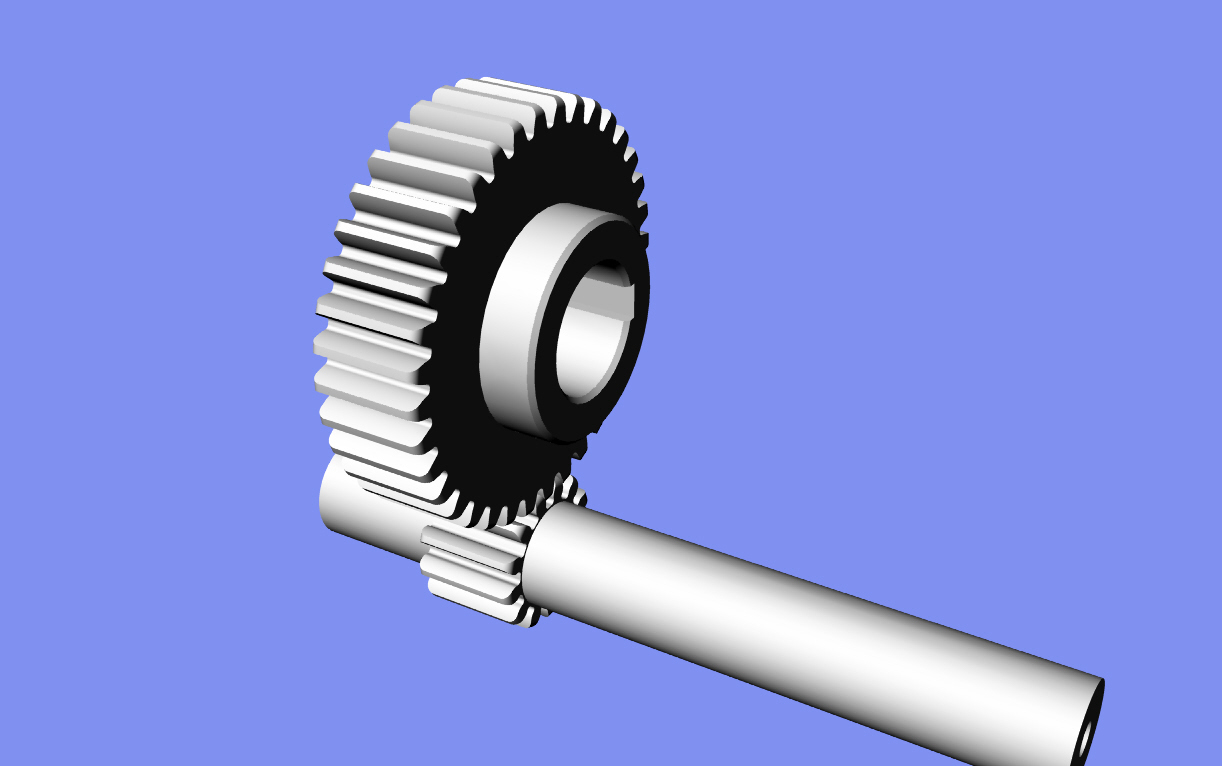
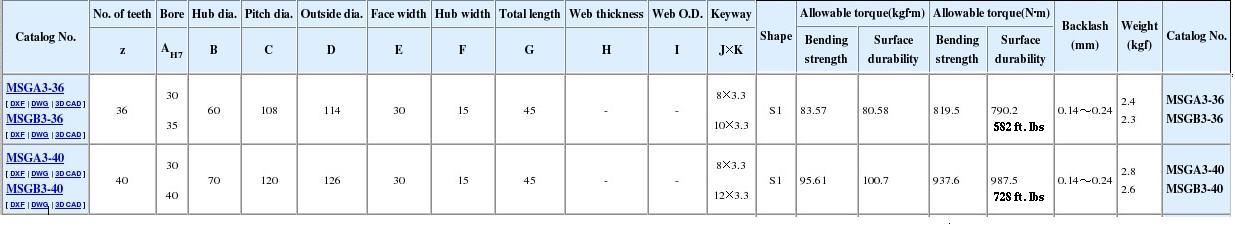
Here is a spur gear set from
http://www.qtcgears.com/
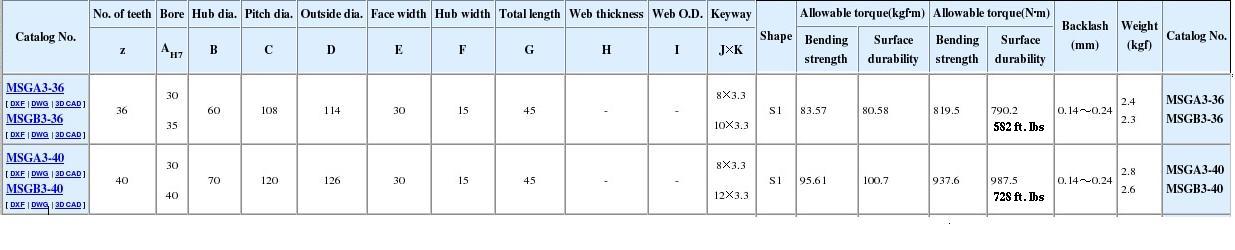
13 teeth on the pinion and 36 teeth on the bull gear
for a ratio of 2.76:1.
Large gear weighs 2.6 KG or 5.72 pounds.
Pinion and shaft weighs 1.4 Kg or 3.08 pounds.
Maximum torque is 582 ft lbs but that is probably near zero life.
You are a long way from done and these gears are not cheap.
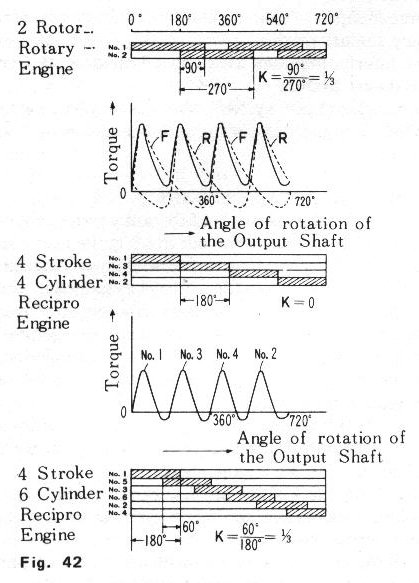
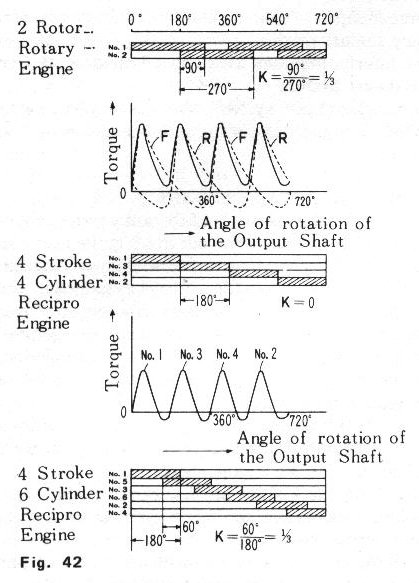
Also you will have to contend with a powerful reversing torque
pulse out of a one rotor engine (dotted line in this chart).
The torque pulse is the same peak as as a two rotor but it
goes negative.
The output shaft must not only take the prop torque but it
must also handle the gyro loads of aircraft pitch and yaw.
I suggest nothing smaller than a 1-3/4 inch OD shaft
five inches long. Solid would weigh about 3.6 pounds.
No prop flange, bearings, housing, torque isolator, bell house
or seals yet. As far as 1/2 inch thick plate housings are concerned
aluminum weighs .1 pounds per cubic inch. You do the math.
I suggest drawing it with a good 3D program like Rhino.
Good luck and keep us informed on how you make out.
Paul Lamar ...No rotor no motor.
The Rotary Engine NewsLetter. Powered by Linux.
ACRE NL web site.
http://www.rotaryeng.net
Copyright 1998-2006 All world wide rights reserved.