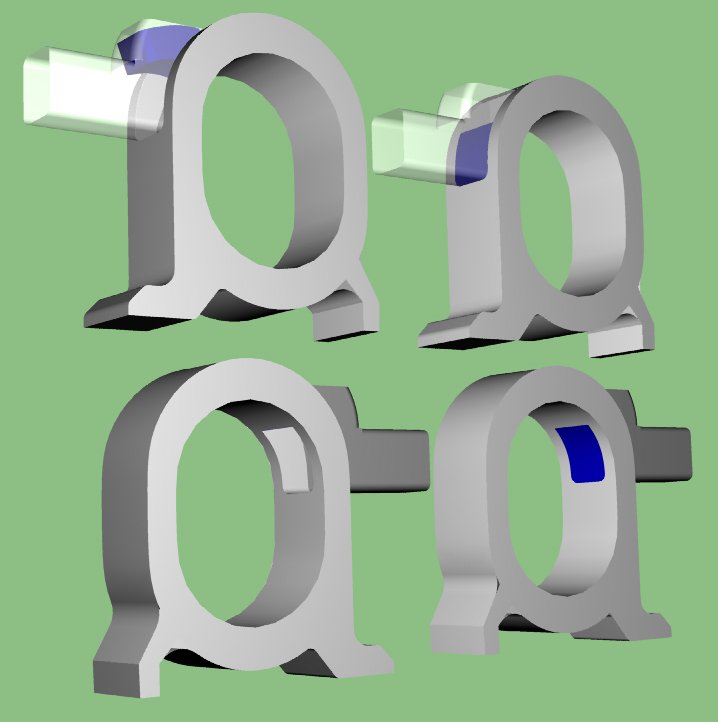
> This is in addition to the side ports.
> Basically what we are doing here is pivoting a section
> of the rotor housing trochoid wear surface up while
> opening a large P-port.
>
> It only opens at full throttle and
> high RPM. Over 6000 RPM. The rest of the time it seals
> the exhaust gas from the intake ports for smooth low RPM
> running and low HC emissions. Just like the current
> RX8 engine. No port overlap at low RPM.
>
> On a 16B this would be spectacular. My guess
> is somewhere close to 400 HP. A real Corvette
> eater for half the price and no increase in RX8 weight.
>
> -----------------------------------------------
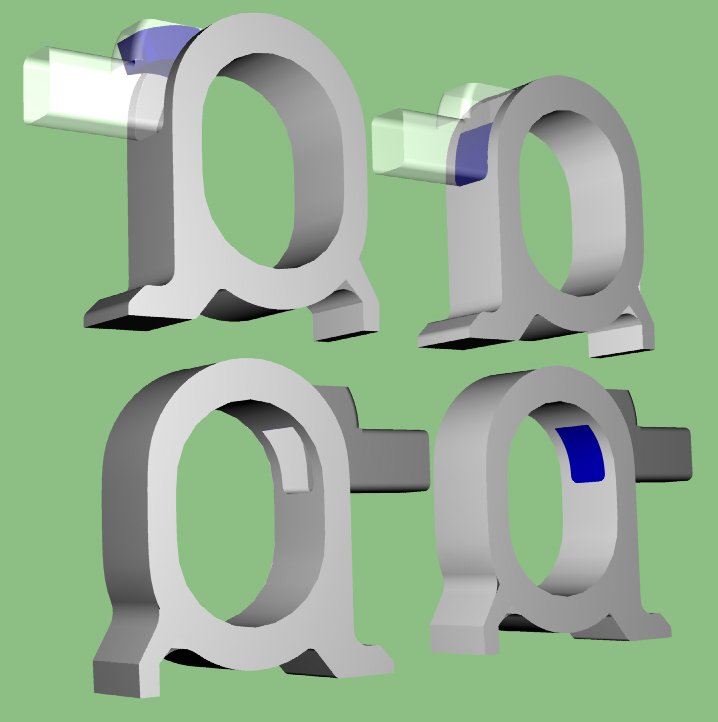
> I redid the 3D for hopefully a clearer picture.
> Second attachment.
>
> This will work on an RX8 engine as well. My guess is
> 300 HP while still meeting all EPA regulations.
> I call it the Trap Door P-port.
>
> -- > Paul Lamar ...No rotor no motor.
>
Three questions Paul,
How do you seal it ?
How do you bolt the sandwich together in that area ?
At what point do you reach max VE ? There must be some point where air
stream
velocity gets low enough to cancel out the advantage of increased cross
sectional area.
Cool idea though and simpler than some other ideas.
John
Does not need to be sealed as the pressure differences inside the
rotor housing are minimal in this area. As the apex seal
passes the top of the trap door that is when the
compression chamber starts to work and the pressure builds up.
Since the pressure is so low in that area fewer tension bolts
need to be used. The trap door pivot could be concentric
with one tension bolt.
I don't know the answer to the last question but I do know
a p-port is worth a 20% higher VE than side ports. Hence
more power. I suspect it is due to forcing the side port air to
make right angle turns while the P-port is a straight shot in.
Paul Lamar ...No rotor no motor.
Paul,
I thought about this idea some time back but considered it such major
surgery that
I figured it would never fly. I thought that a sliding plate in a
dovetail constraint would
be the best solution. Another thought was that wouldn't it be better to
pivot or slide
the the door DOWN rather than up as this would give more benign timing
to the P-port?
Also pivoting or sliding the door down would the least overlap exhaust
back flow. The
true ultimate system would be a radiused slide that would leave the
inner surface
as unaffected as possible. My 2 cents worth.
Bill Jepson
---------------------------------------------------
I agree it will never fly nor should it. It is something Mazda
should do for car engines. Also it has nothing to do with
throttling the air going into the P-port. It snaps
fully open at say 6000 RPM and stays open until red line. It
snaps closed when the RPM drops below 6000 RPM. All throttling
of air is done by the stock fly by wire throttle body.
It is intended to improve the VE and add p-port power to an
engine that is saddled with all side ports due to emissions
regulations.
--
Paul Lamar ...No rotor no motor.
The Rotary Engine NewsLetter. Powered by Linux.
ACRE NL web site.
http://www.rotaryeng.net
Copyright 1998-2006 All world wide rights reserved.