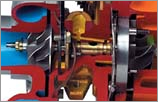
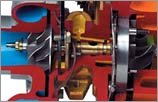
I just ran across these interesting charts from
a tech paper Caterpillar did on turbo compounding
diesel engines. Diesel engines have way less waste
heat/HP/kinetic energy in the exhaust than gasoline
piston engines and rotaries. Despite this they were able to
reduce the fuel consumption as much as 10% at sea level and
full power at 1800 RPM.
--
Paul Lamar ...No rotor no motor.
Paul,
I am a neophyte to homebuilt aircraft and am looking at a couple of
designs that I want to use the rotary with. Info I have read
seems to
say there is a bit of wasted charge sent out the exhaust. I've been
trying to keep up with your turbo compounding theories and I
must say it
is very intriguing. Is something akin to this setup Caterpillar
has
designed feasible for the 13? Is it cost effective and would it
be able
to be engineered into a homebuilt? I'm not sure of the 13's exhaust
temperature but I know that it's pretty high. Would it need to be
cooled prior to entering turbine or is it more feasible to use
exotic
metals on the turbo's intake section? I'm presently looking at the
Bearhawk and the Bede Corps BD-4(preferable). I'm not an engine
"type"
guy, but have no qualms learning my way into that category. Thanks
again for all the work you do and information that you disseminate.
Allen Slominski
Houston, TX
Well the exhaust energy is a bit higher for the rotary than it is
for a piston engine but only about 5% or so more. Say 50% rather
than 45%. The big difference is two thirds of the exhaust energy
is dissipated by the exhaust valves in a piston engine. All engines
have a heat balance where the percentages of the energy in a gallon
of gas is distributed to various systems in the engine.
I assume you have read
http://www.rotaryeng.net/turbo.html
<http://www.rotaryeng.net/turbo.html>
Building a turbo compound yourself is very expensive. I have
spent $7,000 on the project so far but I have a few contacts
in the aerospace biz and they tell me a large company is working
on it for small UAV rotary engines. Plenty of tech papers have
been written on the rotary turbo compound. Mostly computer
simulations. Most are very positive. So far no rotary based hardware
has been built to my knowledge yet.
I am waiting until I get more info from that source
as it will save me doing a lot of very expensive R&D. Hopefully it
will not be classified. If developed for the worlds cars a
theoretical 20% in fuel consumption world wide is possible. If you
can't wait and want to try it yourself I will give you all the help
I can including loaning you my $7,000 turbo charger gear box.
The technology is 70 years old so it should not be all that
hard. Yes you can cool the exhaust but in theory that wastes
some of the energy in the exhaust. Better to deal with the
heat. One way is use a thermo pile ahead of the exhaust turbine
to extract some of the heat as electrical power and cool the exhaust
a bit.
http://www.harvestfields.ca/etextLinks/16/05.htm
Paul Lamar ...No rotor no motor.
Guys,
Have you ever thought of using Garret VNT turbos. I receive the Garret
Boost Mag as a one of their supplier, and all new turbos for diesels are
VNT (Variable Geometry). Basically the principle works by closing
"camera
eye type" flaps are low revs to increase exhaust velocity thus it reach
working rpm at very low revs.. these flaps open up in proportion to rpm
thus keeping the exhaust speed constant. According to Garret fuel
consumption and turbo lag improved significantly, thus it is now
allowing automotive companies to design smaller but yet more power
diesel and gas engines through this technology
regards
Roderick
Yes we have considered it and yes it is a very good idea. Makes it
much much easier to match the turbine HP to our requirements
both turbo compound and straight turbo charger.
Can you scan some relevant pictures from the mag and send them
to us?
Paul Lamar ...No rotor no motor.
" The idea for VNT? came from the need for rapid boost response. Large,
high-flow turbines, while powerful and efficient at a steady state, are
not as responsive and do not provide as much low speed boost as small,
low-flow turbines. To overcome this problem, the GarrettŪ VNT?
turbocharger adjusts the gas flow cross section at the inlet of the
turbine wheel in order to optimize turbine power with the required load.
At low engine speed and low gas flow, the vanes of the VNT? close,
thereby reducing the inlet area to the turbine. This results in an
increase in turbine inlet pressure, which increases turbine power and
drives higher engine boost pressure. At high engine speeds and load, the
vanes open, thereby increasing the turbine inlet area. This has a
combined effect of preventing over-boost and reducing engine outlet
pressure for improved fuel economy at high load operating condition.
Currently, GarrettŪ VNT? technology has two design variations:
Multivane? VNT? and Slidevane? VNT?. While the ultra-efficient
Multivane? VNT? uses a system of synchronized pivoting vanes to control
boost, resulting in maximum torque and fuel economy at all speeds,
the Slidevane?VNT? model employs fixed vanes and a sliding nozzle piston
system, providing a cost-effective and reliable solution for smaller
applications.
"
Roderick Scotto
--
Paul Lamar ...No rotor no motor.
The Rotary Engine NewsLetter. Powered by Linux.
ACRE NL web site.
http://www.rotaryeng.net
Copyright 1998-2006 All world wide rights reserved.