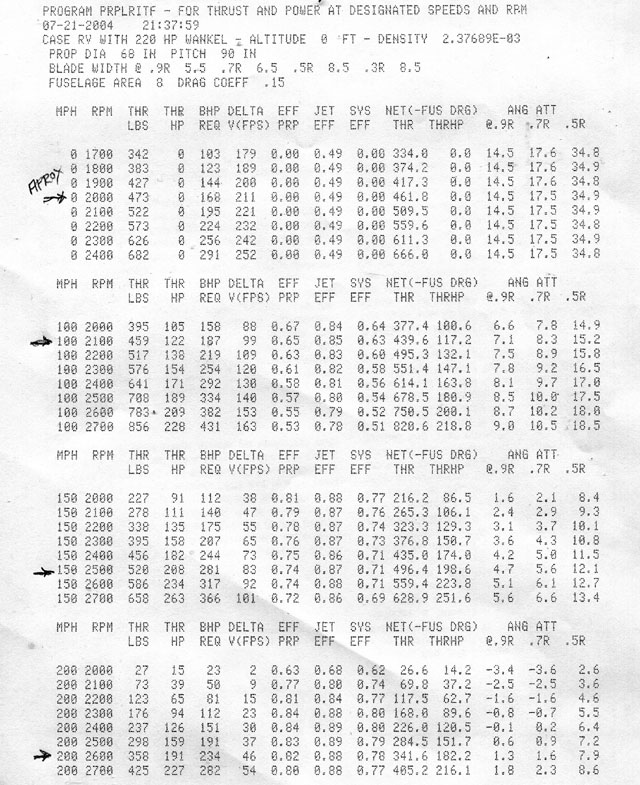
>Bill Eslick has run a bunch of interesting prop tests and
>published the data on his web site.
http://www.weslick.com/
>I reproduced some of it here and added some comments.
>The airplane is running into a brick wall at 165 MPH.
>Increasing the power does not help and just burns more
>fuel. It does not result in an increase of airspeed.
>
>My theory is the prop tips are stalling and running
>into the high drag transonic region at the same time.
>
>Quoting Bill:
>"I used a Props, Inc. 67 x 68 wood prop, a Felix Bi-Cambered
>68 x 72 wood prop, and a Warp Drive three-blade ground adjustable
>carbon-fiber prop."
>
>Quoting Jordonoff:
>"If the propeller were turning in solid material, as is the case with
>a screw in wood, it could act without slipping, and so the distance
>traveled in one revolution would be equal to the theoretical travel
>of the propeller. Inasmuch as the propeller is turning in the air,
>however, there is a certain amount of slip; there fore its actual
>travel distance falls short of its theoretical travel distance."
>
>The ratio of how far it would screw into wood to how far it would
>screw into air is called the Advance Ratio. IMHO these props are
>at the limit of the advance ratio.
>
>The Warp Drive have no twist so the tip drag is higher.
>
>The tip thickness is as follows.
> Felix: 0.235" Props, Inc: 0.420" Warp: 0.272"
>
>I am guessing here. The solution might be more blade area with
>a shorter prop. The Warp drive blades can be modified by
>cutting off the aft part of the blade at an angle and sanding
>them in such a way as to reduce the tip angle of attack and hence
>the drag. However one would probably have to add another blade.
>I'll do a 3D shortly
>
>What is your theory on what is happening?
> Paul Lamar
The Warp Drive prop has very little twist - about 13 deg and was designed
and
optimized for ultralights and 100 mph operation. At higher speeds, the
inboard
sections of the prop are actually going into reverse thrust. Look at the
prop
and see if you have any bugs on the forward face of the prop. There should
be none, only on the back of the prop (this is near the hub).
I had the same problem with my 125 hp Soob EA81 powered Europa and
after doing the research went to a Catto custom fixed pitch. WOT speed
instantly jumped from 150 to 175 mph with no other changes. Climb stayed
the same.
The Catto has 40-45 deg twist at the root. This is so at higher speeds, the
hub area is still at a positive angle of attack to the relative wind.
I had no idea what was going on and I emailed Stuart Gort at Powerfin
Props and he was
very helpful with the following:
The Powerfin B-model has only about 2 more degrees of twist than the
Warp. The twist is important on your application because as you approach the
fast part of the flight envelope, the inboard sections of the prop begin to
go into beta mode. This means the air is being accelerated over the lower
camber faster than over the upper camber, essentially making reverse thrust
(or at least making enough drag to be the main factor in achieving
equilibrium - no more acceleration). Our prop, because of the 2 more degrees
might have some positive effect but I wouldn't bet the farm on it. Chances
are that any improvement would be negligible. For airplanes in the 135 mph
range, a proper design might have about 40 - 50 degrees of twist from the
tip to the most inboard definable sections. A Warp, at 64" has about 13
degrees. So, the lack of twist on the Warp and the resulting drag on the
inboard stations is certainly slowing you down but there is no off the shelf
design out there yet that can well accommodate your plane.
Stuart Gort
Powerfin Props
GLENN CROWDER
The thing that stumps me is this: As the engine turns faster, it should
put out more power, yet when I de-pitch the Warp prop (3-blade), it
still hits the same airspeed wall at a higher RPM. Granted, the Warp
prop has problems at higher airspeeds, but the Felix and the Props Inc.
wood props have the same high twist that other RV's and yield results
similar to the Warp. I have pretty much resigned myself to the fact
that I am power-limited. One of my future projects would be to build up
a 3rd-gen or Renesis core and use the 2.85 redrive with a larger prop.
Seems to work fine for others, including my neighbor, Jason Hutchison,
with his new rotary 6-A. He is significantly faster, and he has a nose
anchor! (I mean, wheel.)
Bill Eslick
I think that is normal for an un twisted blade. At some radius
of the blade the pitch is right and at all other radii it is
wrong. When you change the pitch by a small amount the radius that
was right before now becomes wrong and some other radii becomes right.
The power consumption is changed some what. However with both
situations the tips are becoming high drag transonic. Less so for
the lower pitch.
Paul Lamar ...No rotor no motor.
RPM = 2700 MPH = 200 Lift Coef. = .5 Drag Coef. = .01
Air density = .0026
Radius Tang Vel Angle Cord Vel Cord Seg Area Seg Thrust Seg Torq
Inch MPH Degree MPH Inch Sq. feet Pound Pound
3.00 48.2 76.5 206 7.20 0.15 8.5 0.04
6.00 96.3 64.3 222 6.60 0.14 9.8 0.09
9.00 144.5 54.1 247 6.00 0.13 12.2 0.15
12.00 192.7 46.1 278 5.40 0.11 15.7 0.23
15.00 240.9 39.7 313 4.80 0.10 19.9 0.32
18.00 289.0 34.7 351 4.20 0.09 24.7 0.42
21.00 337.2 30.7 392 3.60 0.08 29.4 0.52
24.00 385.4 27.4 434 3.00 0.06 33.3 0.61
27.00 433.5 24.8 477 2.40 0.05 35.4 0.67
30.00 481.7 22.5 522 2.40 0.05 46.1 0.88
33.00 529.9 20.7 566 1.80 0.04 44.3 0.86
36.00 578.0 19.1 612 1.20 0.03 37.2 0.73
Total Thrust Lb = 316 Thrust HP = 169 AvgCord Ft = 0.34
Induced Drag Lb = 4.24 Torque Due to Seg. Drag Lb = 5.52
Total Torque Ft/Lb = 18.3 Calculated HP = 9.4
The Rotary Engine NewsLetter. Powered by Linux.
ACRE NL web site.
http://www.rotaryeng.net
Copyright 1998-2006 All world wide rights reserved.