Hi Paul;
Here are a few pages of another Mazda tech paper on Pports.
I can scan the rest or shrink it further.
Cheers
Cary
GREAT paper find Cary. WONDERFUL!!! THANKS A BUNCH.
Scan a few PAGES at a time with the same rez if you don't mind
as when I use gimp to scale them down the quality seems to improves.
Thanks again Cary this is a breakthrough for us on
P-port research.
--
Paul Lamar ...No rotor no motor.
Cary,
Notice the 80 degree ABDC for the closing inlet ( IC) event ( Fig.10). I
would suggest that's the latest most try to do the IC. Notice the d3 (
Fig.10) 46mm ( 1.8") and that's ( I assume) for racing application, I
believe 42 would be plenty and keep the inlet velocity high - Fig 13
supports my theory. As well the 450mm ( 18") inlet pipe length
corresponds
to conventional wisdom.
I notice 42mm x 450mm is ideal for our RPM range ( much better than
bigger
inlets) and if one could guesstimate ( extrapolate) before 7,000 RPM, it
would be best of all, for 6,000 RPM!
I will have to look at Fig.11 more closely
Is that 1m ( before the muffler) ( Fig 12), if so I will have to
rethink my
exhaust - not a lot of room to play with here. It will have to shorter or
longer than 1M - I assume that's what it's saying.
If I find anything interesting I will let you know - but for the most
part
it's telling me ( confirming ) what I already feel is right.
George
It would be a big mistake to read too much into this paper.
If you feel this is right you would be wrong :)
Feelings and looks have no place in engineering.
Physics is physics.
The primary purpose of this paper was and is to develop a
mathematical tool for predicting the performance of any intake
system. It is not what they choose to race at Lemans.
We copied the Lemans configuration and verified the HP on the
dyno. Modify at your own risk.
> Paul
Hi George;
It would have been nice if the graphs had continued to lower rpms...
I came to the same conclusion regarding the intake port open/close
angles days ago based on the previous tech papers and the calculations
for flow reversion due to compression - a reasonable upper limit is
probably around 75-80 ABDC (a little before the oil injection hole)
The exact IO/IC timing still does not appear to be critical unless you
want the very last pony.
I'm using the Lemans tech paper for lengths. My calculations for acoustic
tuning were within about an inch of the published Lemans variable
induction lengths.
I'm not adding any more restrictions.
I'm following Paul's/Lemans dyno results - do you remember how Paul's
dyno run flattened?
The 841017 tech paper had another comparison of exhaust lengths, Paul
posts it periodically.
There are lots of dynamic exhaust effects. Looks like 1.0m is bad, 0.5m
is good, probably related to mass air flow.
Paul, did you take note of any of the exhaust section lengths used to
dyno the engine?
Primary lengths?
Were they a Y joint to help scavenge?
Thanks
Cary
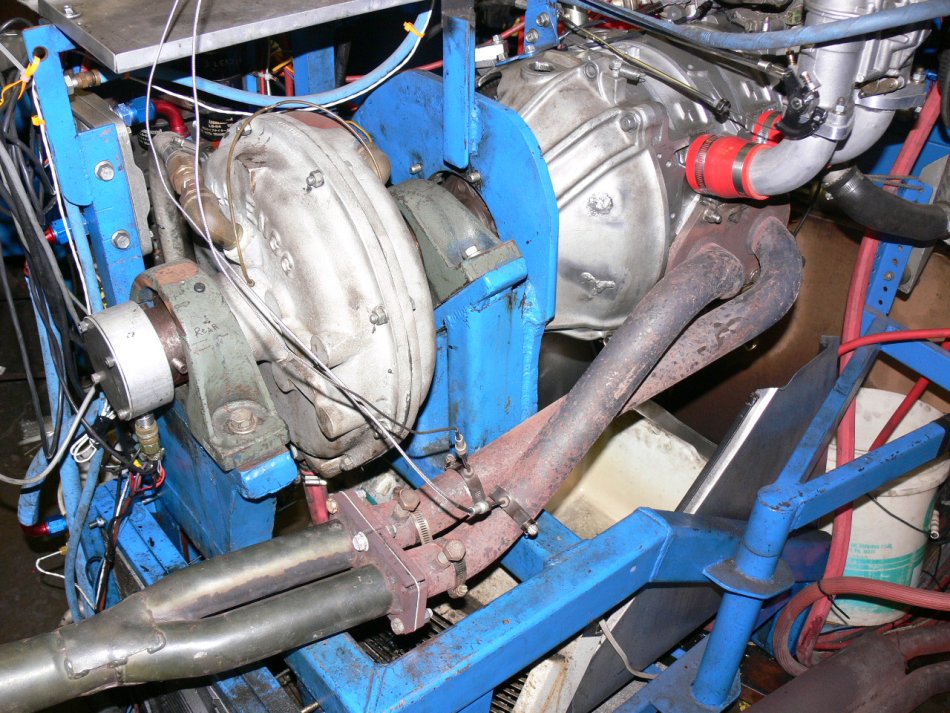
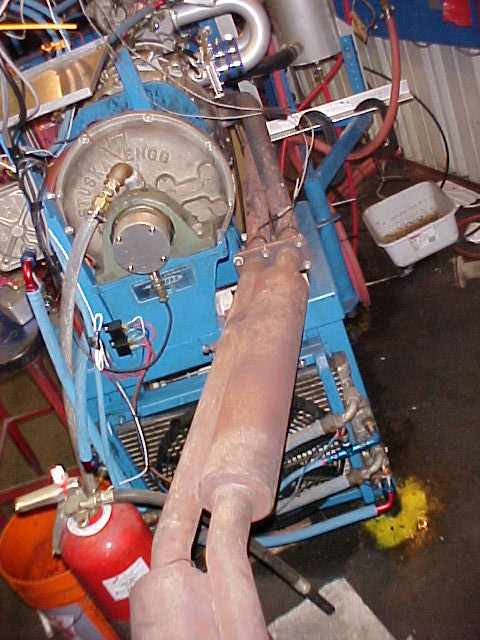
Yes on the Y joint.
We were forced to use an elaborate exhaust system for noise reasons.
Here are some pictures. The one meter length has been used by
racing beat for many years. I am surprised the p-port generated as
much power as it did with all those mufflers on there.
--
Paul Lamar ...No rotor no motor.
The Rotary Engine NewsLetter. Powered by Linux.
ACRE NL web site.
http://www.rotaryeng.net
Copyright 1998-2006 All world wide rights reserved.