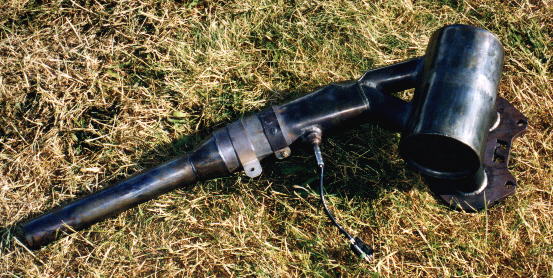
Paul, here are few pictures from my new muffler construction. The
flange has two stubs with slip joints 0.065 SS that are pulled
together with strong springs (not shown). The perforated tube is
welded only on one side to the can. The other side fits into a slip
socket welded to the lid, so it is allowed to float. Sofar works
very well , but I need more time to see how it will hold?
Bulent.
I assume that is 321 SS. Nice workmanship.
I hate to be the bearer of bad news but the perforated tube
will run white hot, melt and eventually puke it self out of the
can and out the through the prop. Tom Jordon had something like that
on a Limo EZ. One could stand behind the prop with the engine
at full chat and look down the exhaust pipe. It was like
looking at a very bright light bulb in there :)
Try to get some sort of air cooling tube down the center.
I'll send some 3D's shortly.
Also put some sort of safety strap on the whole muffler
so if worse comes to worse the whole muffler won't go through
the prop taking out a blade.
Paul Lamar ...No rotor no motor.
-----------------------
I was involved in the Exhaust industry for a number of years
including
designing the odd muffler.
What Paul says is true, however the one thing not mentioned is
just how
bad this style of design is
it will allow exhaust gas flow that's about it, this is what is
nicknamed a "back pressure" it is
unbelievably bad in gas flow which = HP which means increased fuel
consumption by quite a bit,
My suggestion is do not use this style design at all. It is one of
the
worst designs there is.
It will shut things up but , it will run a lot hotter, create
excessive
back pressure, increase fuel
consumption & reduce horsepower just to name a few things all of
which
you really do not want!
Sorry. I just had to stress this.
Try another style. While not the best option it will work somewhat
better if you use the can with out the tube
in the middle try to improve the tube curve into it, and use the pipe
out it bigger the better within limits in the
same place, while not the most efficient it is better than with the
perforated tube in the middle it will also last a while
and yes use at least 2 or more support straps to stabilise it and to
ensure if it breaks it stays right there you
will hear it if it breaks.
Regards David
You must use extreme caution testing experimental mufflers on pushers.
I don't remember the details now but I think Joe Hull had a problem
with
the muffler on his Cozy. If he's on this list maybe he can refresh our
collective memory.
Is there some way to capture all the parts that might shed and go
through the pusher prop? That must be part of the design.
I just use the stock 2nd gen cast iron manifold, bulletproof, not that
loud, not that much excess weight, no problems in 650+ hours of flying
over the last 7+ years.
Perry
Joe caught it before it broke off completely.
Needed some support links for the weight of the can back and
up to the engine block. Perry uses the one on the left in
the second pic.
Paul Lamar ...No rotor no motor.
"> Exhaust - I was on my way to OSH and about an hour east of
Cheyenne,
> Wyoming, over Nebraska when I felt a slight change in the
vibration of the
> airplane. All the temps, pressures and RPM were fine - just a
slight
> change
> in the vibration. So I figured I better get on the ground and see
what was
> up. I landed at a little ranching town (population 267) with a
4000ft
> runway
> (since I need lots of runway to land) and after landing and
running up the
> engine - the engine quit DEAD. The paint on the cowling started
to bubble
> and burn - not good. I pulled the cowling and found that the big
tube of
> the tangential muffler had broken off both of the 2" runners that
come off
> the exhaust flange. The hot exhaust had melted the wires
together to the
> injectors and other wires in that area - that's why the engine
quit."
Paul,
I see few mistakes just from the photo. Hope I don't discover some
more on my muffler installation :)
Use of light gauge inconell. The resonant vibrations sooner or later
breaks it apart. It happened to me with my straight pipes. They were
0.035 wall and all the welds broke apart from vibration. Use 0.065 or
even like ED uses 0.10 wall tubes.
The whole system is welded as one piece. No room anywhere for
expansion. I hope i avoided this by having 3 slip joints on the most
suspect areas?
Aluminum plate as heat shield. On both my systems I use 0.016 321SS
with forced air in between by the augmentor. It works good for now.
When my first pipes fell apart on my first cross country over
alligator country, the stainless shield kept my (white paint on the
inside) cowling spotless.
That all I can see from the photo. Hope we all learn something from
Joe's and my mistakes.
Bulent
I think the Inconel was welded wrong. Perhaps the wrong rod
was used or something. Lots of turbine stuff is welded from .035 Inconel.
Dave Atkins has been flying this Inconel muffler for at least
seven years. It is .035. He shows at OSH every year having
flown in from Seattle.
Paul Lamar
The Rotary Engine NewsLetter. Powered by Linux.
ACRE NL web site.
http://www.rotaryeng.net
Copyright 1998-2006 All world wide rights reserved.