>> Gentlemen,
>> I agree I did not follow exactly what you are
trying
>> to do.
>> Sorry if I said something silly.
>>
>> All I was saying is that 500 ftlbs of torque
require
>> a larger than 1"
>> solid shaft,
>> even if made out of higher grade shafting
material.
>> The G-Modula, or
>> springiness
>> of the various steels does not change with their
>> ultimate strength,
>> although their load capacity does.
>> But often vibrations lead to breaks, not the
torque
>> load.
>>
>> If the torque is not smooth then an additional
load
>> factor must be used,
>> depending
>> on the torque fluctuations of the source. With a
six
>> rotor unit the
>> fluctuations are not
>> as high as from a two rotor. But still, 20 or 30
%
>> should be added to
>> the torque.
>>
>> Rolf
>
> Kenneth
> I checked with an ME friend about your comment
that
> the journals and lobes would add strength to the
> splined shaft. He said they would contribute
little
> and the majority of the torque introduced into the
> shaft by the lobes would be carried by the shaft.
With
> the stress formula provided by Rolf and your 1.182
> dia, the safe max torque would be 213#'. Is this
about
> right, Rolf?
> regards, Robert
>
Robert,
Yes your number is correct. (I get 216 ftlbs using
PI/16 instead of 0.196.)
If the shaft is splined with a DP 24, the depth I
find is .098 ".
Subtracting that from 1.182 we get 1.0836" as root
diameter.
The maximum torque is then near 167 ftlbs.
Applying a factor of say 1.25, the torque applied
should only be near
133 ftlbs.
Regards, Rolf
I am reposting my last msg from a couple days ago; it
seems to have been lost.
Rolf, Bill and Kenneth
Thought I would give one more try on this subject. If
it is possible to operate lobes and journals with a
thin wall of .06" min, then the min dia of the spline
approaches 1.47" [1.69-2(.06)-.098] which meets Rolfs
stress criteria at 415#', without the torque ripple
factor. My question is simple; is this wall too thin?
Kenneth
Have you addressed the rather large tapped holes
required for the oil squirt jets? Seems they would
take away a lot of the shaft cross section area.
regards, Robert
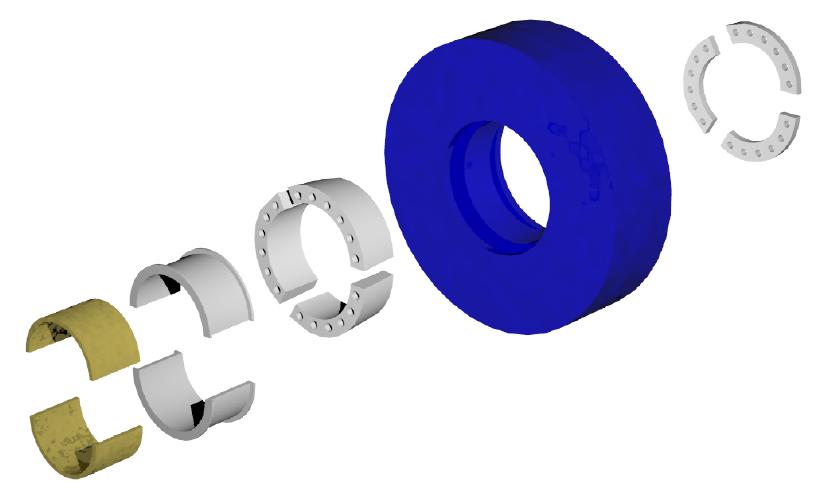
Robert the tapped holes would be in the bearing sleeve that can be modified
as you wish. the 1/4 inch center hole is to feed oil to the lobes and squirt
jets.they have to be drilled after the parts are in place.
In a previous post I suggested that the minimum diameter be the same as the
front shaft 1.182" I also said the spline teeth should be larger. I find it
quite amusing that someone chooses to redesign it and then find fault with
their changes.
I guess everyone believes the Wankel engine as we know it today is the be
all and end all and cannot be improved by having access to both sides of the
rotor for assembly.
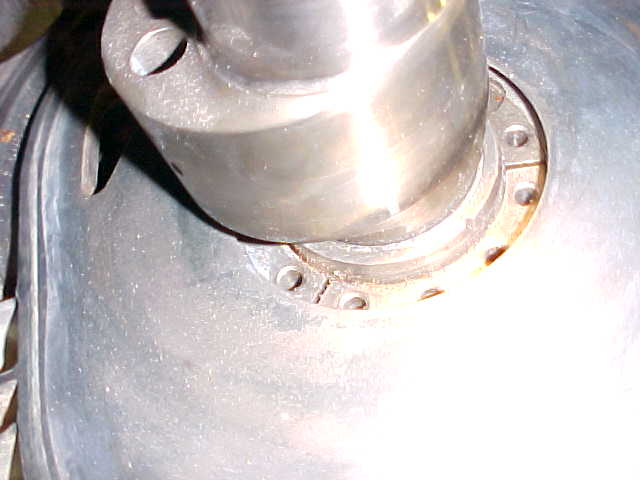
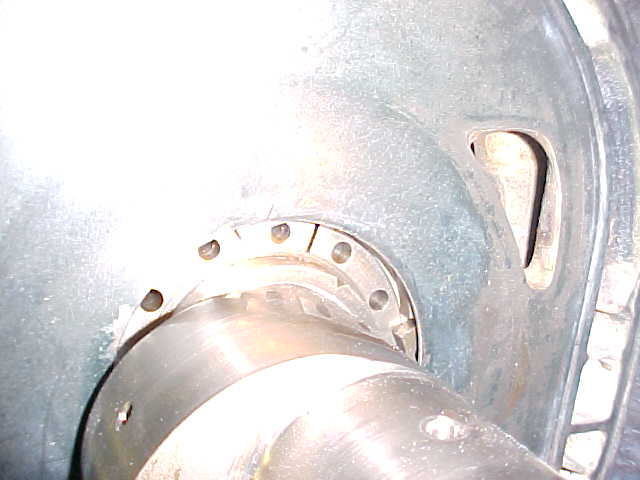
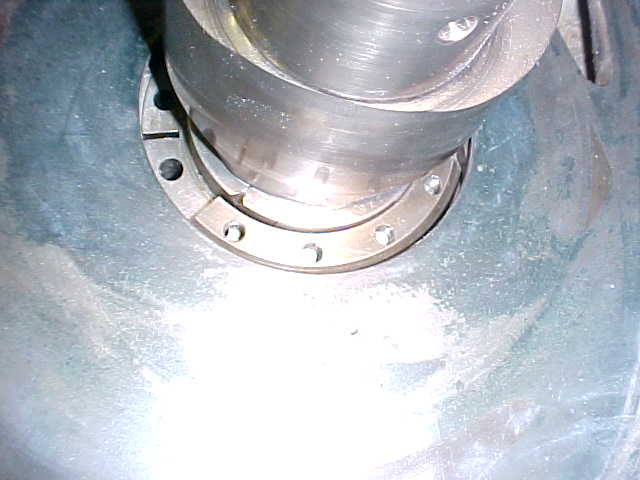
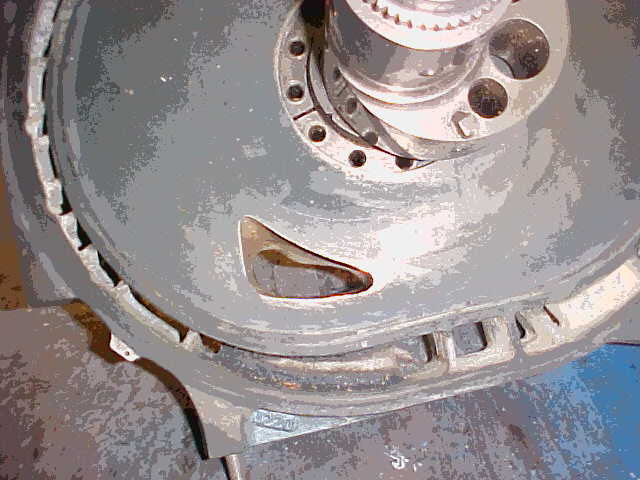
A one piece spline that is supported by sleeves and the intermediate and
end housing bearings has far less deflection than what the Mazda e-shaft now
has.
The ability to place stationary gears on both sides of the rotor will hold
the rotor assembly far truer more secure than the single stationary gear
now used.
Most important is the instructions for making your own e-shaft provide a
clearer understanding of the process and functions.
Kenneth McKenzie
You don't need a splined shaft to have a center main
bearing. Guru Racing sells a two piece 2 rotor shaft that
will accommodate a center main bearing. Curtis Wright did
it with a one piece shaft.
E-Shaft bending is not a problem in a rotary until you get
over 9000 RPM. Not a factor at all for aircraft use as the
engine is limited to 7500 RPM by the prop. We never
have trouble with the one sided phasing gear either.
Improving the rotary for racing is a fruitless exercise.
It effectively is already outlawed or severely handicapped
in car racing. There is absolutely no advantage to
making it run faster. If you want to improve it,
develop aluminum end housing instead of focusing
on a non problem.
Good luck on a splined shaft. It is a mass of stress
concentrations. I am not saying it won't work. You need
to build one and prove that it will. Your best bet is
a one rotor.
--
Paul Lamar ...No rotor no motor.
The Rotary Engine NewsLetter. Powered by Linux.
ACRE NL web site.
http://www.rotaryeng.net
Copyright 1998-2006 All world wide rights reserved.