Paul
Recently I visited your most excellent web site. I??ve always
liked rotary engines. The only shortcoming I can complain about
is the insufficient number of rotors that most are designed with.
Only one production car has featured more than two rotors. That
was the Mazda Cosmo with its three rotor 20B. There are several
here in New Zealand and they are very good cars. That three-rotor
engine sounds really good under load. Thereā??s a company in
Auckland that builds a four-rotor engine. Iā??ve yet to hear it
run but I understand that one sounds as good as the Le Mans cars.
I certainly wish Iā??d heard them on song!
You discuss turbo-compounding for aircraft. Itā??s definitely the
way forward for all the reasons you identified. Iā??ve been
studying it for marine applications (for which it is also well
suited) and also for cars/ trucks. The main trouble with
turbo-compounding in those applications appears to be in the
part-load regime (sometimes misleadingly referred to as ā??part
throttleā?). Efficiency of the system as a whole falls at part
load conditions. The dynamic machines (turbines and compressor)
fall off the most. Additionally, load following and response to
power demand (ā??throttle responseā?- another misleading term)
is not ideal. In those respects the turbo-compound engine is
similar to a straight gas turbine, although not as bad.
The issues of part load efficiency and response are problems
Iā??d like to address. How can they be solved? I thought of
some methods and would be most interested in your opinion and
guidance on this.
The obvious approach would be to have a ā??father and sonā?
turbine set. That is, a large turbine and a smaller one linked
back to the crankshaft or load. The smaller turbine (and related
compressor section) would handle part load situations efficiently
while the large one would be employed for high load. Perhaps
they would both operate at full load, each handling a portion
of the total gas flow. Efficiency should remain high across all
operating regimes. A series of flow control valves could allow
switching between one turbine and another etc.
What Iā??m uncertain about is how to get excellent load following
capability. This is important for high performance boats operating
in a seaway, swell or even a chop (a beam or following sea being
demanding).
Perhaps the way to get fast response would be to have the ā??sonā?
compressor and turbine a little larger than necessary for low loads.
That way there would be an excess of compressed air over that which
was required by the positive displacement machine at the time.
This air could be burnt on requirement to
accelerate the large rotating machine set (compressor and turbine).
I donā??t know how well this would work in practice. Another variant
would be to utilize multiple small turbines and compressors. They
would be bought ā??on-lineā? sequentially.
The difficulty I see, which is hard to overcome, is to accelerate
turbines and compressors quickly. This is a non-trivial problem.
The rpm that these components need to achieve is high. There is
considerable inertia and the time delay in getting from low idle
speed to operating or design point is experienced as an unacceptable
lag.
Elimination of this is necessary for terrestrial application.
Either a greater compressed gas flow rate than necessary for low
load needs to be available at all times (so some of it can be burned
for machine acceleration) or a ā??spinning reserveā? must be provided
(turbine and compressor spinning in partial vacuum, analogously to the
piston engine downstream of a throttle). Or is there another option?
What are your ideas about these issues? How would you go about solving
the response problem and the part load efficiency problem?
I look forward to hearing from you. Your comments are appreciated.
Regards
Gerald Ryan
Auckland, New Zealand
The response problem has been addressed and several cars, Porsche
is one of them, that use variable turbine A/R geometry.
In the past electric and hydraulic motors have been used
to successfully rapidly accelerate the turbo charger RPM and
hence the boost responce.
--
Paul Lamar ...No rotor no motor.
The Rotary Engine NewsLetter. Powered by Linux.
ACRE NL web site.
http://www.rotaryeng.net
Copyright 1998-2006 All world wide rights reserved.
Gerald,
I'm going to jump in with a couple of thoughts.
Turbocompounding is ideally suited to aircraft engines. This is
because airplanes -- especially high performance airplanes -- fly
at altitudes where we can get a lot of power from the recovery turbine.
This is because the power generated by the turbine -- and therefore
the power recovered back to the engine -- is a function of the
pressure delta across the turbine. This pressure delta, in turn, is
a function of the engine's intake manifold pressure and the ambient
pressure. If we are flying at 20,000 feet, the ambient pressure is
less than half of sea level. If we boost our engine to maintain sea
level manifold pressure at altitude, we will have a large pressure
drop across the turbine wheel, which will get that wheel spinning
and make a lot of energy.
This does not happen in terrestrial and marine applications. So the
efficiency you get from a power recovery turbine will never equal
what it will be in the airplane. One way to achieve this on the
ground is to run a lot of boost. If you run 2 bar of manifold
pressure you will have basically the same advantageous pressure
delta as an airplane flying at 15,000 feet.
Another thing to remember is that the rotary is an "ideal gas
generator" for a turbine, as Paul has stated. It has a lot of energy
in its exhaust, perhaps twice as much as a piston engine with valves
-- because a rotary does not have valves. So there is no kinetic and
heat energy is absorbed in the exhaust valve as it is in a piston
engine. All that energy goes straight out the pipe and can be
harnessed by a turbine.
So there is probably a fair bit of efficiency to be gained even in
terrestrial and marine applications from turbocompounding a rotary.
A piston engine probably would not be worth it, but a rotary just might.
The problem you have articulated about maximizing efficiency across
the operating range might be addressed with a couple of approaches.
Two turbines as you suggested might work somewhat, but you will lose
efficiency, big time. Two small turbines cannot approach the
efficiency of one big turbine.
There are other approaches that seem, more promising. Paul mentioned
the variable geometry turbine, which is in effect a turbine that
decreases its A/R ratio at low rpm in order to spin up and make power.
Porsche is using them as Paul mentioned, but another, perhaps more
readily available source is GM and Ford diesel pickup engines, which
have been using these for a few years. The turbines are made by
Garrett. Do a search on Duramax and PowerStroke...
These really do work to get the turbo spinning at low rpm. However,
my question would be, do you really need to have the turbine making
power at all rpms? I would think the main concern would be having
boost at low rpms. Engine responsiveness is a function of having
good boost at low rpm.
Remember, you don't need to have the turbine coupled to a
compressor. If you have a separate supercharger, you can control
engine boost so you have power at any rpm. For making lots of boost
and power at low rpm, I like the positive displacement superchargers
like the Eaton or better yet, the twin-screw. These make great boost
at low rpm. Unlike a centrifugal compressor, they are a positive
displacement pump, so it is like adding cubic inches. At 2 bar
manifold pressure, you have an engine that is basically twice the
displacment, right from idle to maximum rpm. NO lag of any sort...
If you have to use a centrifugal supercharger, you could get better
boost at low rpm by using a variable gear ratio, such as a CVT
(cintinuously variable transmission).
The CVT is also something to think about for connecting the turbine
back to the engine too. If you can have a lower reduction gear
(higher numerically) at low engine rpm, your turbine can spin faster
and make more power. Combined with the VGT turbine, such a system
could make good power across a wide band.
Doug Fir is exploring the possibility of using a scooter-type belt
CVT and VGT turbine for his turbocompound Seawind engine.
Snowmobiles also use belt CVTs and can handle a lot more power than
scooters if you have a big engine and a big recovery turbine.
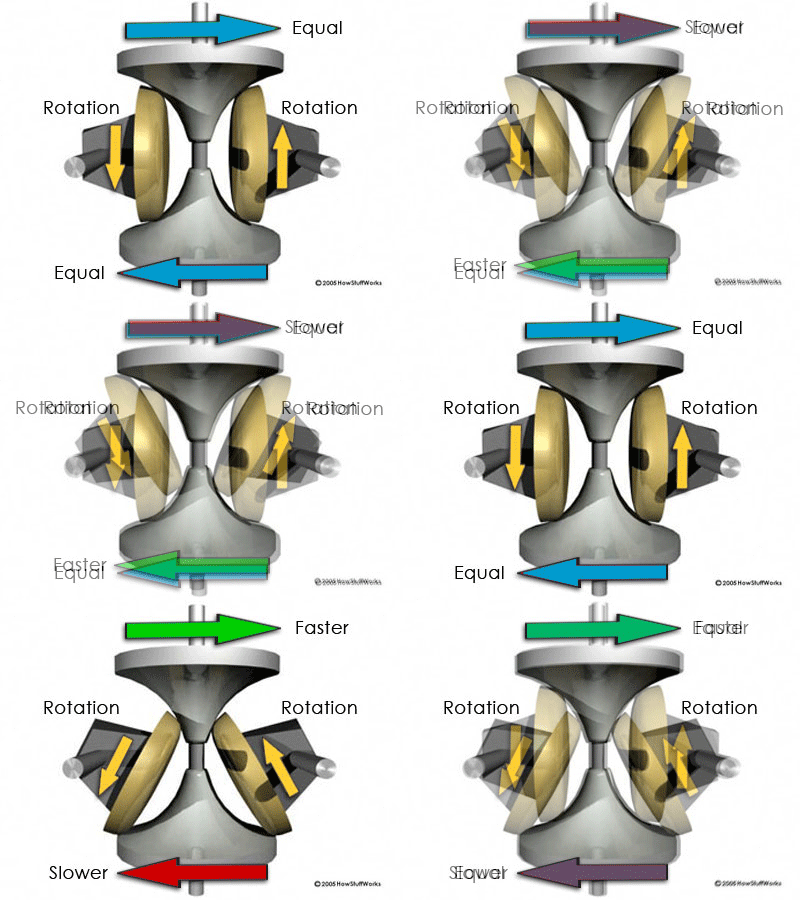
There are some interesting new CVT options now that the automakeers
have jumped on the CVT bandwagon. Toroidal CVTs can handle more
power than belts and have some packaging advantages in that the unit
could be mounted axially between the engine and the turbine, for a
very neat cylindrical form factor.
Overall I would try to tune the system so the recovery turbine works
at cruise rpm and maximizes efficiency in that regime. Even in a car
or a boat, you spend most of your time in cruise. I'm not sure it
makes sense to chase after maximimum efficiency throught the range
-- I don't think you spend a lot of time operating in accelration,
for example.
As long as you have the boost you need at lower rpm, there will be a
good pressure drop across the turbine, so it will give back some
power that would otherwise be lost. If you add the variable turbine
geometry and the CVT you will only widen the band in which the
turbine is making power. And it's the boost that gives the engine
its respoinsiveness -- the recovery turbine is just gravy...
Regards,
Gordon Arnaut.
The Rotary Engine NewsLetter. Powered by Linux.
ACRE NL web site.
http://www.rotaryeng.net
Copyright 1998-2006 All world wide rights reserved.