Paul
Recently I visited your most excellent web site. I??ve always
liked rotary engines. The only shortcoming I can complain about
is the insufficient number of rotors that most are designed with.
Only one production car has featured more than two rotors. That
was the Mazda Cosmo with its three rotor 20B. There are several
here in New Zealand and they are very good cars. That three-rotor
engine sounds really good under load. Thereā??s a company in
Auckland that builds a four-rotor engine. Iā??ve yet to hear it
run but I understand that one sounds as good as the Le Mans cars.
I certainly wish Iā??d heard them on song!
You discuss turbo-compounding for aircraft. Itā??s definitely the
way forward for all the reasons you identified. Iā??ve been
studying it for marine applications (for which it is also well
suited) and also for cars/ trucks. The main trouble with
turbo-compounding in those applications appears to be in the
part-load regime (sometimes misleadingly referred to as ā??part
throttleā?). Efficiency of the system as a whole falls at part
load conditions. The dynamic machines (turbines and compressor)
fall off the most. Additionally, load following and response to
power demand (ā??throttle responseā?- another misleading term)
is not ideal. In those respects the turbo-compound engine is
similar to a straight gas turbine, although not as bad.
The issues of part load efficiency and response are problems
Iā??d like to address. How can they be solved? I thought of
some methods and would be most interested in your opinion and
guidance on this.
The obvious approach would be to have a ā??father and sonā?
turbine set. That is, a large turbine and a smaller one linked
back to the crankshaft or load. The smaller turbine (and related
compressor section) would handle part load situations efficiently
while the large one would be employed for high load. Perhaps
they would both operate at full load, each handling a portion
of the total gas flow. Efficiency should remain high across all
operating regimes. A series of flow control valves could allow
switching between one turbine and another etc.
What Iā??m uncertain about is how to get excellent load following
capability. This is important for high performance boats operating
in a seaway, swell or even a chop (a beam or following sea being demanding).
Perhaps the way to get fast response would be to have the ā??sonā?
compressor and turbine a little larger than necessary for low loads.
That way there would be an excess of compressed air over that which
was required by the positive displacement machine at the time.
This air could be burnt on requirement to
accelerate the large rotating machine set (compressor and turbine).
I donā??t know how well this would work in practice. Another variant
would be to utilize multiple small turbines and compressors. They
would be bought ā??on-lineā? sequentially.
The difficulty I see, which is hard to overcome, is to accelerate
turbines and compressors quickly. This is a non-trivial problem.
The rpm that these components need to achieve is high. There is
considerable inertia and the time delay in getting from low idle
speed to operating or design point is experienced as an unacceptable lag.
Elimination of this is necessary for terrestrial application.
Either a greater compressed gas flow rate than necessary for low
load needs to be available at all times (so some of it can be burned
for machine acceleration) or a ā??spinning reserveā? must be provided
(turbine and compressor spinning in partial vacuum, analogously to the
piston engine downstream of a throttle). Or is there another option?
What are your ideas about these issues? How would you go about solving
the response problem and the part load efficiency problem?
I look forward to hearing from you. Your comments are appreciated.
Regards
Gerald Ryan
Auckland, New Zealand
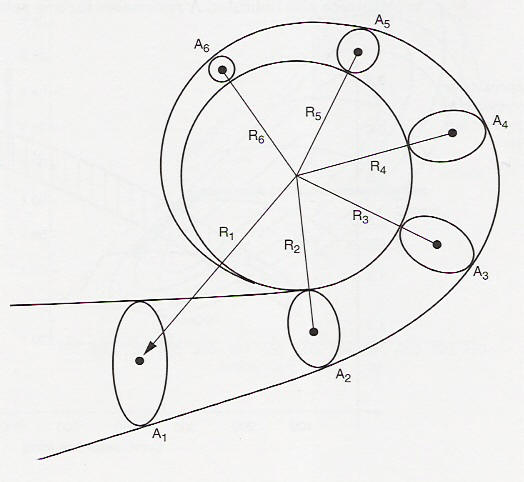
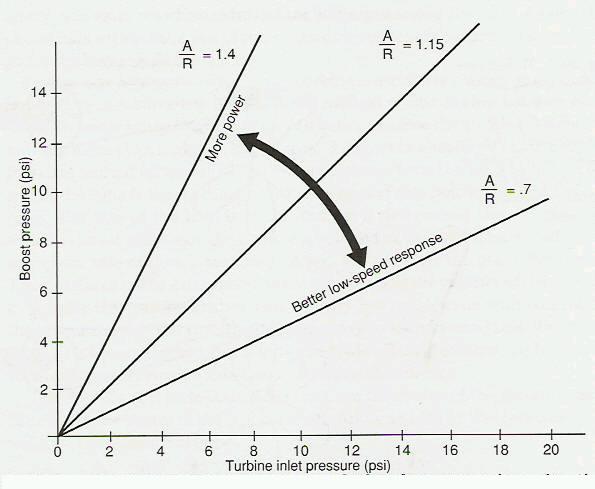
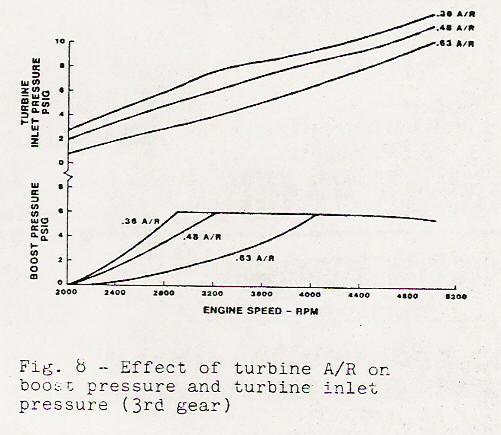
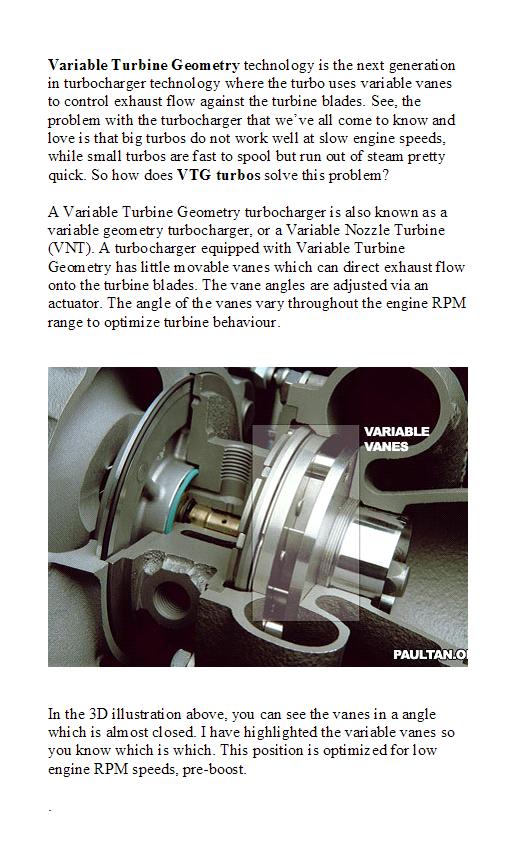
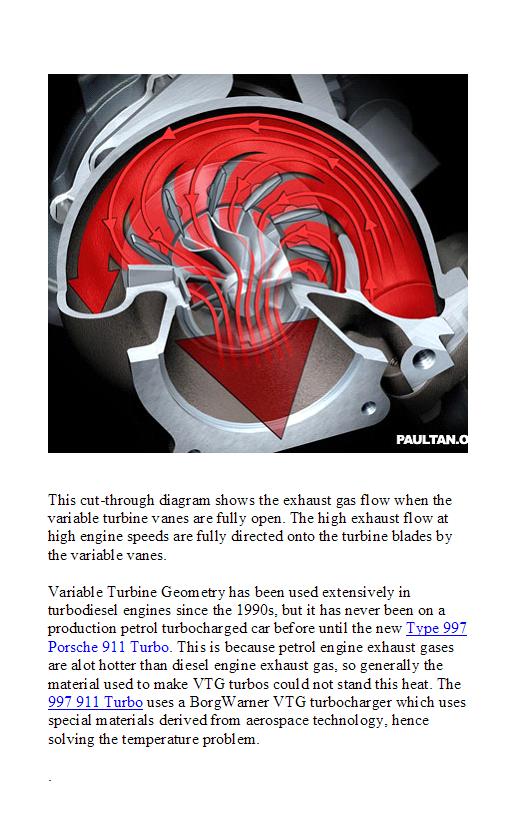
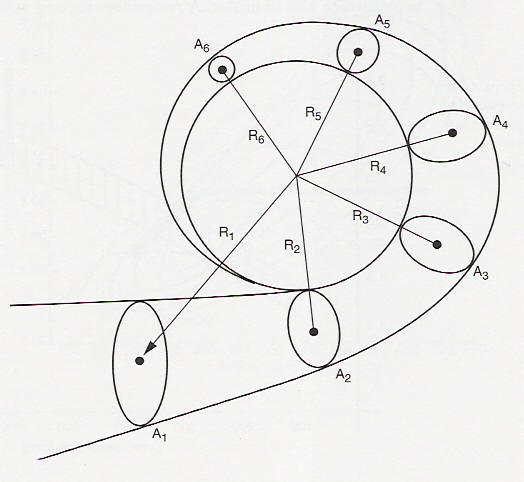
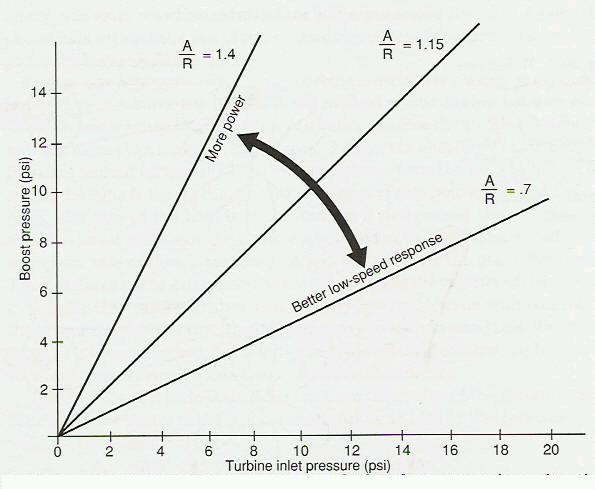
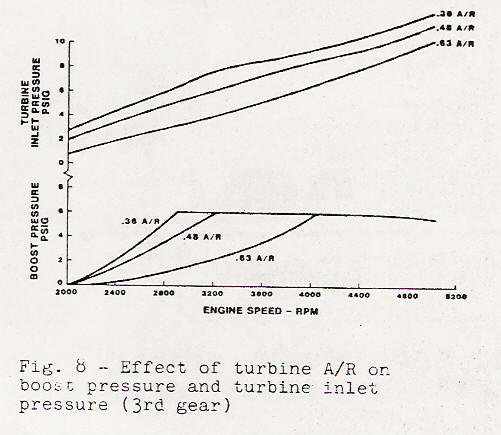
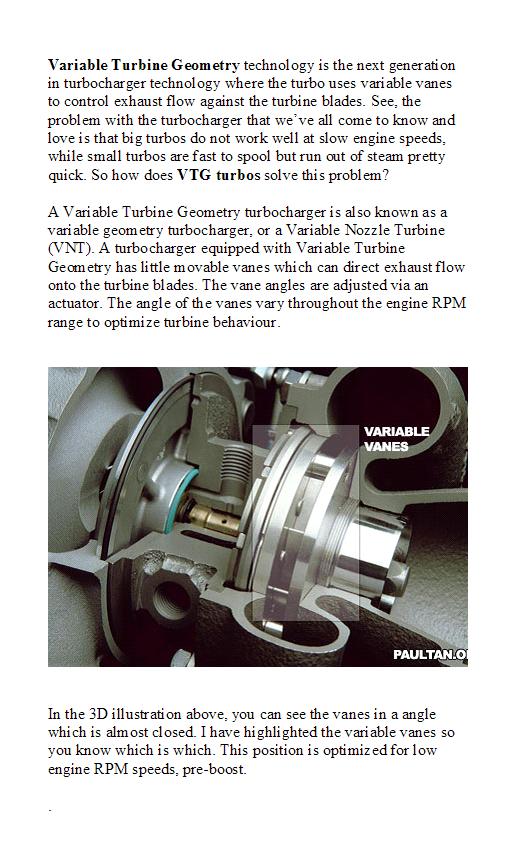
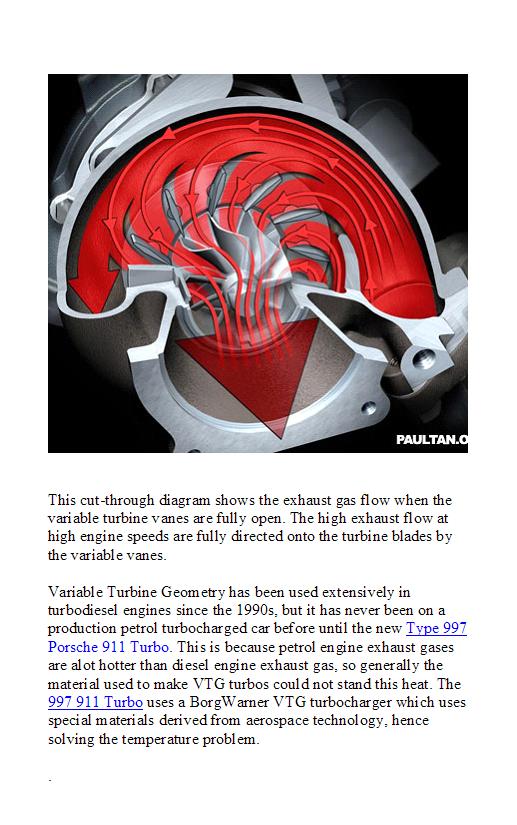
The response problem has been addressed and several cars, Porsche
is one of them, that use variable turbine A/R geometry.
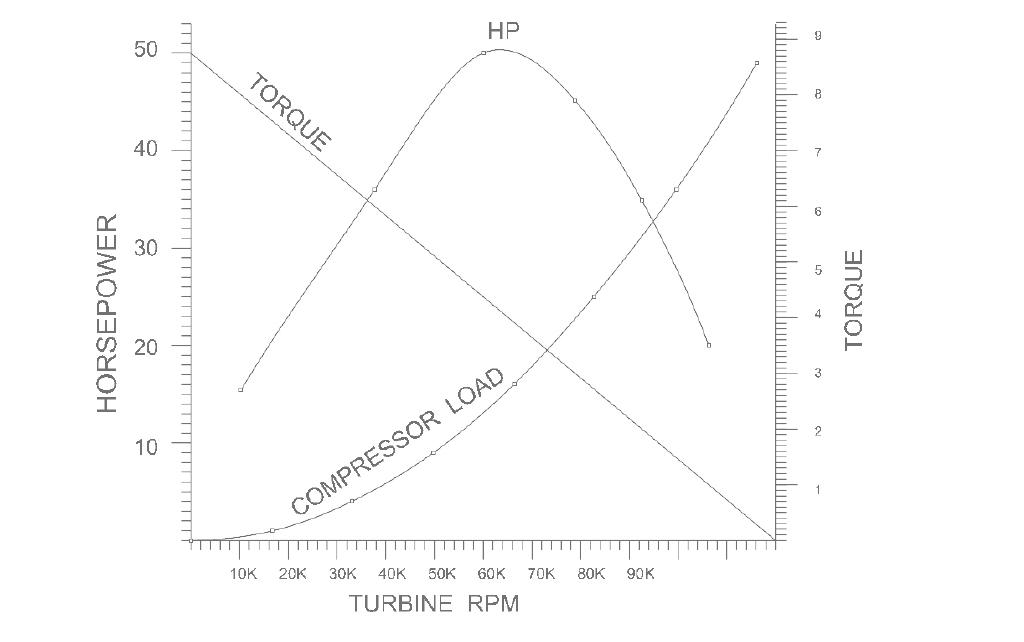
In the past electric and hydraulic motors have been used
to successfully rapidly accelerate the turbo charger RPM and
hence the boost responce.
--
Paul Lamar ...No rotor no motor.
The Rotary Engine NewsLetter. Powered by Linux.
ACRE NL web site.
http://www.rotaryeng.net
Copyright 1998-2006 All world wide rights reserved.