>
> > Paul: You, any one else, ever look at RB's aluminum end and
center
> housings
> > and wonder how much trouble to machine out of solid aluminum
billets
> for
> > PPort engines? After all, they won't need intake ports in them.
> > jofarr, soddy tn
> >
> > Can't be done because they are hollow. Now if somebody invented
> > a tiny robot milling machine that you could put down a small
hole
> > and have it mine out cavities in the material that would work.
> >
> > No intake ports would certainly help.
> >
> > If you made them in two pieces that would also work if you could
> > figure out a way to seal the internal joints. Could be done with
> > some sort of gasket or O-rings and that is exactly what Richard
> > Sohn is working on.
> >
> > Paul Lamar ...No rotor no motor.
> >
> > Paul,
> > Those two pieces could easily be furnace brazed together.
According to
> > Alan Tolle Everett even did a steel 2 piece milled and furnace
brazed.
> > For the "superlite" engine. For aluminum the problem remains the
> coating.
> > I'm convinced that it would be "do able" just expensive. I
think that
> the
> > state of milling equipment probably do a better and faster job
than
> > casting.
> > Bill Jepson
>
> > hi Bill, this is the way my machinist and i have planned to do
it. what
> > would you estimate the cost of casting them? just so i could
compare
> costs.
> >thanks , wyo. walt.
>
> Walt
> The problem is the cost of the pattern making. You could easily
spend 10K
> to 15K setting up the patterns to cast the various parts. That
is before
> making a single casting. Additionally the sad thing is you could
find
> that your
> casting still didn't work due to porosity or core shift. The fact
is
> that billet
> construction would probably be cheaper until at least the 100
unit mark.
> machining from billet you have a reasonable expectation that your
first
> part
> would work. All the aluminum concerns about coating are about the
same.
> Bill Jepson
>
> One possible problem I can see Bill is the compressive strength
> of furnace braze is not as high as the base material.
> The tension bolts put a lot of compressive stress on
> the engine end housings.
>
> Paul Lamar
>
> Paul,
> This is a reasonable concern, but with proper layout shouldn't be a
> problem
> The key is to place the braze material around the piers or in a
center
> reservoir
> so the base material is in near contact. (a super thin film is
wicked to
> the base
> material by heat and usually a flux) The way I've seen this done
is to
> weight
> the two parts together to force out excess. Your separate wear
surface
> idea
> with o-ring seals is another way to do this. (I thought that hot
rivets
> from
> opposite sides could hold the plates in place) Lastly, modern
thermally
> conductive epoxies could be used to fasten interlocking opposite
sides.
> For
> the CNC milled parts that might be the most effective method of
all. the
> parts could be well located and pressed together during cure.
Detgun
> coating
> for least unwanted heat transfer. There are many ways to go after
this, I
> wish I had the money to pursue it. FWIW
>
> Bill Jepson
>
> JB Weld them together might work.
>
> Paul Lamar
>
> Paul,
> If you setup the edges that come together like this, with a small
> clearance
> to allow the epoxy somewhere to go, it would work fine. You
could do the
> brazed part exactly the same way, only the clearances would change.
> Pardon the crude model but the concept is obvious.
> Bill Jepson
>
> That jpg did not work.
>
> Paul Lamar
Paul,
With the differential thermal expansion of the center plate,( two
combustion
chambers and cooling water between), it appears that there could be
tension
in any internal ribs passing from one face to the other. Any joining
method
would have to accommodate this.
Colin Smith
Possibly. Short of an FEA we would not know for sure.
Do you have an FEA available?
Paul Lamar ...No rotor no motor.
Does the aluminum piece have to be done in halves?
Can an iron/steel wear surface used which also bridges the openings in
the housing which allow for the machining to be done?
A one piece housing might be fairly crudely cast. Then put it through a
finish milling process to touch things up where precise tolerances are
required. Mill where the iron wear surface fits plus an o-ring groove
to seal it. Might be cheaper overall than taking huge billets of Al and
milling them out. And you might get away without gluing anything
together.
Matt-
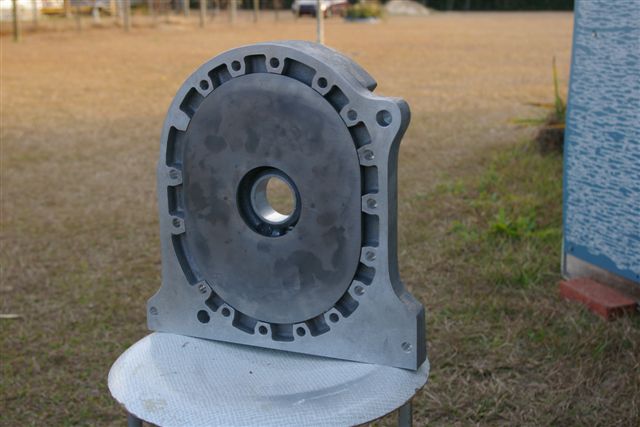
That is what I did. Made my own pattern, got a really cheap casting and
machined precise joining areas. The inner O-ring seals against the running
surface and the outer one against the aluminum section. The only issue is
a delicate tolerancing for the proper pressure on the CI running surface.
The o-ring grooves are in the rotor housing.
Richard Sohn
N2071U
Congratulations Richard. That is real cool looking.
You are close to a major breakthrough in two piece end housings.
Paul Lamar
The Rotary Engine NewsLetter. Powered by Linux.
ACRE NL web site.
http://www.rotaryeng.net
Copyright 1998-2006 All world wide rights reserved.