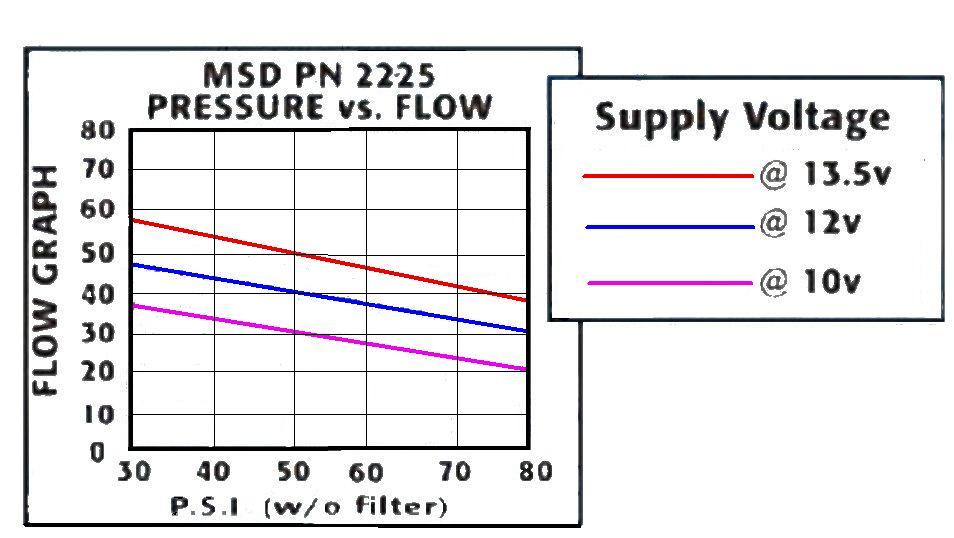
"MSD High Pressure Electric Fuel Pump
Multiport EFI systems require a stable fuel supply to maintain best
performance throughout the engine's rpm range. This high pressure and
high flow Fuel Pump features a roller vane pump mechanism which is
extremely resistant to clogging and jamming. The pump mounts in-line
(out of the fuel tank) with two supplied cushioned clamps for a quick
and sturdy installation. The nipple inlet is 3/8" with a 5/16" outlet.
The wire terminals feature brass studs for secure connections. Made
in the USA, the pump is ideal for use as a "booster" for nitrous
oxide applications, or as a stand alone pump for multiport EFI
systems on engines up to approximately 500 HP. Capable of 43 gph at
40 psi.
Approximate flow is 43 gph (282 lb/hr) gasoline (specific gravity
0.788) @40 psi and 12 volts/5.4 amps. Has 3/8-in. hose nipple Inlet,
5/16-in. hose nipple Outlet. Includes 2 cushioned mounting clamps
and 4 mounting bolts."
This is head and shoulders better than any other pump I have
found so far. Not only is it only $109 but it is made in
the U.S. It is also a true positive displacement pump meaning
that it will draw fuel from a considerable head. That also means
it is a very linear pump with out put directly proportional
to pulse width or voltage.
It is very very efficeint. at 40 psi with a pulse width of
50% (six volts) it will put out 20 gallons an hour which is about
what we need for take off and climb. Current drain should be around
2.7 amps. At cruise or 10 gallons and hour and a 25% pulse width
it should draw half of that or 1.35 amps. That gives you a long
time to find an airport on battery power alone if your alternator
dies.
If your planning a PWM constant dribble fuel system snap one of
these up before they raise the price :) Heck it would be great
for Tracy's system as well.
I am not going to mess with the Walbro/Mazda/Focus peripheral type
pumps. These are much much better for our purposes. No air sucking
problems.
Paul Lamar ...No rotor no motor.
Any idea how it performs @ 2psi?
Doc Custer
Retired Software Engineer and sometime Audiologist
Not yet but I will find out. It should be entirely linear.
I think we ought to run this
at a higher pressure than that by restricting the size of
the holes in the p-port. Something in the range of 15 psi
to 30 psi is my guess. Of course the pressure will increase
with a positive displacement pump as the flow increases.
Perhaps we should label it a variably pressure system.
The bottom line is the amount of fuel flow through a given
size hole as a function of pulse width. That can be stored
in a look up table or calculated if the data fits a simple
mathematical curve. The last option is preferable with these
PIXAXE chips as they don't have a lot of excess memory.
I did a little more cosmetics on the chart.
--
Paul Lamar ...No rotor no motor.
The Rotary Engine NewsLetter. Powered by Linux.
ACRE NL web site.
http://www.rotaryeng.net
Copyright 1998-2006 All world wide rights reserved.