> The stock water-pump pulley arrangement is inappropriate for
constant
> high RPM ,the biggest drawback is the stock water pumps are
designed to
> operate at relatively low speeds, as a result,the standard
impeller WILL
> cavitate-churn coolant rather than push it through the
cooling system
> when spun by stock pulleys at high revs(5, 500and6.000rpm
).The water
> hoses are a clue to whats going on inside the water pump,When the
> impellers starts to cavitate,the hoses jump around due to
turbulence
> caused by cavitation and the resulting aerated coolant,Racing
> beat/mazmart/Mazda offer a number of pulley combinations that
will slow
> water-pump speed sufficiently to avoid cavitation and also slow
down the
> alternator,as the alternator is overdriven by approximately
33%-if the
> engine is turning at 6.000rpm the alternator is spinning at
8.000rpm,
>
> robert pay rotary owner from the 1970s/02/07,
>
> I think that is an urban myth Robert. Not what we found with
> our water pump dyno. No cavitation at up to 7000 RPM as I recall.
> You need a lot of water flow to cool an aircraft engine
> as it runs 150 HP all the time. A car is lucky to see 40 HP
> all the time. Might be true on an 11,000 RPM race car engine.
> It will cavitate if you let the water level in the block get too
> low.
>
> Paul Lamar ...No rotor no motor.
Isn't that cavitation erosion in the two water pump pix?
Doc Custer
Retired Software Engineer and sometime Audiologist
---------------------------------------------------
Yes caused by low water level in the engine.
Note the dividing line is horizontal.
Paul Lamar ...No rotor no motor.
Thanks paul,If some people are in need of a company that can make
eccentric shafts and grind epitrochoidal forms try www.
Polgain.co.uk
<http://Polgain.co.uk>
<http://Polgain.co.uk> used this company when I was replating
NSU/norton rotory housing in the 1990s the man to talk to is adrian
Bond he has worked on rotary engines from RR to NSU/ may not be the
cheapest but they do know what they are doing......
robert pay
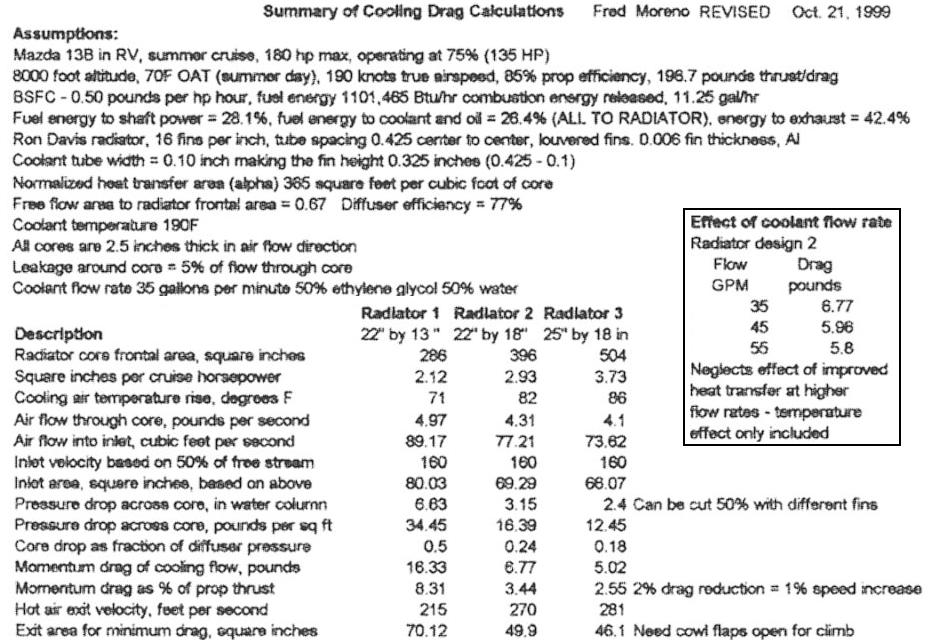
Back in 1999 we had very good engineer on here by the name of
Fred Moreno. He was an expert in aircraft engine liquid cooling
systems. He did a computer study on the effects of the coolant flow
on the liquid cooling drag of an aircraft engine. He found that upping
the coolant flow in the rotary engine from the standard 35 gallons
per hour to 56 gallons per hour reduced the cooling drag by 15%!!!
Over a pound. Thats a lot.
Upping the flow from 35 GPH to 56 GPH would result in only about a 25%
increase in water pump HP from about 3 HP to about 4 HP.
The cooling drag is far far more important than a 1 HP reduction
in net engine HP.
The moral of the story is use the stock diameter hoses and keep them short
and straight. Don't use smaller radiator hoses. I see some people that should know
better using smaller hoses. Don't use an under drive pulley on the water pump. If
anything use a slightly smaller water pump pulley to up the RPM and increase the
water flow.
Fred also found out that a larger frontal area rad with more volume
also reduced the cooling drag. That was the main reason for the
study. Note the fin and tube dimensions. If buying a new rad compare
those dimensions.
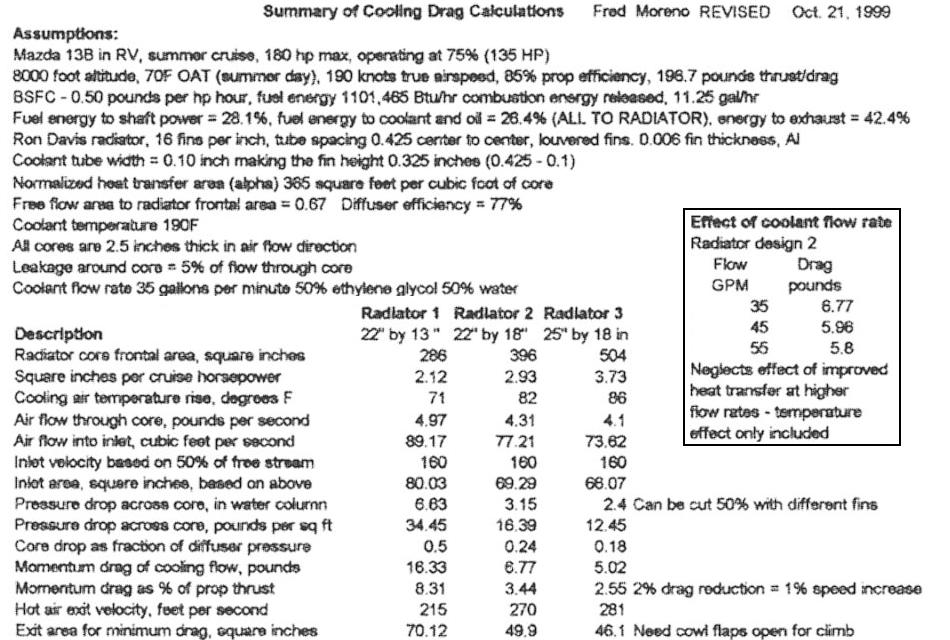
Here is the results of Fred's study.
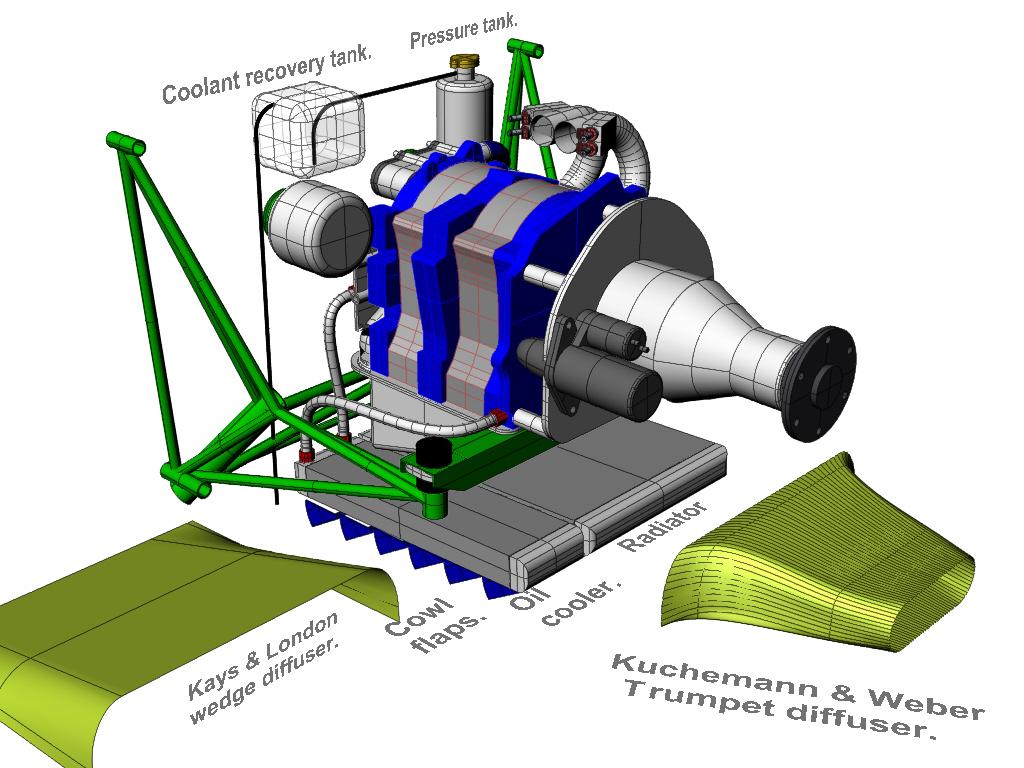
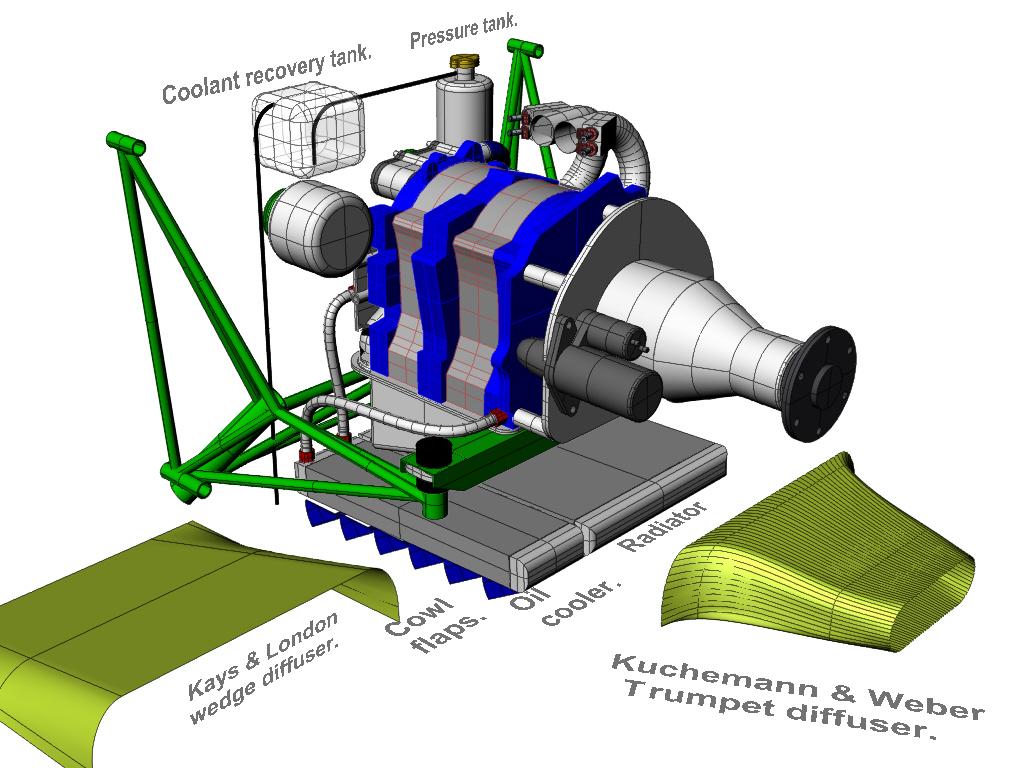
Here too is a 3D of such a cooling system installed in
a Tailwind.
BTW the scoop opening area of Fred's study was 67% of the rad
frontal area. Total rad area was 25" by 18" or 450 square
inches. Fred lumped in the oil cooling requirements along
with the water requirements. So intake scoop area would have
been 300 square inches or 10 inches wide by 3 inches high. It
would require cowl flaps as Fred noted. Are you listening Dave ? :)
If this 3D looks familiar there is a good reason :)
Paul Lamar ...No rotor no motor.
The Rotary Engine NewsLetter. Powered by Linux.
ACRE NL web site.
http://www.rotaryeng.net
Copyright 1998-2006 All world wide rights reserved.