The RX8 intake manifold is still confusing people.
The RX8 six port intake porting was designed to optimize
the torque at 2000 RPM and up. What Mazda needed was
intake runners about 40 to 50 inches long which is impractical
in just about any car. That also means the individual RX8 pipes are
small in diameter as a small diameter pipe keeps the air velocity
high in a low load, low RPM, low air flow situation. High intake
runner velocities are needed at low RPM for good chamber filling
due to inertia effects. At high power air velocities in the intake
manifold can be as high as Mach .4. Mazda alternately
connects these small short pipes together on and off in the RX8 intake
manifold system as functions of RPM and throttle opening to make
them look like 40 to 50 inches long sometimes and 20 inches
long at other times. The RX8 intake manifold is a series of
dynamic chambers.
Mazda uses the dynamic chambers to sometimes effectively
double the length of the pipes to 40 to 50 inches. What that also
means is if any two pipes coming from the same intake port position
(end housings, center housing) on the front and rear rotors are
connected together in theory the pipes only have to be 10 inches
long at 7500 RPM to simulate 20 inch long pipe. Nobody has tried
this yet to my knowledge and it might be worth a try for the RX8
engine. See the 3D's. The three levels required for
the six port RX8 engine would be far more complicated than what
is shown in the 3Ds.
People have tried dynamic chambers in the past without really
understanding or mis-understanding how they work, made them too long
and failed. Tracy's original intake manifold was the first example.
Unfortunately several people followed his lead. One of the people I
have in mind got mad at me when I objected to one of his lectures on
the subject and has hated me ever since. Kill the messenger of bad
tidings syndrome. Humorously he recently "discovered" Kuchemann and
Weber's book Aerodynamics of Propulsion which I have been touting on
here for the last six years or more.
Tracy, to his credit, has now abandoned the dynamic chamber approach
and now uses only four short straight pipes into a large plenum. My
guess is he has somewhere around 190 HP on his four port RX8 engine.
Far from the 240 HP rating of the stock six port RX8 engine. Perhaps
he would get a bit more power if he lengthened those pipes a bit.
If you don't want to convert the RX8 engine to P-port the
best thing to do is make all six pipes the same length at
around 20 to 25 inches. I am not sure exactly as the exact
length changes with different pipe diameters. One would need
a dyno to find out for sure. The problem with that is
pumping (sucking) air through six long small diameter pipes takes a
relatively large amount of HP out of the engine compared
to pumping the same amount of air through two larger
diameter pipes of the same total area.
Bottom line is a p-port RX8 engine, four port or six port, is
almost guaranteed to get 240 HP at 7500 RPM with a best BSFC at
around 5000 to 6000 RPM cruise. The lower pumping losses result
in a better BSFC.
-------------------------------------------------------------
The attached excerpt from this book pretty well sums up the tuned
intake manifold situation qualitatively.
*Advanced engine technology by Heinz Heisler. Published by
the SAE in 1995. ISBN 1 56091 734 2
This is actual data tediously gathered from a test engine
by building a bunch of manifolds and testing them.
Paul Lamar ...No rotor no motor.
Amazing! Who would have guessed that changing the diameter of the pipe would
cause the effect shown in fig. 5.31?
The data in fig 5.32 are what I would have expected.
This means that the p-port tube dia. of 1.875" favors the higher RPM range
as opposed to using a smaller diameter pipe.
I always assumed bigger was better. It seems not necessarily so, although
the 30 mm pipe does show a lower peak than the others. I am not sure, but I
think the 40 mm has the highest peak.
Doc Custer
Retired Software Engineer and sometime Audiologist
As you will shortly see this is piston engine stuff and the ratio
of the intake valve diameter to the bore diameter also affects
the peak position. It does not necessarily work exactly the same
way for the rotary.
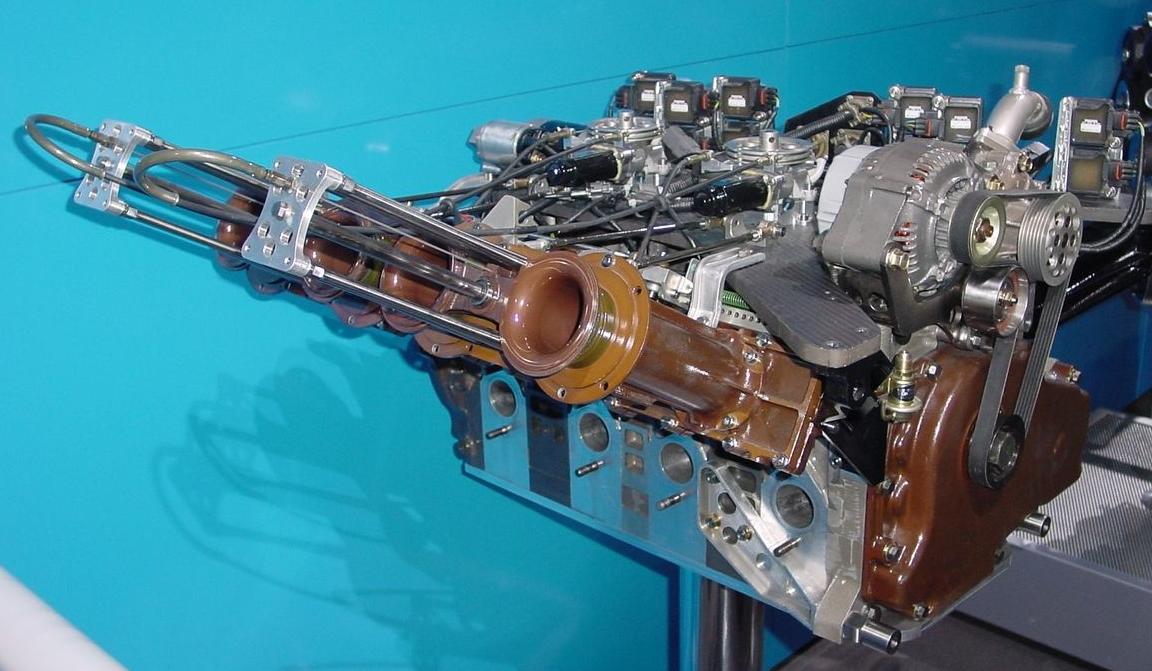
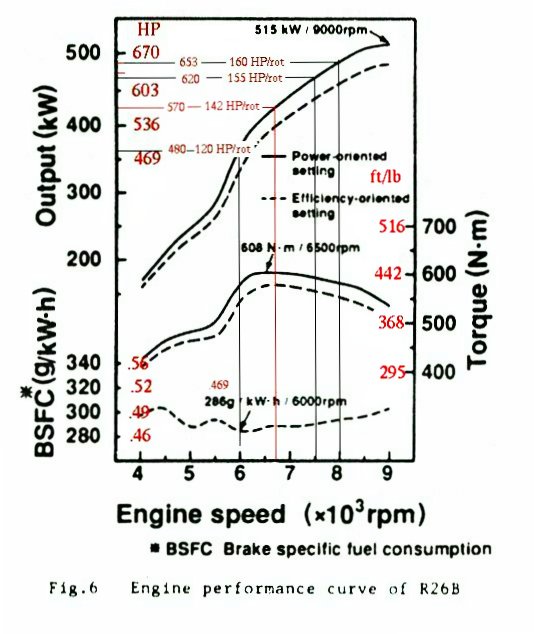
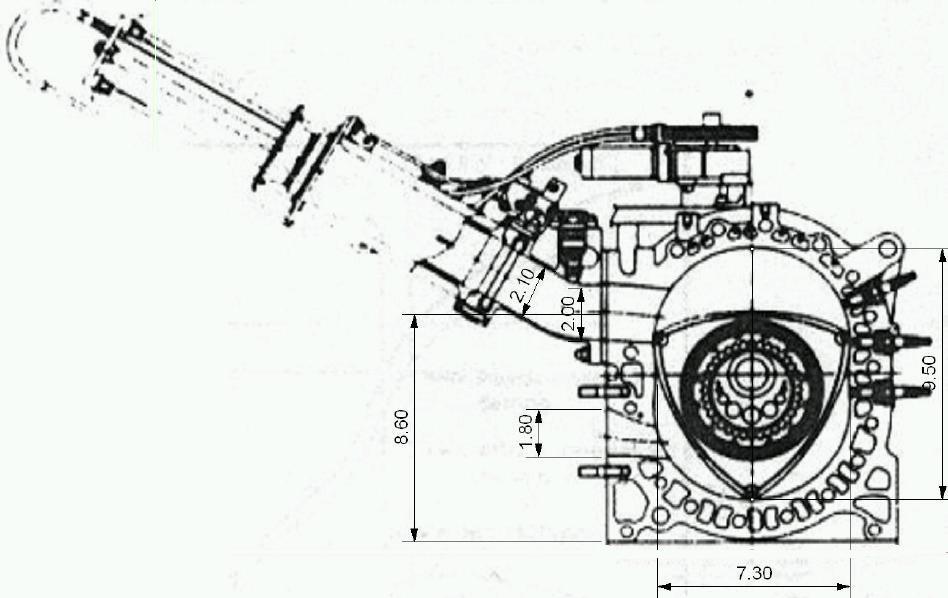
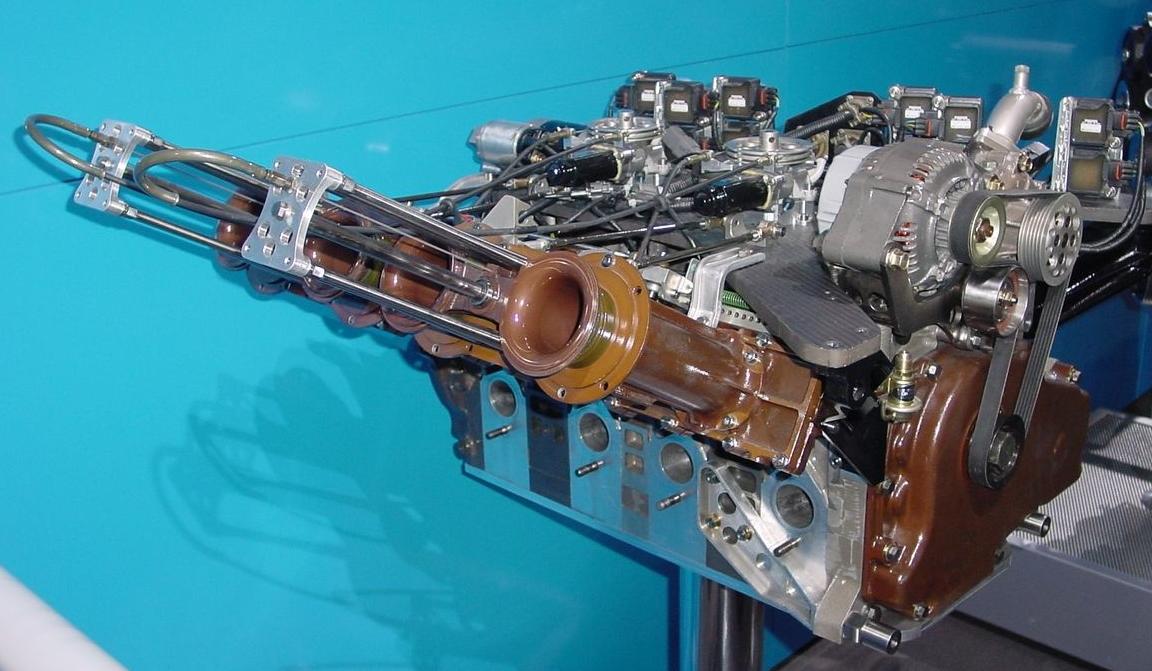
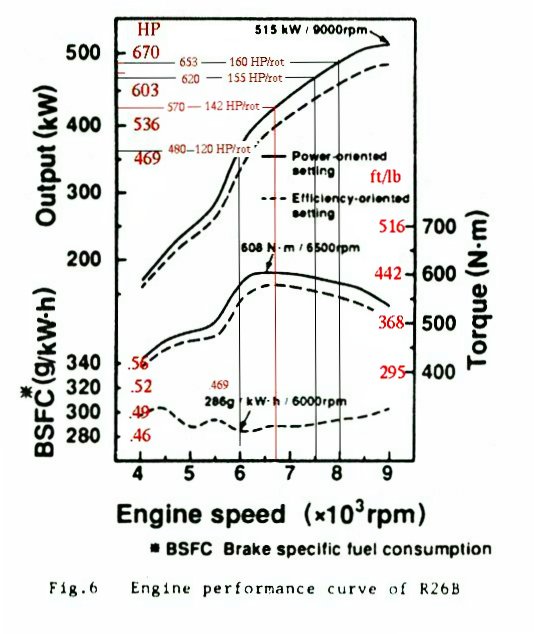
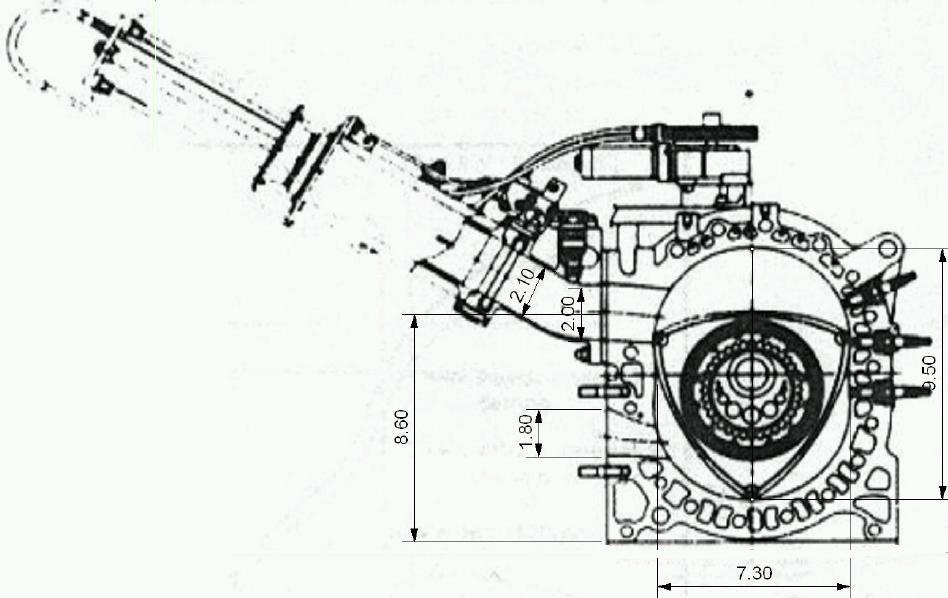
I copied the Mazda Lemans p-port engine which has about
the largest practical diameter of intake pipe possible and Mazda
published dyno data on that engine for a range of pipe lengths
in an SAE paper.
We built a p-port engine based on that design and basically verified
the torque and HP numbers published by Mazda on the dyno at Mazdatrix.
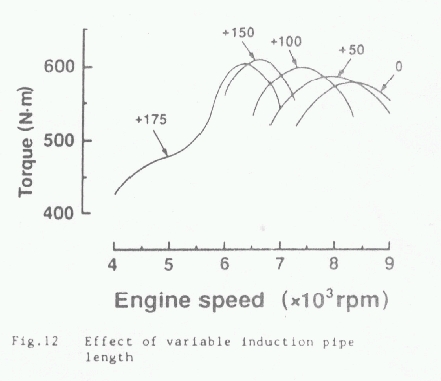
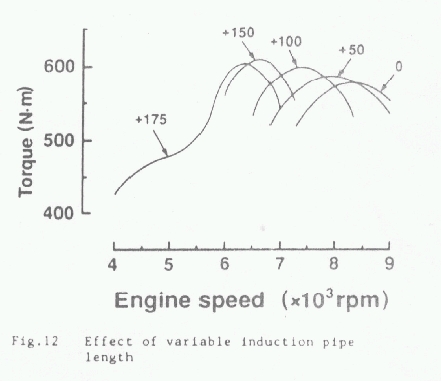
Here is some of the Mazda data. On the torque curves you
need to add 14 mm as these number are from the fixed length
part of the runners.
http://www.rotaryeng.net/intake.html
--
Paul Lamar ...No rotor no motor.
The Rotary Engine NewsLetter. Powered by Linux.
ACRE NL web site.
http://www.rotaryeng.net
Copyright 1998-2006 All world wide rights reserved.