Paul,
The following was copied from the 6/02, issue 72, of a Contact! magazine
article on the Renesis engine.
"DYNAMICALLY BALANCED ROTORS To further refine the superior balance of
the twin-rotor configuration, Mazda shifted from the previous static
balance setting, and instead adopted dynamic balance calculated from the
mass of oil entering the rotors."
"With the previous rotary engine, the direction of rotation of the
fixed gear locating the rotors in the front and rear housing was the
same for both rotors. With RENESIS, the direction is reversed for front
and rear rotors, achieving smoother rotation and reduced gear noise."
My question. Were you aware that Mazda used only static balancing on
prior engines? There has been some off line discussion about the
necessity of a "wet" balance. Nice for perfect balance, but necessary?
The second paragraph, above, appears to be gibberish to me. How say you?
Fred O.
I don't think it was ever statically balance. You don't need
balance weights for that. Put the E-shaft on two knife edges and
the rotors alone will balance each other out. Adding the counter
weights dynamically balances the engine.
Well it is probably an accurate quote from Mazda PR so those people don't
always know what they are doing as they are translating from what the
Japanese engineers tell them. There are a lot of those types of obvious
errors in Ken Yamamoto's book Rotary Engine as well. I was given a CD in
Japan with all that PR stuff on it. I basically ignored it.
Maybe J.D. on here wrote it :)
The big change in the RX8 rotors is how they are cast. In the old
days, prior to the RX8, they cast the rotors from one side. That led
to an
inherently un-balanced rotor due to cast iron density variations that had
to be balanced by milling holes in one or more apex areas. Now the RX8
rotors are centrifugally cast from the center. Here is a pic
I took at the factory. Ironically that led to a crack in the notch
that located the RX8 rotor... rotor bearing :) Since fixed I am sure.
Wet balance?... maybe at 11,000 RPM. I suspect the amount of oil in
the rotor is a function of RPM. The question is: how much weight
do you use to simulate that?
My RX8 shift lever vibrates slightly at idle
at low frequency because of the two torque pulses per rev. Nothing
you can do about that except add more rotors :)
Paul Lamar ...No rotor no motor.
Hopefully this will save people a lot of research...
It is my understanding that the RX7 rotating assembly was statically
balanced at the factory and
the RX8 is dynamically balanced.
This page on Mazdatrix shows the normal/measured weight of new rotors:
http://www.mazdatrix.com/faq/rotorwgt.htm
Each rotor has a weight code stamped on it's gear side - A, B, C, D, E.
E is lightest.
Pairs of rotors should be matched within 1 letter. Meaning a B&C (or a
D&E) rotor will work together, but a
B and D will not. "C" letter weight is often quoted as middle weight.
An assembly should have the correctly matched front counterweight and
rear (automatic)
counterweight for the series. i.e. Series 4(86-88), Series 5 and Series
6 rotors and counterweights are
supposedly the same.
The manual transmission flywheels have the counterweights cast into them.
Each letter weight code covers approximately (.75oz)21g-25g gram spread
of weights.
The mazdamotorsports site indicated a maximum 50g unbalance between
rotors. 50g/2=~25g
http://www.mazdamotorsports.com/webapp/wcs/stores/servlet/Tech?storeId=10001&subject=balancing
This letter codes varies for each series of rotors as identified in the
mazdatrix site. They may also vary between NA and turbo?
Note that the spread of the new rotor weights Mazdatrix given as an
example appears to be well below the "nominal" values
- newer rotors appear to weigh less (better quality control?)
Here are a few links:
http://www.rx7club.com/archive/index.php/t-498941.html
http://www.rx7club.com/showthread.php?t=405208&highlight=rotor+weight+letter
http://www.rx7club.com/showthread.php?t=505525&page=2&pp=30
http://www.rx7club.com/showthread.php?t=505525&page=2&pp=15&highlight=rotor+weight+letter
I have a few more measurements...
There is much debate on balancing (blueprinting) even between the rotary
experts. e.g. whether to include the weight of the springs and seals and the
exact amount of oil in the rotor...
Messy!
Ideally, the rotors should be exactly the same "dry" weight within a
gram or so. They will self balance each other somewhat at rpm.
The front and rear counterweights are there to counteract the eshaft
rocking couple from the rotors being out
of plane. (This is an orbital type motion of the ends of the eshaft if
there were no bearings or counterweights)
This is why it is recommended to use the correct front and rear
counterweight for the series of engine because
of the rotor weight difference.
If you are assembling an engine from parts of different engines or plan
on running at race rpm, you might consider a balance job...
Cheers
Cary
I would have to disagree with this statement.
"RX7 rotating assembly was statically balanced at the factory and
the RX8 is dynamically balanced."
They are both in a state of dynamic balance. What is or is not included
is another separate issue. All masses should be included.
There is confusion here on terms. The terms having different meanings
in different context's.
In the act of balancing if you do it
with out rotating the assemble it is static balancing. Dynamic unbalance
can only be detected while the part is spinning. This is I think
is what Cary is referring to when he says the engine is statically
balanced at the factory.
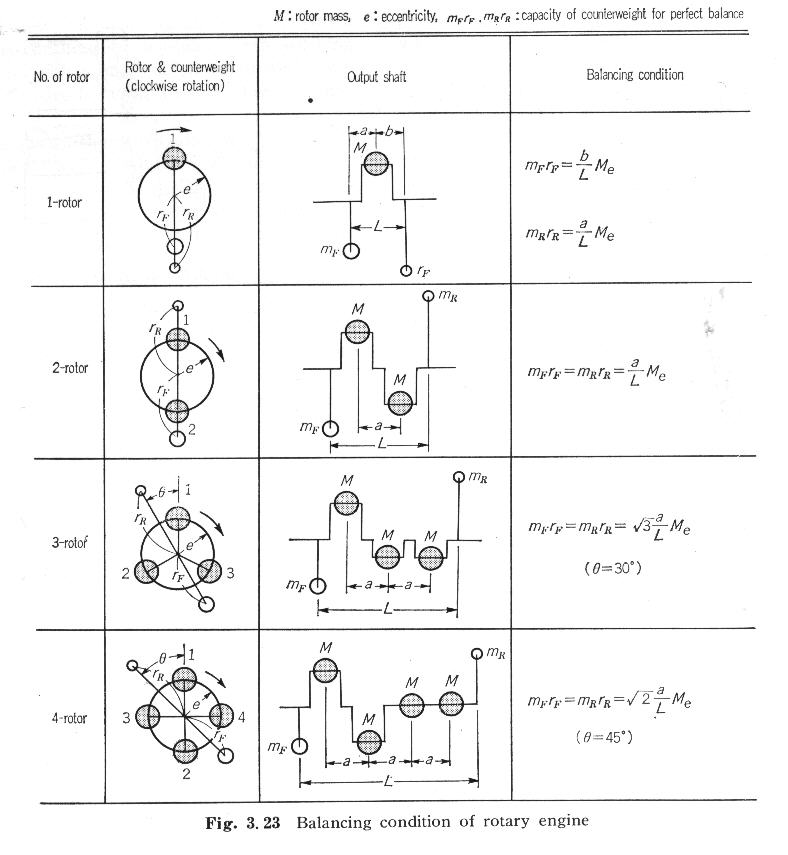
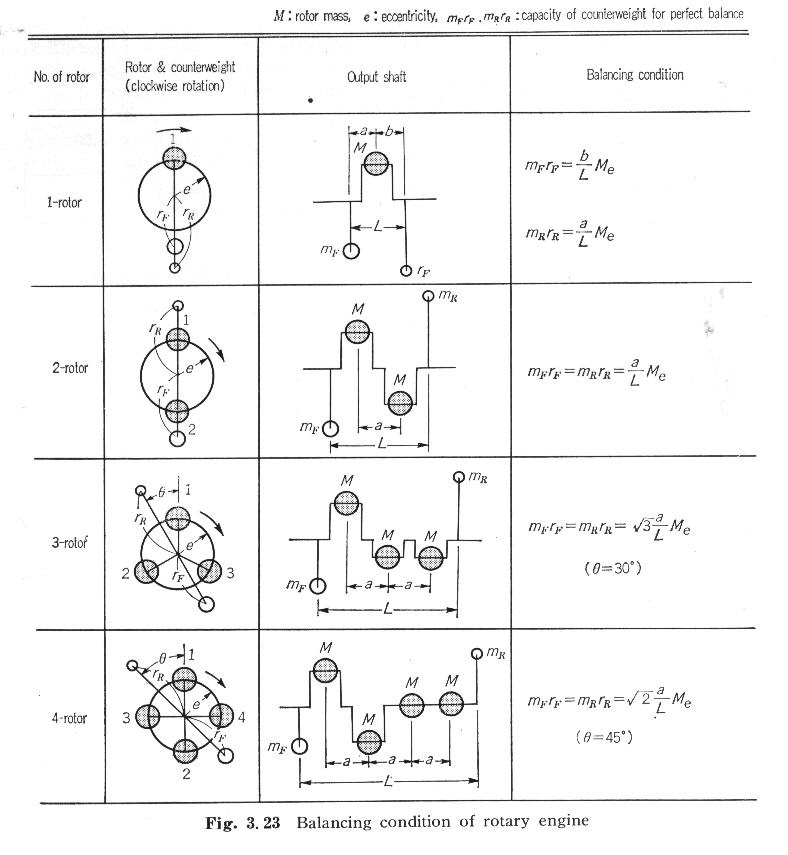
However it is possible for a design to be statically
balanced but not in dynamic balance. In the two rotor diagram
attached if you take away mass-sub-Rear and mass-sub-Front the
engine is still statically balanced.
It takes both mass-sub-Rear and mass-sub-Front to dynamically
balance the engine.
Two off set masses rotating at high speed will tend to rotate around
an axis perpendicular to a line between their centers regardless of
the position of the shaft. If two more masses of the proper size and
position are added then the system will rotate smoothly around the
shaft axis.
I know this is not clear but it is the best I can do right at the moment :)
This web site does a pretty good job of explaining things.
http://www.balancemaster.com/Balancing_explained.htm
------------------------------------------------------------
To further clarify the issue (if that is even possible :))
the rotors must be dynamically balanced about their own
axis as well as exactly match a precise weight target.
It is not sufficient if they merely weigh the same.
If they are anything other than the exact weight they
will not perform properly in the over all balancing of the
engine as the counter weights are counting on them being
in perfect dynamic balance and be of the correct weight.
Pardon the pun.
Furthermore if the rotors them selves are not in dynamic balance
they will have a detrimental effect on the rotor bearings.
One side and end of the bearing will wear more than the opposite
side and end. In other words the rotors should be mounted on a
special shaft and spun up to check their dynamic balance.
--
Paul Lamar ...No rotor no motor.
The Rotary Engine NewsLetter. Powered by Linux.
ACRE NL web site.
http://www.rotaryeng.net
Copyright 1998-2006 All world wide rights reserved.