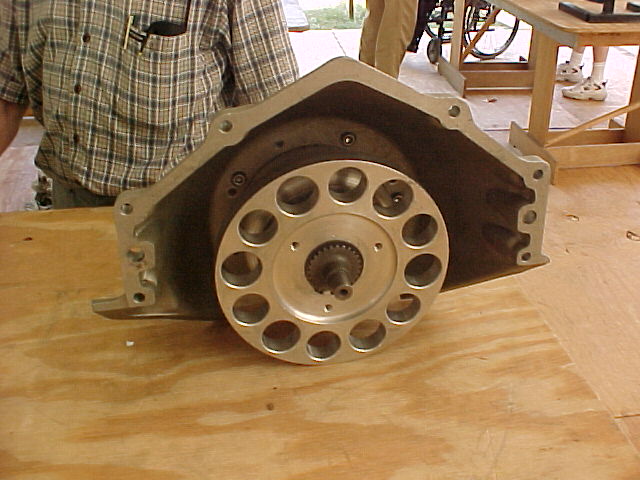
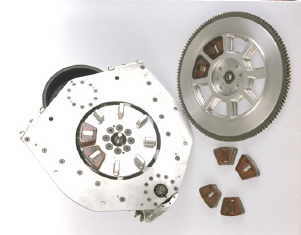
Cary,
There was an article in Contact magazine about a chap who was testing
dampers for a 4 cylinder 4 stroke engine for aviation use. This
would be
similar to a single rotor torque reversals. He discovered that his
rubber
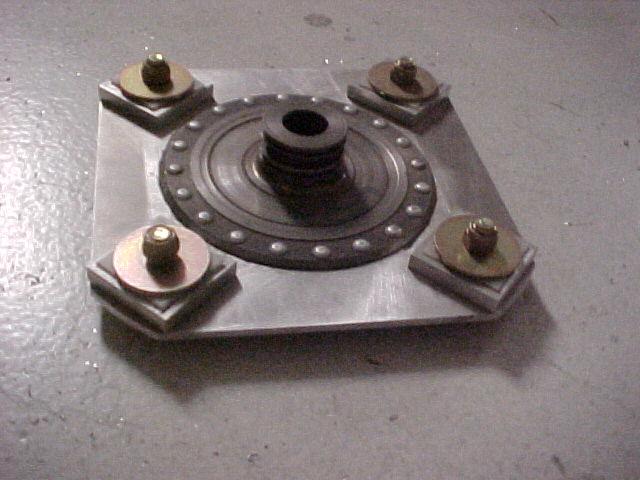
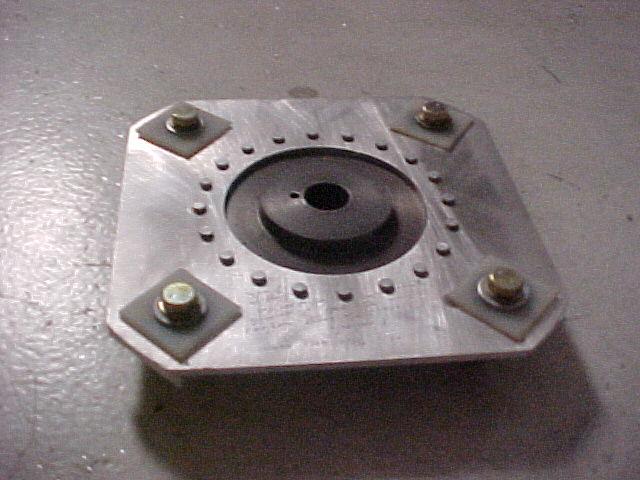
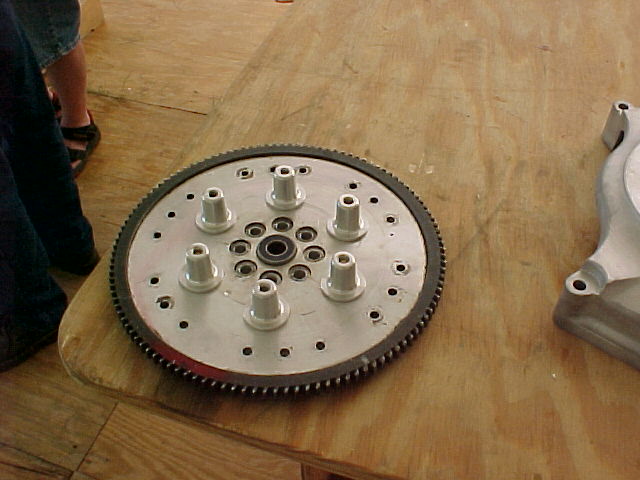
dampers ( like Tracy's) disintegrated in short order. He
experimented with
many types of dampers and finally used 6 synthetic, 4wd shackle
dampers.
They are in fact harder.
His argument, if I remember it correctly, was that the softer
dampers gave
more (obviously), opposite direction to the prop and equally in the
torque
reversals , which put the damper in constant and extreme reaction
environment ( my best words to describe the situation).
So it would seem the opposite is true, of what I originally
believed. I does
make sense to me!
George ( down under)
Hi George;
I would be interested in seeing the article - what was the Contact
issue/date?
There are many variables and many possible solutions.
One way to think of torsional resonance is two spinning discs connected
by a rubber band. One disc represents
the moment of inertia of the engine's rotating assembly, the other
(larger) disc is the inertia of the prop.
During normal operation, with a steady state force being applied to one
disc(engine), the rubber band will twist, causing the
attached disc(prop) to spin in the same direction.
At a harmonic frequency, the discs will be turning in opposite
directions, completely out of phase,
causing the rubber band to unwind and wind up in the opposite direction
and back, again and again.
With little damping, this can build up until the rubber band eventually
overstretches/fatigues and breaks.
Softer bushings would lower the fundamental frequency of the system,
harder would raise it.
If the softer dampers are disintegrating - it could be that the system
frequency or a low order harmonic
is very close to the engine's torque pulse input frequency (VERY BAD) in
some portion of the
operational range resulting in resonance, or that there is simply not
enough bushing material to take the load.
Some of the commercial couplings provide engineering data.
In the absence of calculation estimates, instrumentation or vibration
measurements, there is trial and error...
Hopefully, without the BD5 excitement :)
Cheers
Cary
(Still investigating this very problem)
Cary,
Can't remember the article details.
Let us know what you find!
George ( down under)
Will do - assuming I don't commit sepuku? first - can you tell that I'm
avoiding the problem with all this writing?
Damned torsionals!
Cheers
Cary
Don't forget the large nylon damping washers Tracy uses out side the
rubber bushings :)
Paul Lamar
The Rotary Engine NewsLetter. Powered by Linux.
ACRE NL web site.
http://www.rotaryeng.net
Copyright 1998-2006 All world wide rights reserved.