Paul,
I was wondering about applications of your turbo compound idea in a Mazda
rotary automobile.
At http://www.rotaryeng.net/why-tc.txt second to last paragraph you have:
"We are now building a traction drive device to extract the excess HP from a
stock turbo charger. Input speed RPM can be up to 120,000 RPM and output RPM
will be one tenth of that. The power from the
traction drive output shaft will be transfered to the e-shaft of the rotary
by a multi v belt to absorb the torsional vibrations from the rotary engine."
Are the torsional vibrations this traction drive is designed to deal with a
factor of the rotating propeller on an airplane? I guess what I'm wondering
- is the traction drive necessary in an automobile?
Apologies for being off the subject of aviation.
Nate Fairchild
Due to the small size and high RPM (100 K) of the turbine and the
pitch line velocity limitations of gears a traction drive is about
the only way I know of doing it.
Paul Lamar ...No rotor no motor.
Hmm. In that case, you may be interested in this:
http://www.w2wpowertrain.com/t-techRotrex-2.aspx
It is a traction drive mated to a centrifugal compressor for supercharging,
but it doesn't look like it would be too difficult to mate it to a turbine
instead.
This brings up my next question - what is the ideal sized turbine, A/R etc?
Nate Fairchild
----------------------------------------------------
Yes I am familiar with it. It is where I got the inspiration for the
traction drive. I think Doug Fir discovered it. Doug on here in Japan has
one. He too is working on a turbo compound rotary. Unfortunately the unit
rotates in the wrong direction for use with the stock turbo in the stock
position. I basically copied the idea but the basic principle was developed
decades ago. The so called patents they "have" IMHO are a smoke screen to
make people think it is unique. Notice in the illustrations on this
website presentation the patented principle is not used. Perhaps the patent
was rejected by the patent office or challenged.
BTW Doug, check out this web site. There are a lot of new Rotrex illustrations
that I have not seen before. Here are a few. The most interesting is
the oil system jpg.
I can't answer your last questions but a large aerospace company here
in LA is working on it for UAV applications I think. NASA has sponsored
several technical studies on the turbo compound rotary. NASA have changed
their data base server web site so look for the NASA/NACA tech paper server.
I have a lot more info so if you are interested keep asking questions.
Paul Lamar ...No rotor no motor.
Paul,
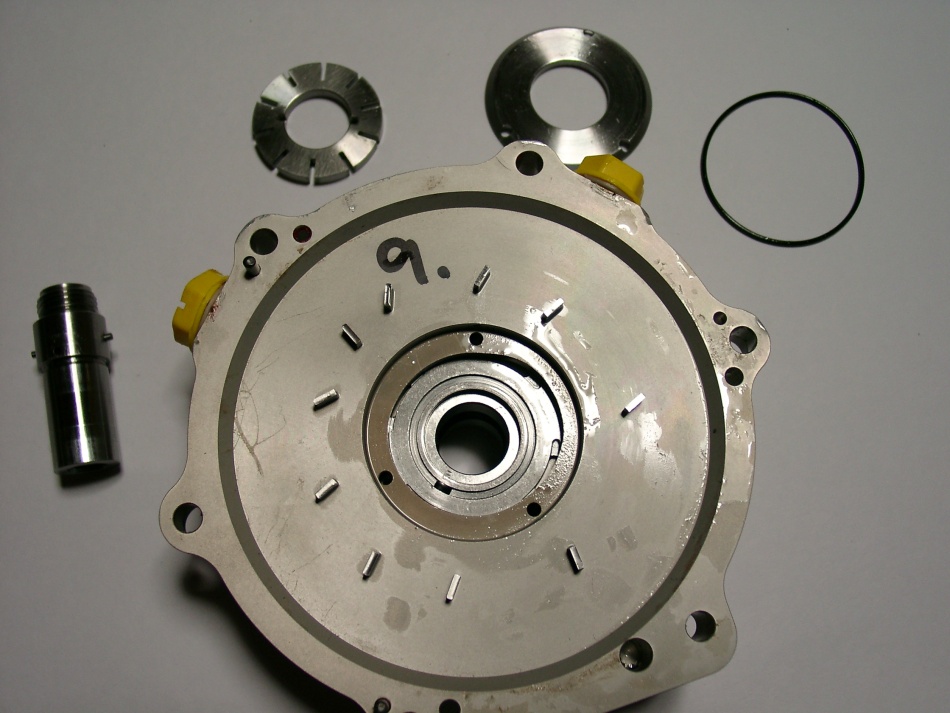
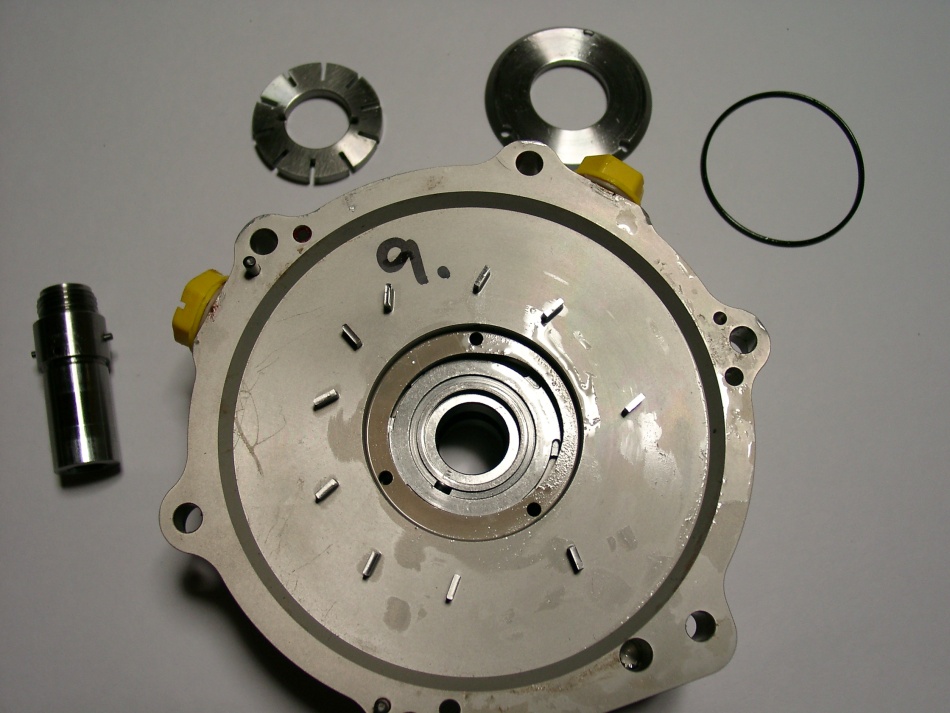
Nice illustrations. Glad I didn't have to pull the bearing off of the
rollers. Simple huh? Notice the oil travels down the center of the tiny
shaft and comes out a few holes there. That 6mm dia. shaft BTW can transmit
over 40 HP at 6,000 rpm according to the engineer I spoke with. I may
eventually have to use the larger 38 series unit with a larger shaft that
can transmit 70 Hp at 6,000 rpm. The difference is in their reduction
ratios and input shaft size.
To run it in reverse I have to do a few modifications.
The oil pump vane pump I have (you have a picture from me) doen't need to
modified but the oil pickup and injection channels will need to be plugged
and redrilled. In Addition the input and output shaft threads handedness
need be reversed. All in all not as bad as I first thought.
I still will have to mount the turbine compressor shaft side facing towards
the flywheel end. This will necessitate flipping it back to front and
rotating the center section back down 180 degree so that the oil drain back
hole remains below.
Regards
Doug
BTW I don't recall mentioning this before but one of the challenges in
the turbo compound rotary is the exhaust temperature reducing the
life and speed of the blow down turbine. There is a solution.
A thermal couple is two wires of different material connected together.
In the presence of heat it will generate a small voltage and a small
amount of current. If a large number are connected together in a parallel
and series configuration they can generate significant voltage and
current AKA electrical power. The combination is called a thermal pile
or some such. If this thermal pile is mounted between exhaust port and
turbine on the inner surface of the the exhaust manifold it will cool
the exhaust gas as well as generate power for electrical needs in a UAV,
aircraft engine or car. This of course further adds to the excellent
overall efficiency of the turbo compound rotary engine.
Paul Lamar
The Rotary Engine NewsLetter. Powered by Linux.
ACRE NL web site.
http://www.rotaryeng.net
Copyright 1998-2006 All world wide rights reserved.