I had read that some of the JU-88's had diesel engines because the
allied fighters had trouble setting them ablaze. Karibian
-----------------------------------------------------------
Besides the 205 and 207 diesels Junkers made three different V12 engines.
Not diesels. The 210 the 211 and the 213. The 213 had 1776 HP.
The 211 and the 213 were used in the JU-88's as well as BMW 801 radials.
http://en.wikipedia.org/wiki/Junkers_Ju_88
The 210 and the 211 were used in the Stuka Ju87 dive bomber.
http://en.wikipedia.org/wiki/Junkers_Ju_87
The 205 and 207 diesels were rather low power at around 900 HP and
where used in the JU86 pre war mostly. Perhaps a few were used in other
functions during the war. April 1939 the last Ju86 was delivered and
the production came to an end. The early model Ju 86-D1 (1936) had
two 600 hp Jumo 205C-4 diesel engines, but the Ju 86E replaced
those with the 800 hp BMW 132F. The Ju 86K was an export model,
also built under license in Sweden as the B 3 with 905 hp Bristol
Mercury XIX engines. Several aircraft remained in service with the
Swedish Air Force until 1956
http://www.geocities.com/hjunkers/ju_ju86_a1.htm
The Jumo 205 engine was modified to a high altitude engine after it
had been removed from the serial production lines of the Ju86. The
RLM was interested in the Ju86H proposal and ordered a total of 40
high altitude bombers from Junkers in September 1939. Under the
designator Ju86P three prototypes were built.
There is a lot of conflicting information as the JU86 was first built
as an airliner in the early 1930's and was sold to other countries.
http://en.wikipedia.org/wiki/Junkers_Ju_86 It was pretty much obsolete
by the start of the war. As you can see there was a lot of mixing and
matching going on.
The bomber was field tested in the Spanish Civil War, where it proved
inferior to the Heinkel He 111. It was again used in the 1939 invasion
of Poland, but retired soon after. In January 1940 the Luftwaffe tested
the prototype Ju 86P that had a longer wing span, pressurized cabin,
Jumo 207A1 turbocharged diesel engines with, and a two-man crew. The
Ju 86P could fly at heights of 12,000 m (39,000 ft), where it was
safe from enemy fighters. The British RAF developed the Westland
Welkin specifically to counter this threat.
No. 12 Squadron SAAF used Ju 86 bombers in the East African Campaign.
Satisfied with the newer version, the Luftwaffe ordered that some 40
older-model bombers be converted to Ju 86P-1 high altitude bombers
and Ju 86P-2 photo reconnaissance aircraft. Those operated successfully
for some years over Britain, the Soviet Union and North Africa.
In August 1942, a modified Spitfire V shot one down over Egypt; when
two more were lost, Ju 86Ps were withdrawn from service in 1943.
Junkers developed the Ju 86R for the Luftwaffe, using larger wings
and new engines capable of even higher altitudes — up to 16,000 m
(52,500 ft) — but production was limited to prototypes.
I was wrong by a few years. They were used during the war in small numbers
but only up to 1943. To put this into perspective 15,000 JU88's were
built with V12 and BMW engines.
From various sources.
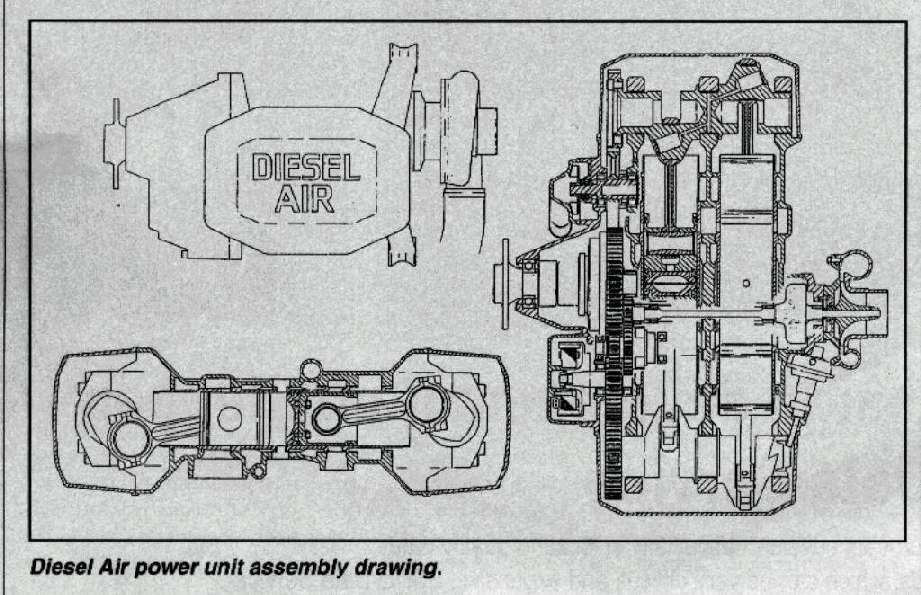
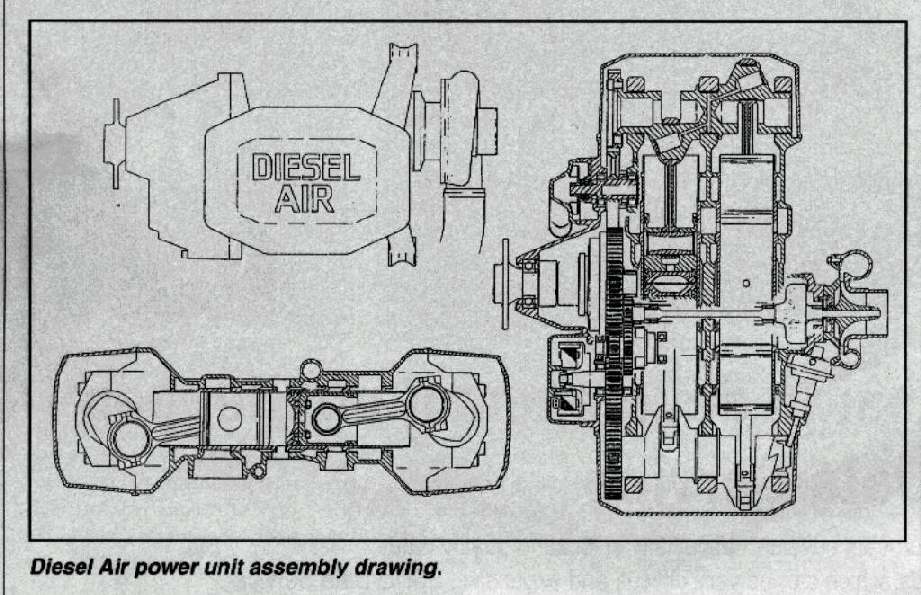
My friend Jeff Spitzer, chief engineer on the Predator at General
Atomics built a scaled down copy prototype of the Junkers Jumo 207
and displayed it at OSH about five or six years back. Here is a
dwg. I have some photos someplace but they are not scanned it.
As far as I know it never went into production at GA.
It should have as it would extend the loiter time of the
predator. However the Predator has been criticized lately as being
too slow to get to the scene of the crime fast enough.
A diesel engine will hurt and not help that. What they need is an
all aluminum turbo compound 13 B :)
Paul Lamar
The Rotary Engine NewsLetter. Powered by Linux.
ACRE NL web site.
http://www.rotaryeng.net
Copyright 1998-2006 All world wide rights reserved.