> ------------------------------------------------------
> Hopefully it will maintain altitude plus or minus 4 inches or so
> until the speed slows from 1.2 times stall speed and 3 or 4 feet
> per second sink rate to nearer stall speed and .5 feet per second,
> or below, sink rate.
>
> Mark S's 60 inch rather than 40 inch range distance sensor will
> ease the situation.
>
> For cross winds the pilot will have to forward slip or yaw using
> the aileron and/or rudder. Perhaps we need two sensors. One on each
> axle and the PIXAXE takes the distance from the lower one.
>
> I would not try the yaw approach on a tail dragger as there is a
> de stabilizing moment of up to the weight of the airplane times the
> distance the CG is behind the main gear tires upon touch down. This
> assumes a 10 degree yaw angle on touch down, or more, with the full
> weight of the airplane on the main gear and on pavement. On grass or
> dirt the situation is eased as the coef. of friction between tires
> and the runway is much less than one. Rubber tires on pavement
> develop maximum side force around 10 degree angles and zero
> camber angle. (The ME109 and other airplanes with cambered tires
> is a whole different story.)
>
> For an example on pavement; if the CG is one foot
> behind the CG, the airplane grosses 2000 pounds and the tire yaw angle
> is 10 degrees or more there will be a de stabilizing moment about
> a vertical axis through the CG of 2000 ft/lbs.
>
> A forward slip, properly done, will reduce the yaw angle of the tire
> relative to the pavement to zero but that situation is
> too complicated for the simple one axis auto flare system to
> handle IMHO. The pilot must forward slip into the wind just enough
> so there is no lateral drift. In other words the required roll angle
> of the airplane in a forward slip will change with the magnitude and
> direction of the cross wind. Hence the required gain of the simple
> elevator/height closed loop servo system will need to change with roll
> angle. Perhaps a few more sensors and an F16 computer system will
> do the trick :)
>
> If it is a nose gear airplane with the CG ahead of the main gear the
> same moment becomes a stabilizing moment and the aircraft will tend to
> automatically straighten itself out no matter what. This I think the
> auto flare system can handle. I have landed my C182 in Baja on a dirt
> strip with a 30 kt cross wind. Drunk tail dragger pilots were standing
> down near the runway approach end waving me off with beers in hand.
> I was congratulated and offered free beer after I landed.
>
> The big problem with this is people might forget how to land
> without it working :)
>
> Paul Lamar ...No rotor no motor.
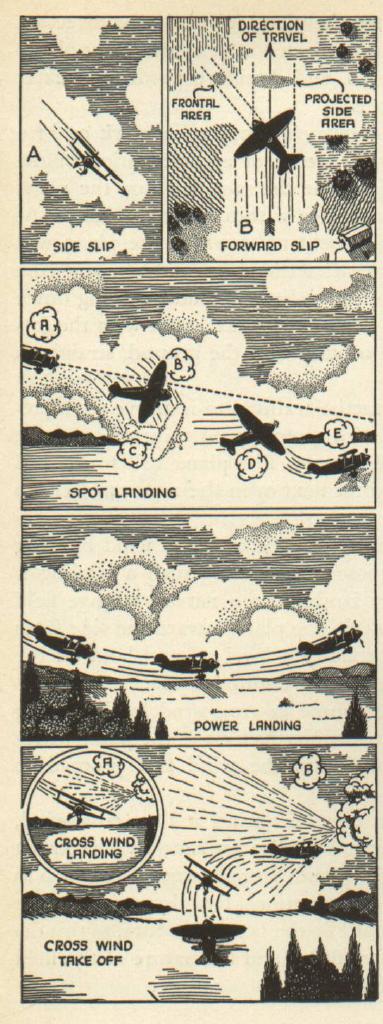
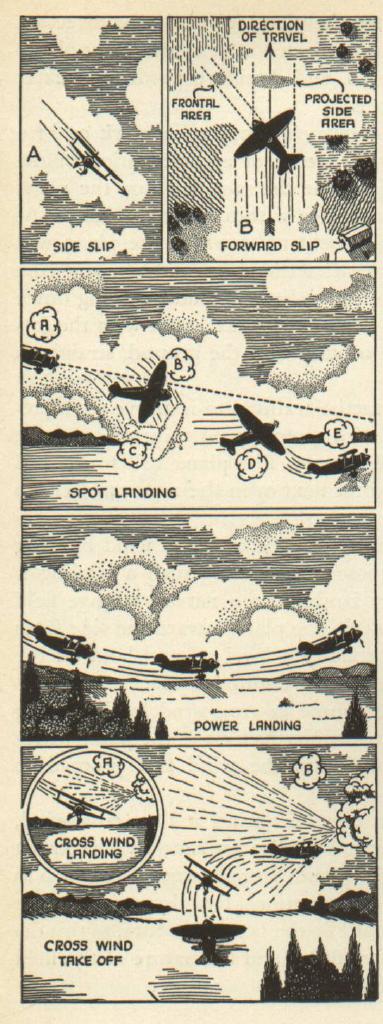
Just a slight nitpic. The forward slip is to lose altitude. Side slip is
to maintain runway alignment in crosswind landings. Karibian
You are correct. My mistake. Brain fade. Getting old. Thanks for
catching that. Side slip it is for cross wind landings. Forward slip
to lose altitude. Attached scan from "Your Wings" by Assen Jordanoff
First published in December 1936. Illustrations by Fred L. Meagher,
Frank Carlson and Eric Sloan. Funk & Wagnalls.
Paul Lamar ...No rotor no motor.
The Rotary Engine NewsLetter. Powered by Linux.
ACRE NL web site.
http://www.rotaryeng.net
Copyright 1998-2006 All world wide rights reserved.