Paul,
I have explored a few VGT turbines now and we need to have a ball
park idea
of how much torque can the turbocompound turbine technique tweak.
Say that phrase 5 times and you will have an idea of my
frustration
level:)
To deliver 54 Hp net to the e-shaft we would like to have about 4
ft/lbs of
torque at the turbine output at 80k rpm.
Said in another way, to produce 4 lbs of torque at 80,000 rpms
a TE-04
turbine would have to output about 61 Hp output. Likely? The torque
on the
three inch turbine tips would be what about 12 ft/lbs
Said another way a compressor attached to this turbine in
operation is
unlikely to requiring 61 Hp to perform its function of compressing
air for
the engine. Logic would suggest we need a bigger turbine. How big?
If it is a blow down impulse style Gordon has already shown how it
would be
over three feet in diameter.
We are planning to use a more efficient reactive turbine with VGT
technology.
Reeves if you get this thread could you give us a ball park figure
on the
torque or Hp output of any turbine in the TE-04 or TE-06 class
you have
experience with testing? Assume 80K rpm. operational speed.
Obviously there are a lot of turbines out there to choose from but
if their
output is only .1 ft/lbs to 1 ft/lb then we have to seriously
reexamine our
turbo compounding.
Best Regards
Doug
Here is one way to crudely estimate the max torque. Calculate the
area of
the blade. The dynamic pressure on the blade in pounds per
square foot
at sea level density when stationary. The dynamic pressure equation
is .0026 times the gas velocity in MPH squared. The exact gas
velocity
will be a function of the A/R among many other things.
Just for our example here I will assume it is 1100 fps or 750 MPH.
Right around Mach one. The shrieking sound coming out of the open
rotary exhaust at full chat strongly suggest Mach one :) If the
blade
is one inch square the area in square feet will be 1/144 or .0069
square feet.
750 MPH times 750 MPH times .0026 times .0069 square feet
equals 10
pounds on each blade.
The center of the blade area is .75 inches from the turbine shaft
center line on the stock Mazda 2nd gen turbo charger turbine. So
the max torque from each blade is .75 x 10 or 7.5 inch pounds.
There
are ten blades so total torque is 75 inch pounds or 6.25 ft pounds
when the blades are stationary. All turbines have max torque when
the blades are stationary.
Figure half that at max turbine HP. Lets say it is 3 ft pounds at
60,000 RPM. HP = Torque X RPM / 5252 or roughly 34 HP.
34/200 is 17% of 200 HP engine. NACA 786 estimated 16% of
engine HP
or 80/500 at sea level for a piston engine.
So I can't be that far off. Remember this is a crude estimate.
Not bad for a crude estimate. You will get more turbine HP
as altitude goes up and back pressure on the turbine is reduced.
Max HP occurs when the tangential velocity of the blade center is
roughly half of the velocity of the gas entering the turbine.
You must work out this velocity number and consequently the turbine
RPM where it occurs and compare it to the assumed gas velocity.
See 13A-HP-torque-turbine.jpg
As the blade speeds up at higher and higher turbine RPM's torque
and HP will be less and less until torque and HP become zero as
blade speed approaches gas speed.
--------------------------------------------------------
Doug,
There is/was a guy by the name of H.E. Rohlik that did a lot
of design research on radial inflow and other turbines.
If you put the key word "Rohlik" in:
http://ntrs.nasa.gov/search.jsp?N=17&Ne=2
<http://ntrs.nasa.gov/search.jsp?N=17&Ne=2>
<
http://ntrs.nasa.gov/search.jsp?N=17&Ne=2
<http://ntrs.nasa.gov/search.jsp?N=17&Ne=2>>
the search engine you will get a list of 36 papers
on the subject. Some of which are down loadable in pdf
form. Some you may have to pay for.
-----------------------------------------------
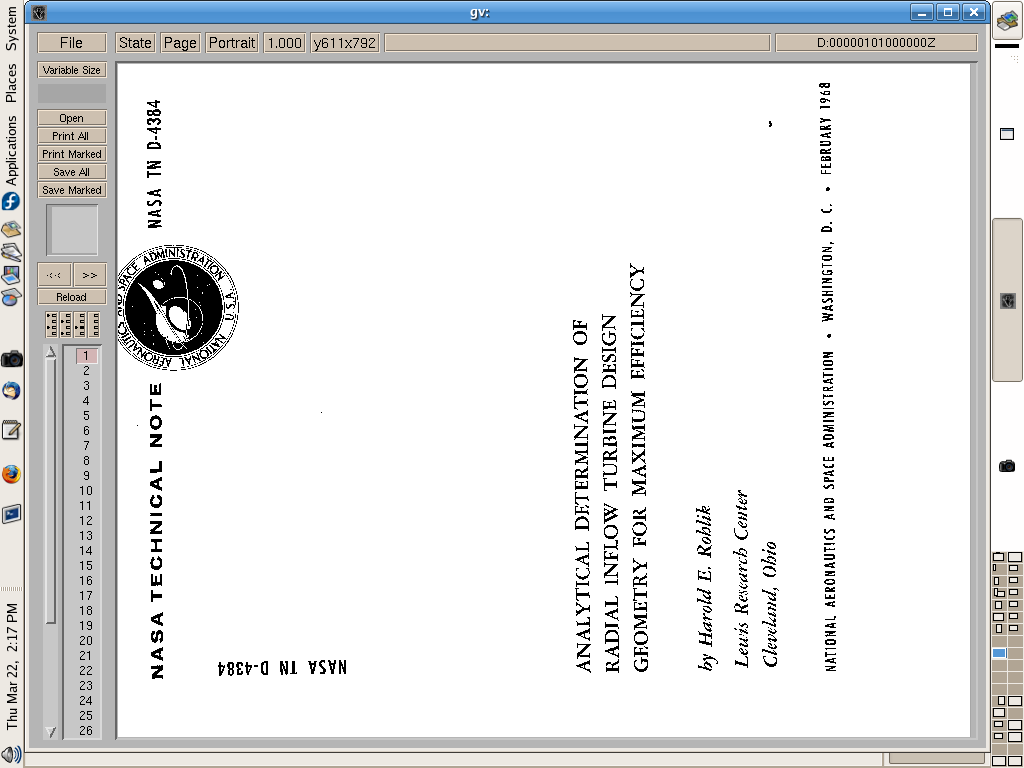
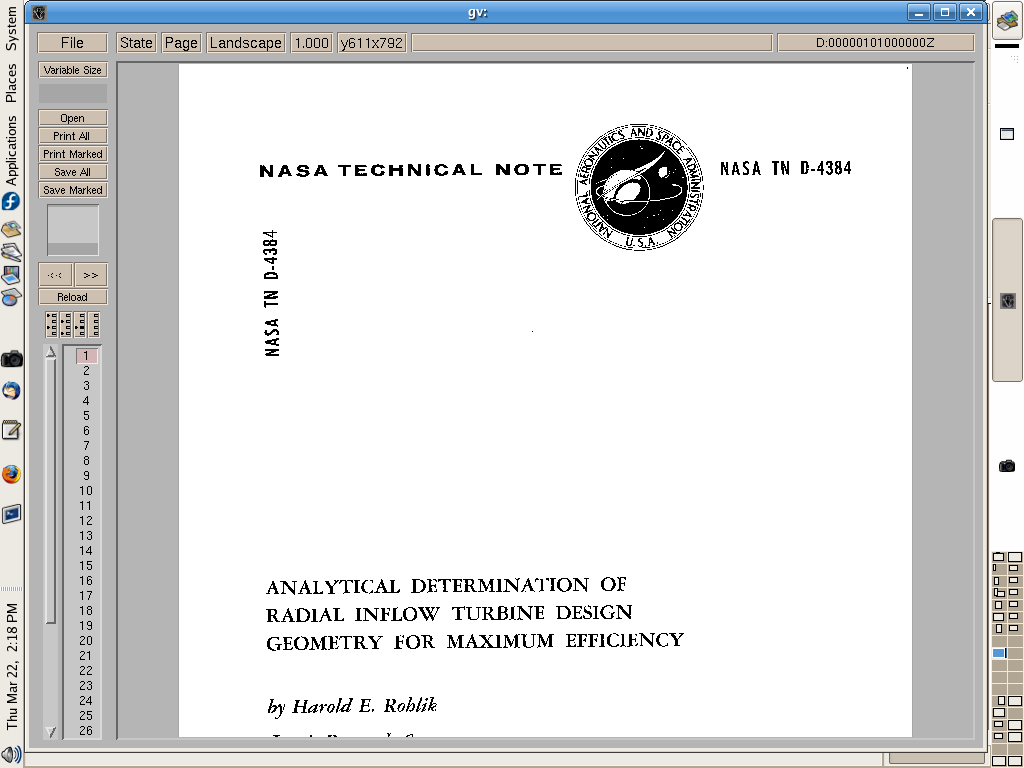
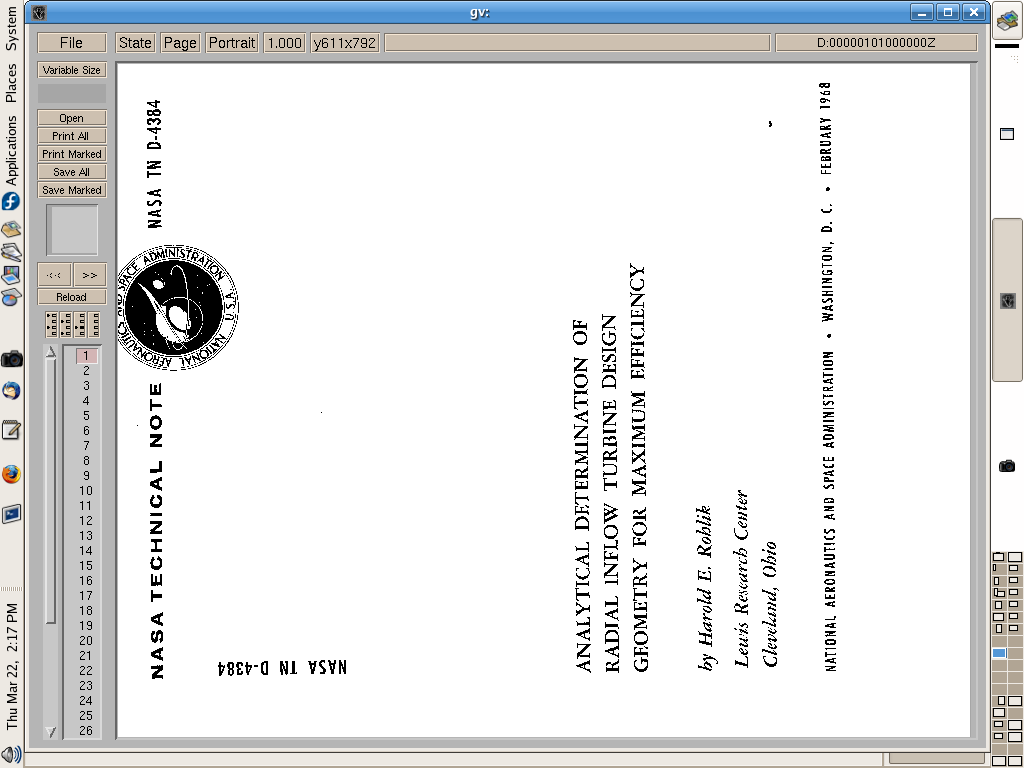
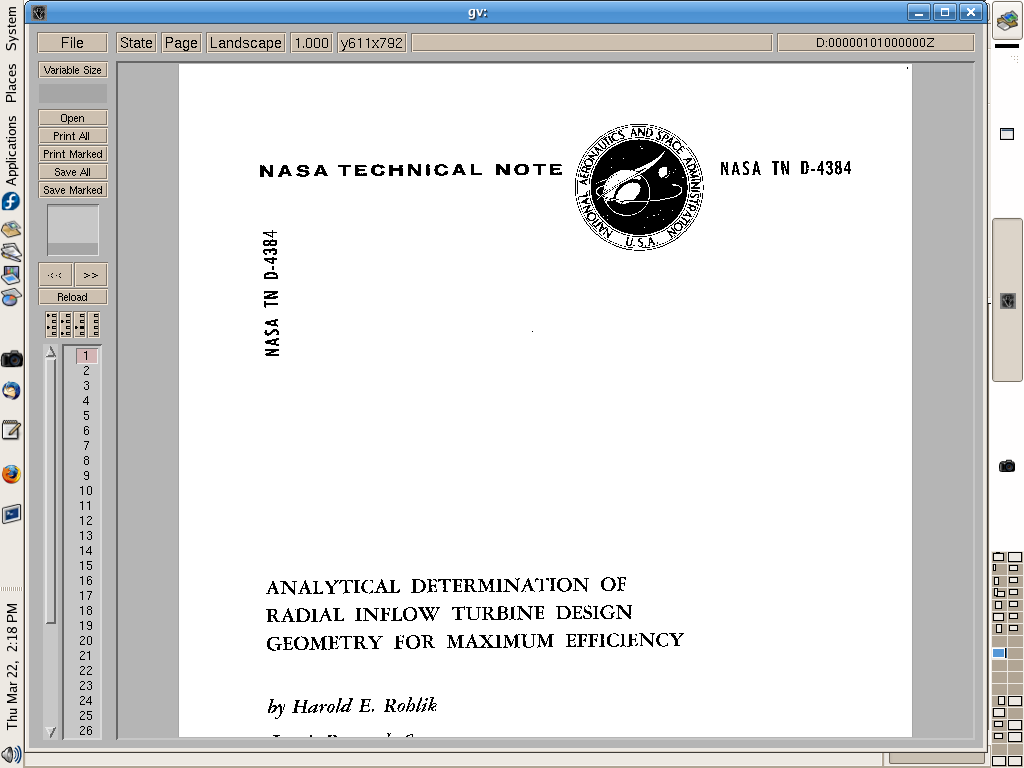
This is a good one you can download. Unfortunately
some one scanned it in side ways so you may have to
print it before you can read it :)
See the attached jpg for a description.
Paul Lamar ...No rotor no motor.
Maybe I don't see your tongue in your cheek..
http://ntrs.nasa.gov/archive/nasa/casi.ntrs.nasa.gov/19680006474_1968006474.pdf
The pdf viewers I have used all have the ability to flip the display
orientation at the click of a button.. Save a tree.
Are you still keeping track of who doesn't sign their emails? I wonder
why people don't sign their emails. Do they just forget, or are they
paranoid about associating their name with a particular statement or
opinion? Or are they just lazy? Hmm..
Matt-
I explored mine Matt and apparently it does no have that feature.
I may have missed it. I can transfer it to windows and try one of
those. Can you flip it and send it back to me?
As far a signing is concerned I think perhaps they just forget.
I don't really know but it is interesting. I always know who
they are so they cannot remain anonymous.
--
Paul Lamar ...No rotor no motor.
I have adobe acroread and gv (ghostview) on this box. If you're running
a standard linux box (with X of some sort), you should gv available
stock. gv is in /usr/bin/X11/gv on my box.
Matt-
X11 not in usr/bin. X11 is now in Include. No gv.
I suspect Fedora 5 rearranged the UNIX sub directories.
I just used the Gnome gui package manager and was blown away.
It automatically searched for gv on the Internet, downloaded
and installed it with two mouse clicks in less than 5 seconds.
AMAZING!! At least I think that is what happened. gv could have
been hiding someplace else :)
I ran gv, flipped it and here are the results.
Paul Lamar ...No rotor no motor.
The Rotary Engine NewsLetter. Powered by Linux.
ACRE NL web site.
http://www.rotaryeng.net
Copyright 1998-2006 All world wide rights reserved.