Paul,
Since we're on the topic of turbines and Doug is looking for a way to
get a grip on how much power a turbine of a given size will absorb for
his turbocompound engine, here is an article that might help:
http://www.du.edu/~jcalvert/tech/fluids/turbine.htm
The article is specificaly about water turbines, but the phyisics are
the same for any type of fluid, including gas generated by combustion.
It's a good primer on the differences between impulse and reaction
turbines. (A turbocharger is an example of a reaction turbine with
radial flow, while the turbine used on the NACA experiment on
turbocompounding is an example of an impulse turbine with axial flow).
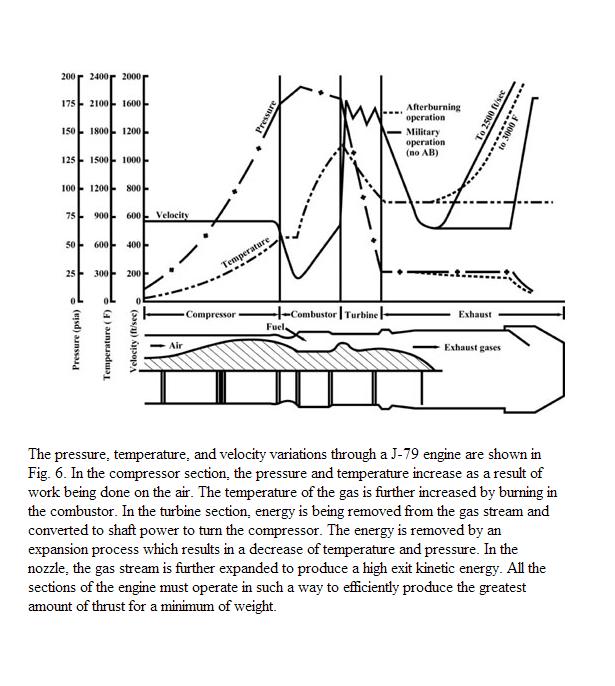
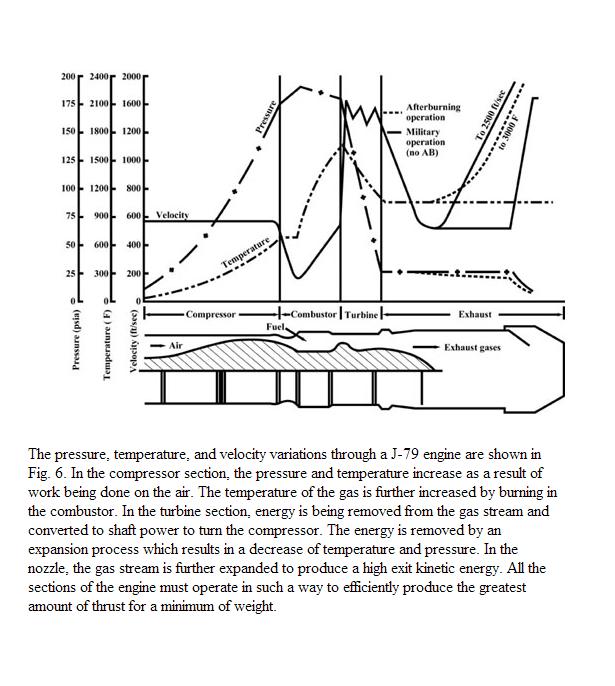
And here is a chart showing the temperature, pressure and velocity of
the gas flow in a turbine engine, the J79.
If we look at the part in the middle, the combustion phase, this is very
similar to the pressures, temps and velocities in a piston engine.
And then in the turbine section, notice how the velocity shoots up as
the pressure plummets down. This is how the turbine extracts work, by
turning pressure head into velocity head.
The exhaust section shows how once again velocity is increased as the
gas is forced through the exit nozzle, which produces thrust. This is
not particularly relevant for us, but it could be in a faster airplane,
where placing a nozzle on the exit of the turbine or turbocharger
pointing straight back could produce significant thrust.
The bottom line, for Doug's question, is that it is possible to figure
out fairly accurately the torque and hp a given turbine will produce
from a given gas flow, but we need to make an intelligent guess at some
key pieces of info regarding gas density, temperature, velocity and
pressure.
Also needed is some basic data on the turbines themselves, such as
cross-sections, radiuses, etc.
Regards,
Gordon.
The Rotary Engine NewsLetter. Powered by Linux.
ACRE NL web site.
http://www.rotaryeng.net
Copyright 1998-2006 All world wide rights reserved.