I picked this up in down town London at a technical book
store. I'll have more from it on Sunday with title and ISBN number.
Here are the first three pages and other stuff.
-----------------------------------
Next three pages. Make a folder and put this stuff in it as there
is more to come.
Paul Lamar ...No rotor no motor.
Paul,
Excellent stuff -- keep it coming.
Regards,
Gordon
I started to look around in this book and see how many more pages I had
to scan and got discouraged. The book is strangely organized with
all formulas in one section on ten pages and all graphs in
another section. I found it very hard to read and keep my train
of thought. Sorry guys you are going to have to mail order it.
Too much to scan.
Title is Gas Turbine Performance. P.P. Walsh and P. Fletcher.
Publisher Blackwell Science 1998.
US office is 800 759 6102.
Canada 204 837 2987
Australia 03 9347 0300
UK 01235 465500
ISBN 0-632-04874-3
www.blackwell-science.com
http://www.blackwellpublishing.com/contents.asp?ref=9780632064342&site=1
Expensive at 75 English pounds ($150 US) and $268 Aus. I don't recall
spending 75 pounds for it in London. But I may have lost the
importance of the exchange rate at the time or they have gone
up on the price in the last few years.
Paul Lamar ...No rotor no motor.
---------------------------------------------------------------
Here's a search web site for books. If you buy it outside of the
US, postage will be a bite more.
http://www.usedbooksearch.co.uk/cgi/search.cgi
Joel
Paul,
Here's an introductory book on turbines recommended by author and
aircraft designer Dan Raymer. It's only $95, and just $69 for
members of AIAA. Comes with software too.
I haven't read it yet, but it's on my list.
http://www.aiaa.org/content.cfm?pageid=362&id=975
Regards,
Gordon.
There is a lot of info around on axial flow gas turbines.
What is hard to find is radial inflow gas turbine design info.
I was thinking of the specific speed concept and how to illustrate
it for our purposes. One idea is a 3D table with typical
rotary engine gas flow numbers. Do you have any ideas on this?
Here are some charts from a NASA paper done by a guy by the name of
H.E. Rohlik that did a lot of design research on radial inflow and
other turbines.
If you put the key word "Rohlik" in:
http://ntrs.nasa.gov/search.jsp?N=17&Ne=2
the search engine you can get this paper in pdf form.
If you can't get it let me know. Doug had some problems.
I have it.
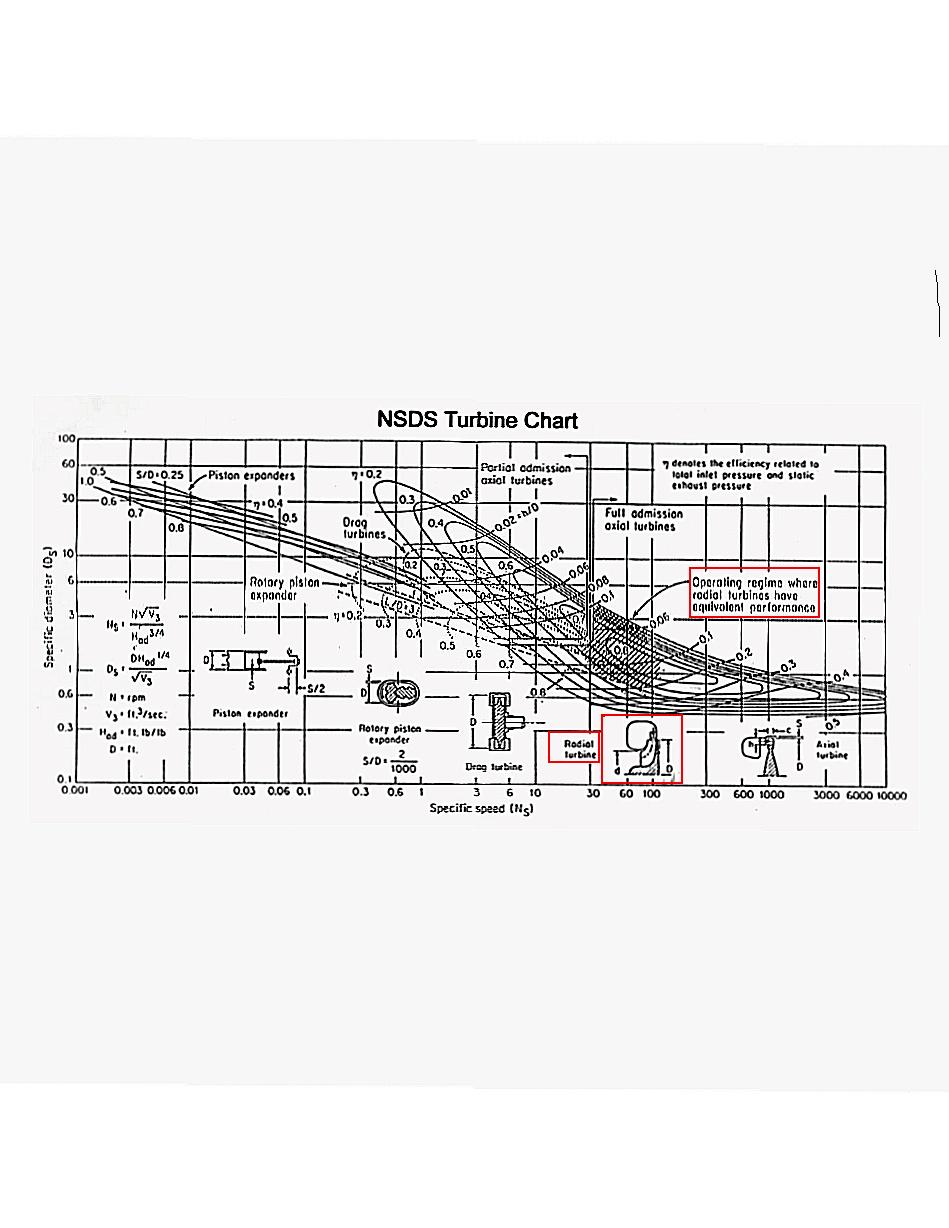
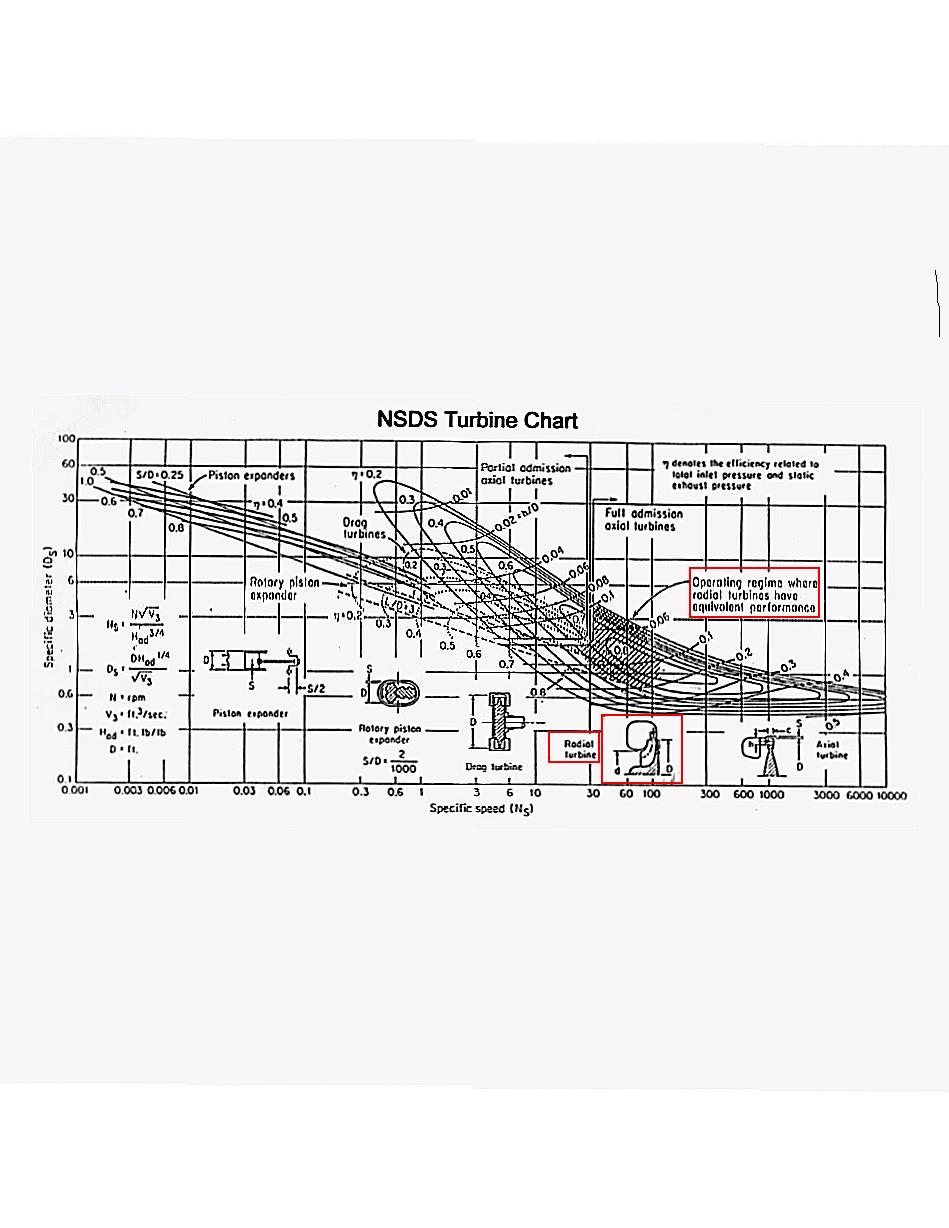
The concept of specific speeds is central to understanding
turbines.
Paul Lamar ...No rotor no motor.
-----------------------------------
Paul,
I downloaded that paper yesterday and am just looking through it
now. It's a good paper. Thanks.
You are right of course that the specific speed of a turbine is a
key figure for comparing turbines. It relates turbine power to
turbine speed and gas pressure head. Turbine specific speed varies
directly with the square root of the horsepower and inversely with
five-quarters power of the head in feet:
Specific Speed = rpm* HP^0.5 / Head^1.25
Looking at this it becomes clear that if we know the specific speeds
for a range of turbines, we can quickly correlate the horsepower
and gas flow of our engine to the turbine that most closely fits the
bill.
The problem is I have never seen specific speed figures from any of
the turbo manufacturers. I think we should try to establish a
technical contact at Garrett or one of the other firms and try to
get that kind of info. It is certain that they have that data -- you
cannot design a turbine without thinking about specific speed. The
question is are they going to give it out?
The other thing we need is exhaust data for the rotary engine. We
can make educated guesses on this, but the best way is to measure,
like the CAFE guys did. I think this is well within our capabilities.
Once we have data on turbines and engine exhaust it would be easy to
devise a spreadsheet that could be very useful for choosing the
right turbine, either for turbocharging or turbocompounding.
I don't blame Doug for fretting over the question of turbine size.
Turbines are designed to work in a narrow range of speed and power,
that is the nature of the beast. You see this in turboprop engines
for example, where you typically operate in an rpm and torque band
no wider than 20 percent. This is much different from piston engines.
The upshot for a turbocompound aircraft engine is that some kind of
continually variable transmission becomes necessary in order to keep
the turbine working across a wider range. Without it, you have a
turbocompound engine that works well at only one design point of
power, altitude, etc.
The variable geometry turbine is a very good thing here, because it
is a turbine that has a variable A/R ratio and therefore works
across a wider band of power and rpm. But I believe Doug will find
that even with the VGT, the CVT will make it work much better.
I think we should redouble our efforts on the turbo compound rotary.
This will be a breakthrough aircraft engine, if done right. The key
is the huge amount of energy in the rotary's exhaust -- much more
than in any piston engine.
I am ready to help out any way I can. Just think of an 800 hp TC
4-rotor that will propel a TBM850 size plane to over 300 knots
cruise, while sipping half the fuel of the PT6A. Even a 2-rotor 400
hp TC will outfly a Columbia 400 on far less fuel. An airplane
designed for these engines can be significantly lighter due to
lighter fuel load and possibly lighter powerplant weight -- and
hence achieve even better performance.
Regards,
Gordon.
I got that reference from the RR book.
Good luck on the technical contact at Garrett. I tried for a long
time. They are very closed. Too competitive. I even did some
consulting work for them years ago but all my contacts are gone.
Here is a chart for a wide range of specific speeds.
--
Paul Lamar ...No rotor no motor.
The Rotary Engine NewsLetter. Powered by Linux.
ACRE NL web site.
http://www.rotaryeng.net
Copyright 1998-2006 All world wide rights reserved.