Our focus here is how much HP can we get out of
a radial inflow turbine as found in a turbo charger.
It is not likely we will ever use a jet engine style
axial flow turbine for a turbo compound rotary engine.
Here is a simple turbine HP formula I found in Aircraft
Gas Turbine Engine Technology by I.E.Treager
The radial inflow turbine can be about the same efficiency
as a axial flow turbine in a narrower range of flows.
Fortunately in the range we are interested. Particularly
with the new variable vane versions.
The red line on the air flow chart is for a 2 rotor and
the blue line is for a 3 rotor.
Running the numbers.
At 100% VE the 2 rotor uses 35 pounds of air per minute at 15 psi boost
or .58 pounds per second. Therefore using this formula a typical
turbo charger turbine would be .58/5 X 679 HP or 79 HP.
Coincidently about what NASA calculated for a rotary based turbo
compound engine.
In the case of the three rotor the number is 108 HP.
P-ports typically have VE of 120% so these numbers become
96 HP and 130 HP.
If you are not as excited by this result as I am you don't
understand the implications of extracting 80 more HP from a
2 rotor rotary engine with NO increase in fuel burn :)
The question is what is the automotive world waiting for?
Paul Lamar ...No rotor no motor.
Two things: firstly, the piston engine, because it is initially more
efficient in extracting the energy from the fuel, does not have as much to
gain as the rotary. And secondly because they have not been forced to
develop the turbo compound by either the market place or the government.
I expect the industry will cry and cry about not being able to meet more
stringent government requirements for fuel efficiency. Detroit has had its
head in the sand since the early '50s when the first Japanese cars and
trucks were being introduced into the US. They had a 5% rule: you didn't
exist until you had 5% of the market.
Someday someone in the auto industry will offer a turbo compound engine and
then everyone else will be playing catch up. In the meantime, an
economically hard pressed industry will try to avoid the investment in
developing a practical turbo compound engine.
What I don't understand is why Mazda doesn't do it. It seems to me that they
have the most to gain. If turbo compounding made the rotary as fuel
efficient as a piston turbo compound engine, the rotary would win on
simplicity, power to weight ration, and probably just about any measure you
would care to use. Hmmm, maybe the Ford ownership has something to do with
it. :)
Doc Custer
Retired Software Engineer and sometime Audiologist
There is another factor and that is the piston engine exhaust
valve is not up to turbo compounding. For all the years
Curtis Wright worked on the piston turbo compound most of
the effort was focused on making the exhaust valves live. Even
at the end of the turbo compound piston engine's commercial life
one out of four turbo compound engines on an airliner would fail
because of exhaust valve failure before the end of a 20 hour flight.
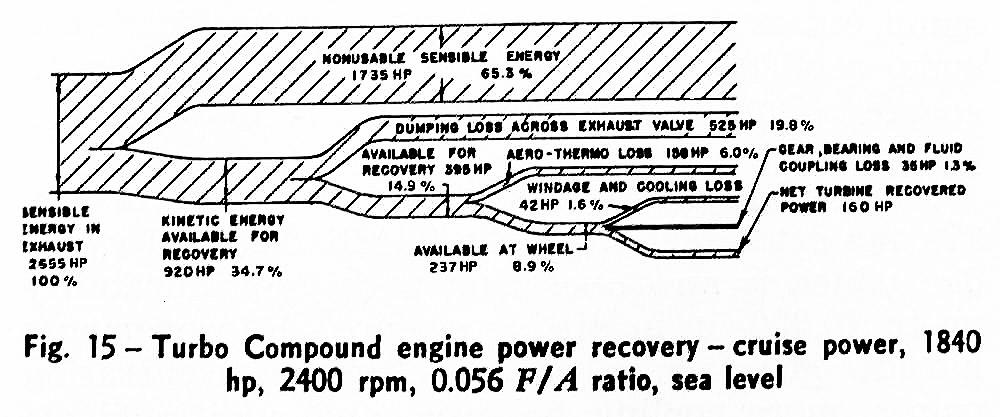
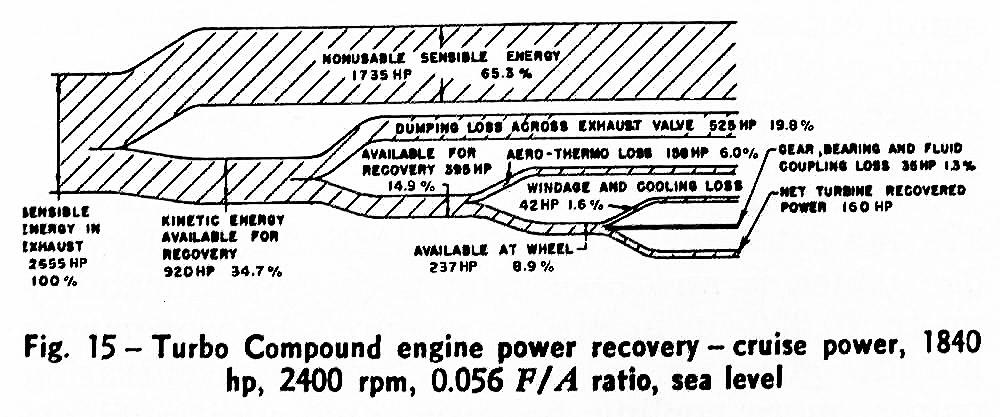
Unlike the rotary engine, which of course has no exhaust valves,
2/3rds of the kinetic energy in the exhaust was dissipated by the
piston engine exhaust valves. See the attached jpg.
Paul Lamar
The Rotary Engine NewsLetter. Powered by Linux.
ACRE NL web site.
http://www.rotaryeng.net
Copyright 1998-2006 All world wide rights reserved.