Our focus here is how much HP can we get out of
a radial inflow turbine as found in a turbo charger.
It is not likely we will ever use a jet engine style
axial flow turbine for a turbo compound rotary engine.
Here is a simple turbine HP formula I found in Aircraft
Gas Turbine Engine Technology by I.E.Treager
The radial inflow turbine can be about the same efficiency
as a axial flow turbine in a narrower range of flows.
Fortunately in the range we are interested. Particularly
with the new variable vane versions.
The red line on the air flow chart is for a 2 rotor and
the blue line is for a 3 rotor.
Running the numbers.
At 100% VE the 2 rotor uses 35 pounds of air per minute at 15 psi boost
or .58 pounds per second. Therefore using this formula a typical
turbo charger turbine would be .58/5 X 679 HP or 79 HP.
Coincidently about what NASA calculated for a rotary based turbo
compound engine.
In the case of the three rotor the number is 108 HP.
P-ports typically have VE of 120% so these numbers become
96 HP and 130 HP.
If you are not as excited by this result as I am you don't
understand the implications of extracting 80 more HP from a
2 rotor rotary engine with NO increase in fuel burn :)
The question is what is the automotive world waiting for?
Paul Lamar ...No rotor no motor.
Paul,
That 80 hp from the recovery turbine is a very exciting result. Doug
was assuming about 50 hp.
However, you are basing this on 15 psi boost, which, in an aircraft
engine you will only see at high altitude.
You can use my turbochart spreadsheet for pretty accurate mass flow
numbers. At 8000 rpm on the ground at ISA temp and pressure, a
P-port with VE of 1.2 will flow 34.1 lbs/min of air and make about
300 hp. (In fact I think this power number is too conservative and
am going to revise the spreadsheet to calculate power on thermal
efficiency instead of mass flow.)
But the mass flow is dead accurate. So 34.1 divided by 60 equals
0.57 pounds per second, pretty close to the number you got. Now this
is with no boost at all.
If you want 15 psi of boost at 15,000 ft., you will be making well
over 350 hp -- that's before taking into consideration the power
recovered from the turbine -- at a mass flow rate of 43 lbs/min, or
0.72 lbs/sec.
Now using your formula that works out to 97 hp from the recovery
turbine. (0.72 / 5 * 676 = 97.)
The spreadsheet shows 374 hp, and if you add the 97 hp from the
recovery turbine and take away let's say 30 hp to drive the
compressor, you get a total of 441 hp at a fuel flow of 175 pph,
which works out to a bsfc of -- hold on to your hats -- 0.39.
And that's at stoichiometric fuel mixture, 14.7. If you lean to 16
or even 18 like they used to on the big Wright TCs, you will get
absolutely remarkable numbers. At AF of 18 : 1, the spreadsheet
shows fuel flow of 142 pph, which is bsfc of 0.32.
I should add though, that your formula is only an approximation
because it is specific to an axial flow turbine which works on the
impulse principle. Radial flow turbines work on the reaction principle.
However, I think the efficiencies are going to be close enough that
this is going to be pretty close.
We can work out the exact numbers though, using the proper
equations, which is what I intend to do. I will be updating the
spreadsheet with a section on exhaust and turbine performance soon.
Regards,
Gordon.
Plenty of street rotary engines see 15 psi boost at sea level.
Dave Garbers 12A engines had 15 psi boost in 1973. 350 HP.
45 inches of Hg manifold pressure. But yes of course you
will get more boost at altitude.
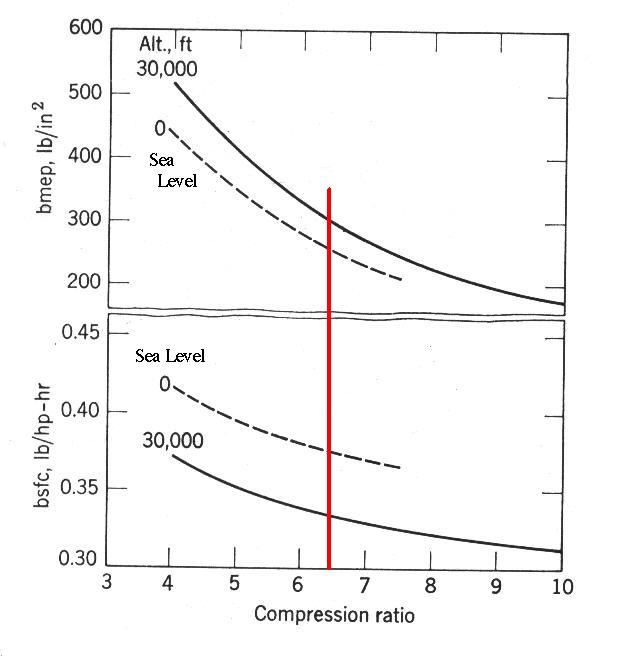
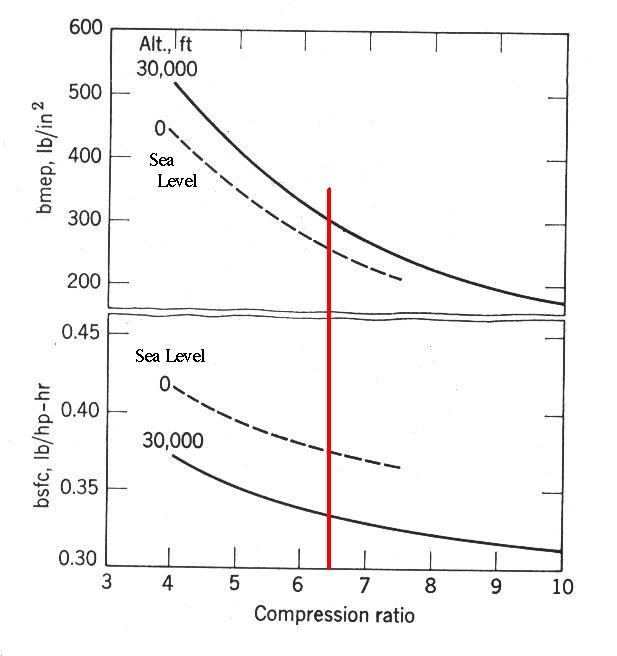
Here is the Wright chart for altitude at a very modest
compression ratio of only 6.4:1
Paul Lamar ...No rotor no motor.
The Rotary Engine NewsLetter. Powered by Linux.
ACRE NL web site.
http://www.rotaryeng.net
Copyright 1998-2006 All world wide rights reserved.