Hi there. :) I'm Adam Wade. I've spent 10+ years in
the motorcycle industry, and was an auto tech on and
off before that. I currently am mostly writing
technical columns for motorcycle magazines, and I'm
the author of The Motorcycle Fuel Injection Handbook
by Motorbooks International.
I'm also owner of a shabby-chic 1985 Mazda RX-7
GSL-SE. Someone mentioned your website on one of my
RX-7 mailing lists, and I stopped by the site to have
a look. I think it's great that the experimental
world is doing well with Mazda rotaries, and you have
a wealth of wonderful info on your site. Thanks for
compiling it and making it public!
The reason I am writing is that in your text article
on your site regarding ignition systems, you have a
few inaccuracies. They're sort of related, as I'll
explain.
The production rotaries of all manufacturers (NSU,
Mazda and Suzuki) all used 3-sided rotors and an
epitrochoid housing. As you noted, they rev higher
than most other auto engines. However, there was a
key point that is missing from the text is that the
rotor rotates at only 1/3 of eccentric shaft speed; in
other words, a full rotation of a single rotor creates
THREE full revolutions of the eccentric shaft. In
your description of ignition, that seems to be the
important missing bit.
In operation, each leading plug fires once per
eccentric shaft revolution, for two power events per
E-shaft rev. This is the same number of sparks as
you'd get from a 4-cylinder 4-stroke engine per crank
revolution. So it's incorrect to state that a rotary
taxes the ignition system harder than that of a
4-cylinder 4-stroke engine at the same "engine" rpm
(E-shaft for the rotary, crankshaft for the 4-cycle).
Also, the combustion event actually lasts LONGER than
those found in 4-cyl 4-stroke engines, as it's 2 crank
rotations per full cycle for a 4-stroke, and
*three*
E-shaft rotations per full cycle (for a given rotor
face) for a 3-sided rotor rotary. This means another
factor that allows higher E-shaft speed than you would
normally find useful on a 4-stroke engine (the others
being as you have noted elsewhere in your page).
Many people have set up MSD ignition systems to work
on Mazda rotaries without using the distributor
(except as a convenient housing for what amounts to
the crank position sensor). Details can be found
here:
http://www.smbaker.com/rail/msd6a.html
With a single coil for each leading plug, each coil
only sees a single spark event per E-shaft rotation --
the same number per rpm as the two waste-fire coils
found on most 4-cylinder motorcycles. They have much
smaller coils and can achieve a very nice "hot" spark
well in excess of 10,000 rpm. It should be more than
is really necessary for experimental aircraft use;
however, it might be a pain to set up two separate
redundant systems if someone wanted to do that; this
is true in large part with any other possible options
as well (you'd still want a way to get a second set of
plugs in the housing somehow, I should think).
Trailing plugs have been found to contribute very
little to horsepower in car use, and appear to be
mostly for lowering emissions. Cars never operate
under load in a LOP condition, so YMMV on the trailing
plugs; however, it should be quite possible to blank
off the fittings for the trailing plugs and run simply
on leading plugs. In addition, it would be pretty
easy to install sensors near the E-shaft pulley and
create a toothed wheel or a wheel with magnets
attached (for Hall-effect sensors) and then you could
blank off the distributor opening entirely and you'd
have redundant sensors if you wanted to go to a fully
redundant spark system.
So it's not as bad a situation from the point of view
of the coil or coils as your article made it out to
be. :) The stock setup for a 2-rotor engine is
certainly taxed more than a single-coil apps for a
4-cylinder car (twice as much (per coil, assuming one
coil each for leading and trailing plugs) at a given
rpm), but using a CDI unit and one coil per leading
plug means that each coil is seeing the same number of
spark events (and therefore the same amount of dwell,
although that's not terribly important in CDI apps) as
a single-coil setup for a 4-cylinder 4-stroke.
| Kawasaki Zephyr 615 (Daphne) Kawasaki Zephyr 550 (Velma)|
| "It was like an emergency ward after a great catastrophe; it |
| didn't matter what race or class the victims belonged to. |
| They were all given the same miracle drug, which was coffee. |
| The catastrophe in this case, of course, was that the sun |
| had come up again." -Kurt Vonnegut |
| M/C Fuel Inj. Hndbk. @ Amazon.com -
http://tinyurl.com/6o3ze |
With all due respect no mistake.
The rotary has only two firing chambers and will run
with only two spark plugs while the four cylinder needs
a minimum four spark plugs with four firing chambers. Therefore
those two rotary plugs fire twice as often at any given RPM
as both engines fire twice per rev.
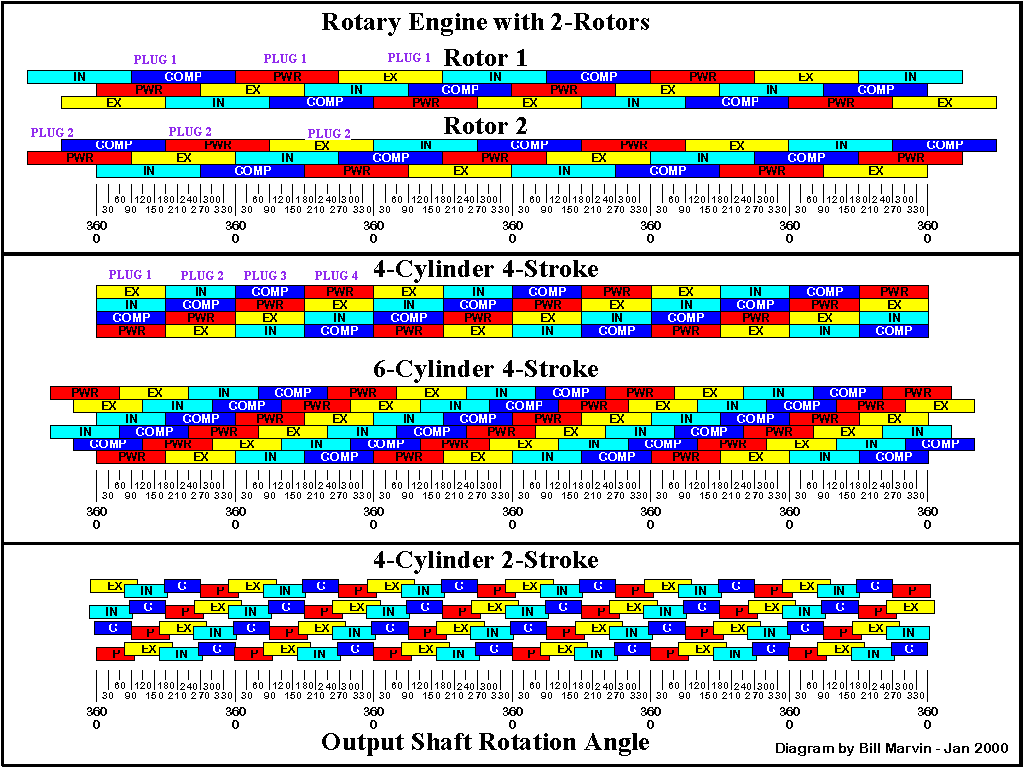
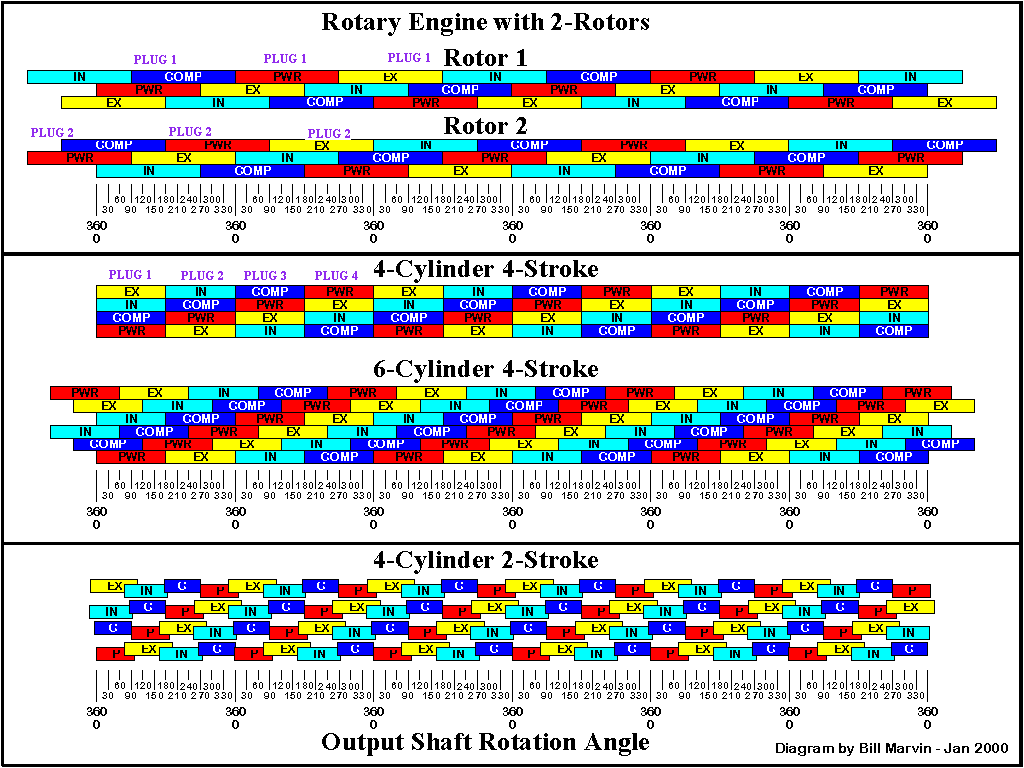
In 720 degrees rotary engine plug 1 fires twice while plug 1 in
the four cylinder fires once. See the attached chart.
In other words it takes 7200 degrees for all four plugs in
the piston engine to fire once while each of two plugs
in the rotary fires twice.
The same goes for individual coils AKA one per spark plug.
In this case the individual rotary coil will also fire twice as
often as the four cylinder individual coil.
This of course ignores the fact the Mazda rotary has two spark
plugs per rotor. Each group of two fires more or less at
the same time. They do not alternate fire. They could
of course but I have never seen a rotary set up like that.
Paul Lamar ...No rotor no motor.
The Rotary Engine NewsLetter. Powered by Linux.
ACRE NL web site.
http://www.rotaryeng.net
Copyright 1998-2006 All world wide rights reserved.