>>>> Rolf, Mark and All,
>>>>
>>>> I have to correct my previous post. Mark was right. The total
>>> pressure
>>>> in the turbine is the sum of the static and dynamic pressure.
>>>>
>>>> This is exactly what Bernoulli's Equation tells us:
>>>>
>>>> Along a streamline: static pressure + dynamic pressure = total
>>> pressure
>>>>
>>>> Expressed mathematically:
>>>>
>>>> static pressure + (density * Velocity^2 / 2) = total pressure
>>>>
>>>> In reference to that turbine chart, the pressure obviously shows
>>> the sum
>>>> of hte static and dynamic pressure.
>>>>
>>>> The reason the flow does not back up is still explained by
>>> inertia, but
>>>> it is true that the total pressure equals the dyanmic and static
>>>> pressure, as Bernoulli tells us. No doubt about it.
>>>>
>>>>
>>>> Regards,
>>>>
>>>> Gordon.
>>>>
>>> Gordon,
>>>
>>> (I cut the bottom of message off as we all know it.)
>>>
>>> Good that we have it correct now. At least I agree with it.
>>>
>>> One point, would the 'dynamic' pressure not be the same as is
>>> described
>>> by 'inertia" of the gas.
>>> I think that is one and the same thing. How do you see it?
>>> However, if so, the dynamic pressure would have a direction, it
>>> would be
>>> a vector quantity.
>>> The direction, of course, is toward the exhaust nozzle.
>>> Any comments on that?
>>>
>>> Regards
>>>
>>> Rolf
>>>
>>> The Rotary Engine NewsLetter. Powered by Linux.
>>> ACRE NL web site.
http://www.rotaryeng.net
>>> Copyright 1998-2006 All world wide rights reserved.
>>>
>>> Rolf,
>>>
>>> I'm glad this thread has come up -- it gives us a chance to
brush up
>>> on some basic physics that are fundamental to both aerodynamics and
>>> propulsion. I realized just how rusty I was on these basics when I
>>> started thinking about Doug's question about turbine size.
>>>
>>> You are right, of course, that dynamic pressure, which describes
>>> air or another fluid that is flowing, is a vector quantity --
it has
>>> both magnitude and direction.
>>>
>>> The tricky part is that static pressure is a scalar quantity. If a
>>> gas is static and not flowing, the measured pressure is the same in
>>> all directions. But if the gas is moving, then the measured
pressure
>>> depends on the direction of motion.
>>>
>>> Now about the inertia part. I believe it is correct to say that the
>>> moving gas inside that turbine engine does not reverse
direction and
>>> flow back to an area of lower pressure due to its inertia. However,
>>> this is not a full explanation of what is going on. Remember that
>>> inertia also applies to objects at rest, which resist being
>>> disturbed by an outside force. Newton gave us this idea of inertia
>>> in his First Law of Motion.
>>>
>>> So yes, this tells us that the moving gas in the turbine will
resist
>>> changing direction because of its inertia.
>>>
>>> But I believe Newton's Second Law gives us better insight into the
>>> question of fluid flow because it deals with the question of
>>> "force." Specifically, it tells us that force is a change in
>>> momentum over time, or mass times acceleration. With this insight
>>> we can now go further and figure out just how much force the moving
>>> air is exerting.
>>>
>>> To understand dynamic pressure, we turn to the conservation of
>>> momentum, a fundamental concept of physics.
>>>
>>> Remember the analogy of sticking your hand out the window of your
>>> moving car? The faster you go, the greater the force on your hand.
>>> This is how the pitot tube works to move the needle on our airspeed
>>> indicator. The greater the dynamic pressure, the more the needle is
>>> deflected.
>>>
>>> As noted earlier, dynamic pressure is simply half the product of
>>> density and velocity squared:
>>>
>>> Q = rho * V^2 / 2 = 0.5 * rho * V^2
>>>
>>> If we add to this the coefficient of lift and wing area, we
have the
>>> lift equation:
>>>
>>> L = 0.5 *rho * V^2 *Cl *Sref
>>>
>>> And if we add dynamic pressure to the thrust equation, we can
>>> analyze propeller thrust. So right off the bat we have lift and
>>> thrust, which is pretty much everything there is to flight. Yes,
>>> understanding dynamic pressure is a good thing to understand if we
>>> aspire to fly...
>>>
>>> There is a good page on the NASA educational website that gives a
>>> more detailed explanation of dynamic pressure:
>>>
>>>
http://www.grc.nasa.gov/WWW/K-12/airplane/dynpress.html
>>>
>>>
>>> Btw, I think we should be able to make some progress on Doug's
>>> question about turbine size. We should be able to work out the
>>> thermodynamics of the rotary engine using standard equations
that we
>>> use in gas turbines. After all both are internal combustion
engines.
>>> From there, we use the same tools to figure out the right size
>>> recovery turbine.
>>>
>>> I'm going to keep plugging on this one. I think we should have a
>>> spreadshet for the exhaust side like the one I put together for
>>> compressor selection.
>>>
>>>
>>> Regards,
>>>
>>> Gordon.
>>>
>> Thanks Gordon,
>>
>> I appreciate your comments and the link. Good stuff.
>> Although I did not follow Doug's question, but the above are all
good
>> tools.
>>
>> PS: As a side note, I trust the pitot tube works by narrowing
the air
>> passage through it, thereby increasing the air velocity which
equals a
>> reduction in air pressure, and this reduced pressure is read by the
>> needle. It is not a positive dynamic (impact) pressure that is being
>> read. Is this right?
>>
>> Regards
>> Rolf
>>
>> I think you are speaking of a venturi Rolf.
>> A pito tube measures impact pressure.
>>
>> For a simple minded example:
>> If one holds a one square flat plate out the window of one's
>> car at 100 MPH at sea level one will measure a force of
>> 26 pounds or 26/144 = .18 psi. Pito tubes work on this simple
>> principle. There is no airflow into the pito tube.
>> One could stick the pressure sensor out the window and get
>> the same result.
>>
>> The simple equation I use is force (drag) = .0026 times MPH squared
>> times the area of the flat plate.
>>
>> The .0026 constant is related to the air density. It is
>> not the air density per se.
>>
>> The same equation is used when calculating drag on a streamlined
>> object where C sub d is the drag coeff. of that object. In that
>> case the formula is Drag = C sub d X Frontal Area X .0026 X
>> MPH squared.
>>
>> The term C sub d X Frontal Area is frequently called the flat
>> plate equivalent drag number.
>>
>> The terms impact pressure and dynamic pressure are interchangeable.
>>
>> Paul Lamar ...No rotor no motor.
>>
>
> Gordon, Paul et all
>
> Every six months I check back in to see what Catapillar Inc. is
doing with
> their mechanical as well as electric turbo compounding schemes.
If you do a
> Google search for "Caterpillar turbo compound turbine" you will find
> several interesting PDF files there.
>
> The first one you can skim through it. It is titled
> "Diesel Engine Waste Heat Recovery Utilizing Electric
Turbocompound" ...
> This report has some clear pictures and gives an understanding of
what it
> takes to perform this task. As much as we may love the concept
this PDF
> will give a clear indication of the sizes and technology involved
to pull it
> off or for us not:) To heavy for flight, even if it is scaled
down to our
> rotary. Switched reluctance generators are also very challenging
to develop.
>
>
> The second PDF I recommend looking at is called "Engine System
Approach to
> Exhaust Energy Recovery". There are some little tibits of
information that
> are real jewels, hints perhaps for our use. I'll let you read it
first and
> then we can discuss it.
>
>
> In another PDF report I found the statement that Garrett was the only
> company that had successfully manufactured a turbo compound system.
> Hmmmm???? I don't think so.
>
>
> Best Regards
>
>
> Doug Fir
>
>
> "Engine System Approach to Exhaust Energy Recovery"
> Hard to fathom this stuff as it is power point presentations
> with little or no text explanation. Probably puts everybody
> to sleep that watches it :)
> What is the base line engine power and BSFC?
> IMHO the TC stuff is marginally cost effective
> as they are starting with a cool exhaust diesel.
> I wonder if it will actually go into production.
>
> Paul Lamar ...No rotor no motor.
Paul
The point is the amount of effort they are expending to raise the
efficiency
of the system 10%. One interesting quote and graph at the end of the
article was about how mechanical turbocompounding systems can go
south real
fast with increased backpressure. Can we interpret that to mean they are
talking about the inline power turbine?
Regards
Doug
You got me Doug. Without seeing the dialog that goes with
all those power point presentations I am not exactly sure
what they are talking about. Very little of that is applicable
to aircraft rotaries anyway as those engines weigh 1500 to 2000
pounds.
Frankly I doubt they will put them into production anyway
unless diesel fuel goes to $10 a gallon. As far as I can tell Scania
discontinued the TC diesel in Europe and diesel fuel over there
is $5 to $8 dollars a gallon. If Scania can't make it pay off at
$8 a gallon it is not going to happen any time soon.
Do you recall what you paid for gasoline in Germany?
Paul Lamar ...No rotor no motor.
The Rotary Engine NewsLetter. Powered by Linux.
ACRE NL web site.
http://www.rotaryeng.net
Copyright 1998-2006 All world wide rights reserved.
Doug,
The point about the backpressure is what I've been harping on
lately. They are talking about the pressure in the exhaust tract
after the recovery turbine. If you raise this pressure, for whatever
reason, maybe running it to another turbine or just long piping, the
recovery turbine will go south as you say.
The reason is the pressure ratio across the recovery turbine. The
inlet side pressure has to be higher than the outlet side in order
for the turbine to do any work. The higher the pressure ratio, the
more work the turbine will do. Gases from the high pressure end will
accelerate more quickly to the low pressure side if the pressure
gradient is steeper.
The greater the acceleration, the more momentum and force on the
turbine wheel. If you have high pressure at the turbine outlet, you
will have a low pressure ratio and poor turbine performance. That's
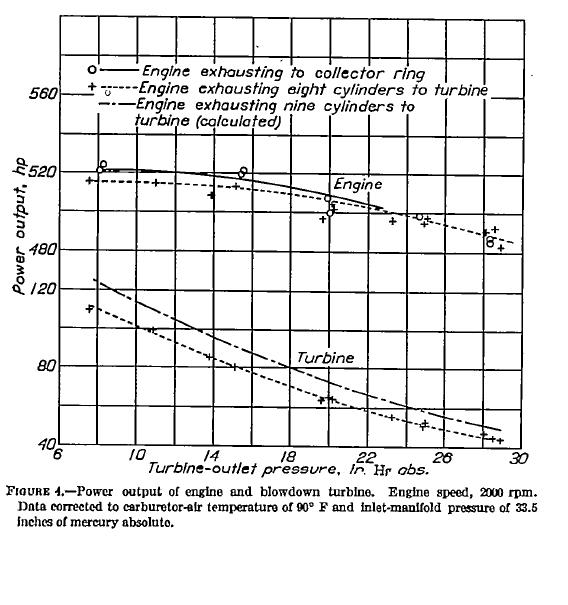
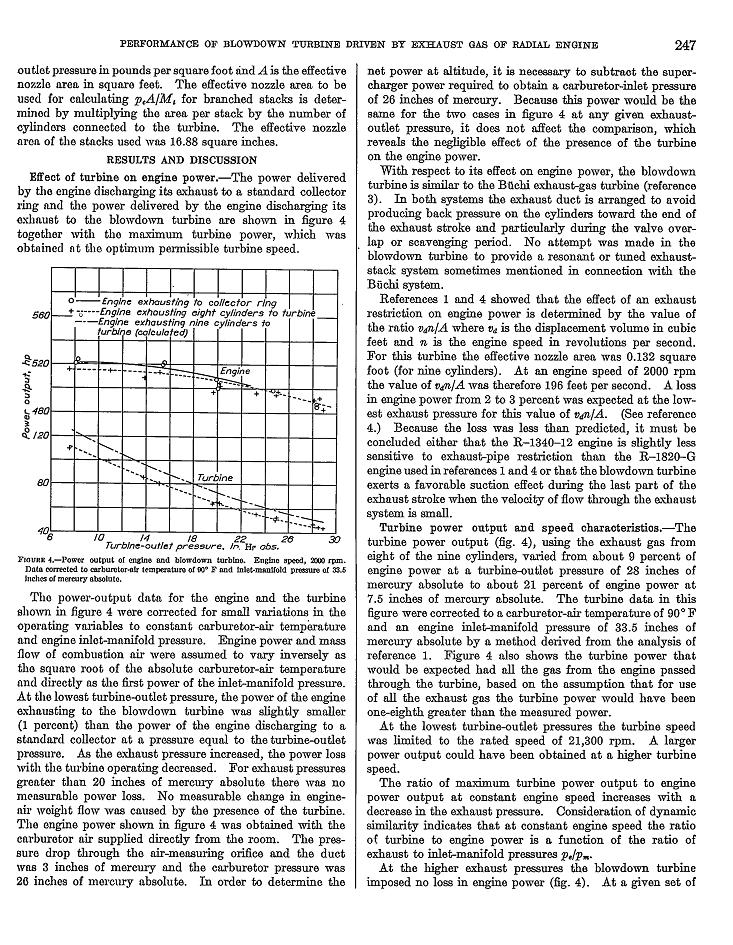
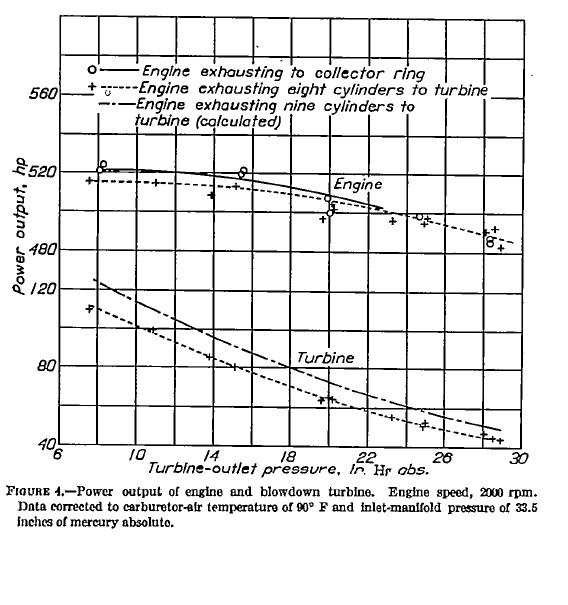
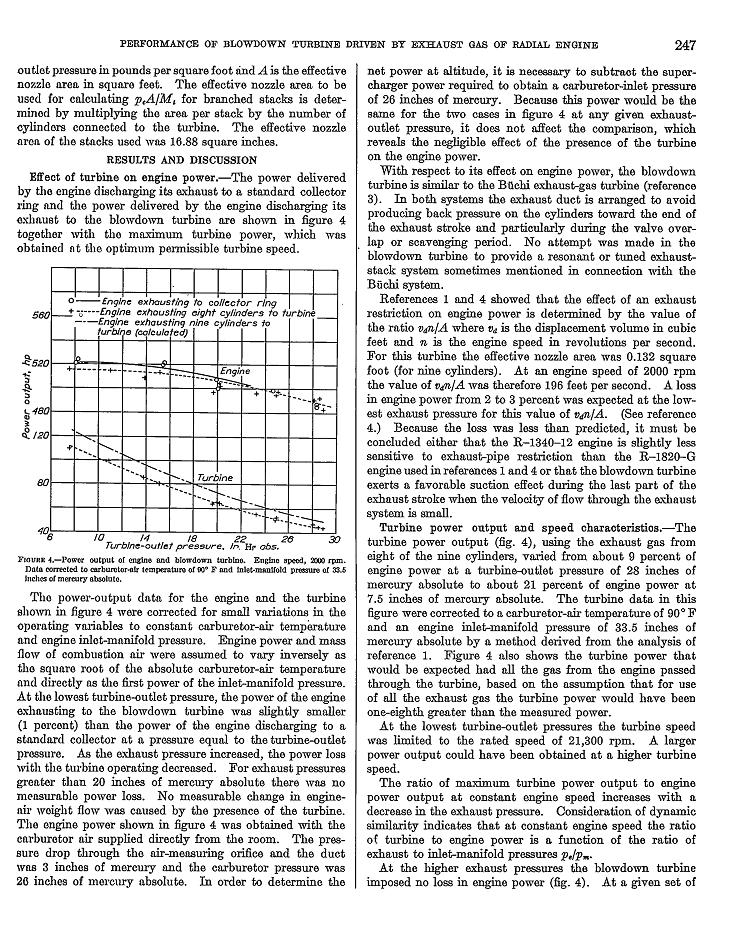
why the NACA paper shows us that recovery turbine performance vaires
in direct proportion to the outlet pressure.
The turbine outlet pressure should equal ambient pressure. As you go
higher the ambient pressure drops and your pressure ratio across the
turbine goes up, provided you keep intake manifold pressure
constant. That's why the Wright TC engines were so efficient in
cruise, because they were up high and those three recovery turbines
were kicking out huge amounts of power as a direct result of the
high pressure ratio.
In an airplane you just dump the turbine outlet to atmosphere, so
your turbine outlet pressure will always be equal to atmosphere --
unless you add a nozzle to try to extract some thrust performance,
in which case you will be making a bit of backpressue. It would be
an interesting trade study to see how much nozzle thrust you could
get before negatively impacting recovery turbine performance.
In diesel machinery it is not so simple to dump to atmosphere form
the turbine outlet and they may need to route that exhaust quite a
ways before dumping to atmosphere. So they could invoke some
backpressure.
Regards,
Gordon.
The Rotary Engine NewsLetter. Powered by Linux.
ACRE NL web site.
http://www.rotaryeng.net
Copyright 1998-2006 All world wide rights reserved.