Hello Paul,
I was looking over my 20B block today and preparing to start the
disassembly process when I noticed something that seemed unusual
to me.
Please understand that while I have quite a lot of experience with
piston engines, my rotary experience is negligible. I noticed that
there was a LOT of carbon build up in the Primary Intake Ports
while the
smaller secondary ports were squeaky clean. Is this
normal? I've seen
exhaust ports do this but usually the intake ports are
clean.....aren't
they???
Don
That is a little strange. I don't recall seeing that on
a two rotor. I wonder the history of this particular 3 rotor.
Perhaps it was loafed around town its entire life. Perhaps
the turbo charger oil seal was leaking and oil was being sucked into
the intake manifold.
Paul Lamar ...No rotor no motor.
Paul,
It looks like could be exhaust residue. My 20B had exhaust port inserts
with passages going back up to the intake, but I don't remember
exactly where they terminated. I do remember that there was a lot of
buildup in them. I removed the 20B exhaust inserts and replaced them
with 13B turbo inserts. Could this be residue from the exhaust
recirculating back into the primary intake ports?
Mark S.
The purpose of that is to warm the cold side of the engine
so the engine does not deflect into a banana shape. The flow goes into
the center housing up and over to the rotor housings down and back
to the end housing and exhaust ports.
This can be seen in the book Rotary engine downloaded from:
http://www.wankel.net/~krwright/cars/rx7/manuals.html
Everybody download both version of this book. It is the bible of the
rotary engine.
Paul Lamar ...No rotor no motor.
Paul,
I just went out to the garage and looked at an '89 6-port center
housing. It has an EGR valve bolted to the top. There's a passage down
near where the exhaust port is located on the rotor housing that leads
up through the center housing to the EGR valve. From the EGR valve,
there are two small passages leading to the two primary intake ports.
There's a thick layer of soot on all passageways. I was thinking that
the 20B had a similar system that would account for the buildup in the
intake ports. On the 20B, I think that this passage is routed through
the intake manifold.
Mark S.
Yes that is true on the 6 port but it dumps into the primary ports
real close to the rotor. I don't know how they do it on the 20B if they
use EGR. I suspect the center housing is stock turbo 13B. The special
20B intermediate housing may be a different matter. My 3 rotor
is completely assembled so it is hard for me to tell.
There are no manuals for the 20B in English.
Oh I just remembered since the 20B is a turbo
The turbo version of the 13B have the EGR blocked off
at the top of the center housing with no EGR valve.
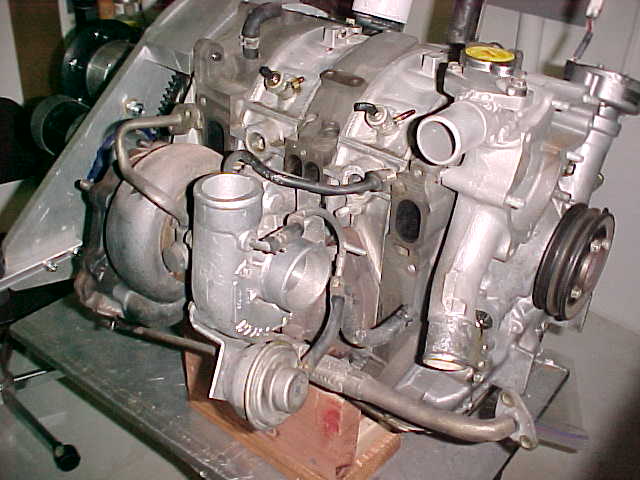
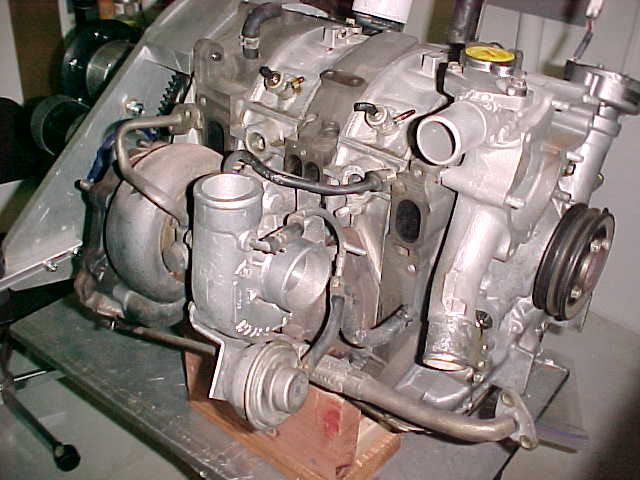
See the attached picture.
There is still EGR however on the 3rd gen 13B but it is
done differently. The 3rd gen turbo 13B is most like a 20B.
I am voting on a leaking turbo charger oil seal.
Paul Lamar ...No rotor no motor.
The Rotary Engine NewsLetter. Powered by Linux.
ACRE NL web site.
http://www.rotaryeng.net
Copyright 1998-2006 All world wide rights reserved.