> I would be interested in reading that paper Adam if
> you can scan it in and email it to me.
> Paul Lamar
I glanced over references to it, and once I figure out
where it was referenced I'll track it down. Should be
a good addition to the topic.
In poking around looking for the actual paper, I did
find some interesting discussions on this and closely
related topics. Most of the research that'll be
applicable to aircraft is stuff for big diesels used
on trucks and the like, as you've noted. The
automotive stuff covers a wider range of operating
regimes for the engine, so the research in those areas
sometimes can be built upon for aircraft use, and
sometimes it's too much complexity for no usable gain.
There are some interesting thoughts there, though...
http://www.aci.dir.bg/
Here are a couple of Bulgarians who had the same idea
(using a hydraulic "shaft" to reduce the issue of
matching turbine to crank speed), but took it a step
further for auto use; they set up a hydraulic
accumulator to store the exhaust energy (and recovered
braking energy), to be distributed among power
accessories and/or drivetrain boosting as needed. No
real use for the accumulator on an aircraft unless you
wanted to use it as part of a redundant hydraulic
system for control surfaces or the like, but the
problems with the hydraulic turbo compounds I was
speaking of, for road use (keeping the turbine inside
of its area of efficiency under a wide variety of
engine regimes), do not exist on aircraft and would
not be an obstacle.
Apparently a lot of people are using a hydraulic
coupling to absorb transients and the like while the
majority of the transfer process is handled by gearing
and shafts. I found several papers relating to such
engines; here's one on control modeling for such an
engine, for instance.
<http://www.vehicular.isy.liu.se/Publications/MSc/03_EX_3443_OF_MG.pdf>
My idea is sort of an intermediate between these two.
You could basically make a turbosupercharger where the
compressor pushed hydraulic fluid, have a small
accumulator to handle any transients in hydraulic
pressure, and then "gear down" the energy in the
hydraulic line by sizing your turbine accordingly.
You could use multiple blow-down turbines as long as
there was enough heat energy left to be extracted to
make the extra weight worthwhile. You could, say, set
up the first stage to apply hydraulic power directly
to the crankshaft; a secondary sequential turbine
could run a small accumulator for control surface
motion or gear retraction/extension. A third you
might direct-couple to a car alternator as a backup
generating source for the electrical system. At
altitude, the drop in ambient pressure would increase
the power recovered, and would continue to increase as
you climbed. Put your exhaust in a low-pressure area
or using a nozzle, I believe, should improve
efficiency at all times as well. And of course, you
can use one of the turbines to drive a compressor to
pressurize the cabin (SAE paper at
<http://www.sae.org/technical/papers/670267> ).
Looks like almost everything I am finding relates to
"hydraulic hybrid" technology, rather than turbo
compounding. The technology uses the ICE to power a
hydraulic system in the examples I have seen which
delivers hydraulic power to the wheels, and recovers
the energy to a hydraulic reservoir under braking.
Not too useful for aircraft use. :/ The EPA actually
has patents on some of that technology, which it is
sharing; UPS recently built a small fleet of hydraulic
hybrid trucks for regular route use, and they
apparently are far more efficient at recovering and
storing energy obtained by braking than electric
hybrids. Getting the weight down for passenger car
use is the challenge there.
Also, looks like someone patented your design idea
(using the CVT, although they connect it to the output
shaft of a transmission rather than to the crank):
<http://www.freepatentsonline.com/4452043.html>
Also, BMW has developed a two-loop steam-based power
recovery stem for use on cars; it takes heat from the
cooling system, as well as from the exhaust and
catalyst, to boil water and turn a turbine which is
connected to the crank. That's not too different from
my idea, which combines what I see called a
"differential" turbo compound system with a
hydraulic-based version of BMW's steam system.
I'll keep looking for more on my idea. I know I saw
reference to it somewhere in my recent travels, but of
course I cannot find it when I want it.
Adam Wade
The problem with all such systems that convert from
mechanical to an intermediate and back to mechanical is
what I call stacked efficiencies.
For example 85% times 85% is 72% overall. Pumps, generators,
electric and hydraulic motors, etc. are all around 85% efficient
on average while purely mechanical systems are in the high 90's.
Lets take an electric car for example using power from
an oil fired power plant a couple of hundred miles away. The
power plant is 50% eff. (giving it the benefit of the doubt) the
transmission lines 90% the conversion to a lower DC voltage and battery
storage 85% and the conversion back to mechanical energy from the battery
is 85%. Add it all up and one would get 32% overall. Just about what
one would get if they burned the oil directly in a piston engine
without the extra weight.
Probably the larger penalty is the weight. A diesel electric
motor locomotive is a good example. There is a diesel engine and
and a generator and motors on all wheels. The weight is desirable
as the friction of steel wheels on steel rails is not that good.
You need a lot of pulling power to accelerate and pull a train.
However the torque of the electric motors at stall is outstanding
and the ease of distributing the power to multiple wheels is
also out standing so this is the defacto standard for locomotives.
The stacked inefficiency is tolerated for those reasons.
All this applies to hydraulic conversion systems as well.
It is hard to beat a purely mechanical system.
Paul Lamar ...No rotor no motor.
The power plant is 50% eff. (giving it the benefit of the doubt)
With the present technology electrical power plants cannot do better
than 35 % , most cannot reach that.
Rino
-----------------------------------------------------------
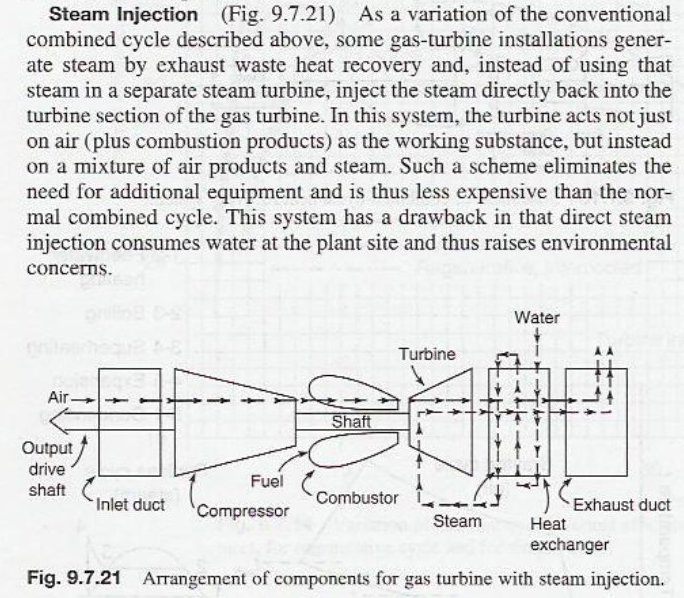
There are some new ones out there using gas turbines that exceed
50%. What they do is take the waste heat from the exhaust (just like
a turbo compound engine) and make steam. Then they feed the steam through
a steam turbine connected to another generator. They are called
combined cycle engines. Here is a scan from Marks Mechanical Engineers
Handbook Tenth Edition page 9-130 on the subject.
-
Paul Lamar ...No rotor no motor.
The Rotary Engine NewsLetter. Powered by Linux.
ACRE NL web site.
http://www.rotaryeng.net
Copyright 1998-2006 All world wide rights reserved.