>> > Paul,
>> >
>> > It is not correct that range has to suffer by burning ethanol. In
>> > fact range can increase if you fly above 10,000 ft density
>> altitude.
>> >
>> > The reason is that ethanol has an oxygen content of about 25
>> > percent. The effect is like supercharging, or nitrous oxide, or
>> > dragsters that use nitromethane which has huge amounts of oxygen.
>> > Gordon
>>
>> Sorry, this is not correct -- the oxygen in ethanol is
>> representative of
>> the fact that is has been partially oxidized, in other words,
>> partially
>> burned. So some of the energy content has been expended over being a
>> hydrocarbon. Nitromethane is a different story. The oxygen can come
>> free
>> of the nitro-groups and combine with any available hydrocarbons.
>>
>> You carry less energy per pound with ethanol, how you use it
>> determines
>> your specific fuel consumption, millage, etc.
>>
>> The evaporative cooling effects and octane effects are real, but the
>> oxygen content has already been used up (i.e. not available).
>>
>> Bill Schertz
>>
>>
>> Bill,
>>
>> Thanks for that insight.
>>
>> What exactly do you mean by, "partially oxidized?" The way I
>> understand it pure ethanol has an oxygen content of 35 percent, so
>> all of that oxygen should be available for oxidization, no? (AGE 85
>> is only 85 percent ethanol -- the rest is pentane isomerate -- so
>> its oxygen content is about 30 percent.)
>>
>> The oxygen is the reason the stoichiometric air-fuel ratio of
>> ethanol is lower than gasoline -- because when you add the same
>> volume of air, there is more total oxygen due to the oxygen embedded
>> in the fuel, so you need more fuel to completely oxidize the extra
>> oxygen. See the attached table, "Ethanol Gasoline Properties."
>>
>> The heat energy of ethanol per pound or per gallon is lower than
>> gasoline, as you pointed out. However, the oxygen in the ethanol
>> results in better thermodynamic efficiency, so power actually goes
>> up. You can see in the attached chart that an O-470 engine running
>> on AGE85 has 15 percent more peak power.
>>
>> The graphic on flight test data shows that at 10,000 feet a Mooney
>> with an IO-360 running AGE85 has a fuel burn at lean mixture that is
>> less than the same plane on avgas at 8,000 feet. One of the
>> advantages of ethanol is that very lean mixtures can be safely run.
>>
>>
>>
>> Regards,
>>
>> Gordon.
>>
>
>
> Gordon,
> Thanks for all the background charts. I need to study them in detail,
> and am traveling without availability of printer at this time.
>
> Here is where I am coming from. You buy fuel to put energy into your
> tank to take with you on the trip. Your engine converts the fuel into
> heat by burning it, converting the carbon in the fuel to CO2 and the
> hydrogen in the fuel to H2O. The engine then converts the thermal
> energy into mechanical energy which drives the prop and then your
> airplane.
>
> When you buy ethanol, you are buying a fuel with 11,600 Btu in each
> pound of fuel, as opposed to gasoline at 18,700 Btu per pound. This
> means that you are carrying less energy with you when you depart the
> ground. Reason dictates to me, that if the engine operates at roughly
> the same efficiency that leaving the ground with less energy
means that
> you will not be able to go as far.
>
> Now as to the comment about ethanol being partially oxidized, let me
> draw another analogy.
>
> Charcoal is essentially pure carbon (C). If we start to burn
charcoal,
> the process is:
>
> C + 1/2(O2) ---> CO, with the release of heat. It then it reacts
> further, CO +1/2(O2) ----> CO2 with the release of more heat.
>
> CO is carbon monoxide, and will burn, going in the second step to the
> fully oxidized state of CO2. CO is a colorless (poisonous) gas, that
> during the turn of the century (1900's) was used as a stove fuel and
> lamp fuel in houses. It was produced by partially oxidizing coal, and
> then shipping the resultant gas to the customers. CO contains less
> energy than C, because it is 'partially burned' carbon. CO2 is fully
> burned carbon.
>
> CO is 57% oxygen content, and
> CO2 is 72.7% oxygen content. I don't anticipate that anyone wants to
> run with CO2 as a fuel even though it is a very highly oxygenated
> compound.
>
> Ethanol is C2H5OH, and can be made (chemically) by partially
oxidizing
> Ethane
>
> C2H6 + 1/2(O2) ---------> C2H5OH + heat
>
> Ethanol will then contain less BTU/pound than the Ethane that you
> started with because you released heat by partially burning it.
>
> As I stated, I need to study your attachments when I can print them
> out and view them in detail. I will do so in about a week.
>
> Keep in mind that ENERGY is what gives you range in an airplane,
> and POWER is what gives you performance. Ethanol can allow an engine
> to develop more POWER, but it contains less energy/unit weight or
volume.
>
> Bill Schertz
Well said Bill.
Another way of looking at is the redox cycle. To oxidize (burn)
something,
else has to be reduced or "un-oxidized." This is called the redox
cycle by
chemists.
When you burn a fuel with oxygen (other oxidizers are possible) the
fuel is
oxidized and the oxygen is reduced. If the oxygen is already
reduced, as it
is in alcohol, it is unavailable for further reduction.
I won't get into the fact that oxidation and reduction are really an
exchange of electrons at the atomic level because it makes my head hurt
to think of it. :)
Doc Custer
Retired Software Engineer and sometime Audiologist
Bill and Doc,
Let's start by defining what is being argued. I contend that the
oxygen in ethanol is fully available for burning, or oxidation, and
the result is that there is an increase in power akin to mild
supercharging.
Your side contends that the oxygen in ethanol is already oxidized
and is therefore not available for burning.
Who is correct? Well, we have to review some basic molecular
chemistry here.
Doc mentioned reduction and oxidization. And Bill mentioned the
concept of "partially oxidized." Both are true.
A decrease in an atom's oxidation state is called reduction.
An increase in an atom's oxidation state is called oxidation.
The state of an atom's oxidation is expressed by its oxidation
number. Most elements have more than one oxidation number, so they
can exist in various states of oxidation. Carbon, for example, which
is the fuel in gasoline, ethanol, coal, etc. has nine states of
oxidation, from -4, to +4.
Carbon that is fully oxidized will have an oxidation number of 4.
Carbon dioxide, CO2 is an example. It cannot be further oxidized, so
it is no longer a fuel that can burn. (It can be reduced back to a
lower number, though, which plants do by using it to make sugar.)
However, the oxygen in that CO2 molecule has an oxidation number of
-2, just like oxygen does in any other compound -- except peroxides,
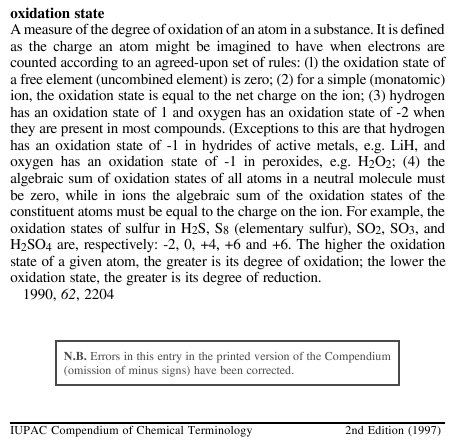
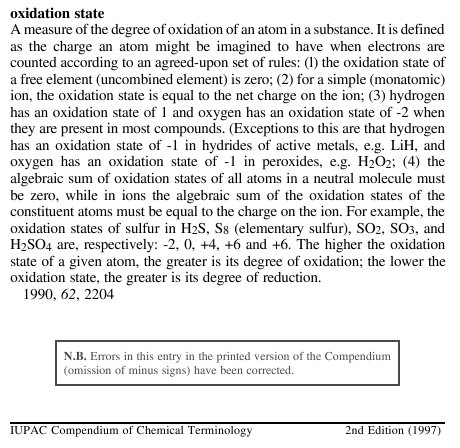
superoxides or oxygen fluorides. You can see the rules about
predicting oxidation state here ( and the attached page):
http://www.ausetute.com.au/oxistate.html
So the oxygen is not oxidized, even in CO2. The same is true for the
oxygen in CO -- it also has an oxidation number of -2.
The difference between CO and CO2 is the state of oxidation of the
Carbon. The carbon atom in CO has an oxidation number of +2, so it
can be further oxidized, or burned. In fact carbon monoxide used to
be burned as a stove fuel in the 19'th century, as Bill pointed out.
Ahh, the good old days...
So the reason why CO will burn and CO2 will not does not have
anything to do with the state of oxidation of the oxygen part of the
molecule -- they have identical oxidation numbers, -2. The reason is
the difference in carbon oxidation. After all carbon is the actual
fuel. Oxygen is simply the oxidant.
So we can see from this that any fuel -- such as hydrocarbon fuels
like gas and ethanol -- will burn (oxidize) when you add oxygen
because the carbon in those fuels has an oxidation state below its
maximum oxidation number of 4.
So what exactly is the oxidation number of carbon in ethanol?
Well ethanol's chemical composition is C2H5OH as Bill pointed
out.(Also sometimes stated C2H6O.
There are basically three groups to this molecule chain:
CH3 + CH2 + OH
The carbon in CH3 has an oxidation number of -3 and the carbon in
CH2 has an oxidation number of -1. The oxygen has an oxidation
number of -2, as it always has when it is part of a compound (with
the above noted exceptions).
There is a diagram of this here (scroll down to near the bottom of
this long page):
http://chemed.chem.purdue.edu/genchem/topicreview/bp/ch19/oxred_2.php
So we see that all the carbon in ethanol is perfectly good for
burning. Both of them can be oxidized quite nicely. Same thing for
the oxygen.
Now just to fill in the loose ends. Hydrogen always has an oxidation
state of +1, except in some very special circumstances. If you add
up all the hydrogen +1s in ethanol, you get +6. Now if you add up
all of the negatives in the carbon and oxygen, you get -6.
So there is a perfect balance which makes this a neutral compound.
So the bottom line is that all of the oxygen in ethanol is available
for oxidation. That is why an engine running on ethanol makes more
power, even though the heat energy in the fuel is lower.
The reason is that the extra oxygen in the ethanol allows you to run
a richer mixture, thereby adding more carbon and getting more total
heat. This is called the Specific Energy of the fuel and is why
racing fuels like Methanol (50 percent oxygen by weight and
Nitormethane make more power).
Here is an article that explains this nicely. Scroll down about
halfway to the heading Racing Fuels:
http://www.jagweb.com/aj6eng/superchargers.php
And btw, it is too simple to say that ethanol will decrease range,
even if it makes more power. Ethanol is like mild supercharging at
sea level. But at higher altitudes, the supercharging effect grows
because the ambient air pressure and density is less, so there is
less oxygen in the air to make power in your engine.
So if your fuel carries its own oxygen, the higher you fly the
bigger the ratio of oxygen coming from the fuel. The upshot is that
the power advantage over gasoline which was minor at sea level
becomes bigger at altitude. Just like supercharging.
And just like supercharging burns more fuel and causes an increase
in Brake specific fuel consumption, your range can actually increase
at altitude. The reason is that you can use the extra power to fly
at a higher true airspeed. The difference between true airspeed and
indicated airspeed grows bigger the higher you fly, but it takes the
same power to fly the same indicated airspeed.
So if you can go higher you can get better overall range and fuel
mileage even if your engine burns more fuel. I worked out an example
previously of a supercharged C-182 that would actually fly the same
true airspeed at 15,000 ft on 2 gph less than a normally aspirated
plane.
Regards,
Gordon.
The Rotary Engine NewsLetter. Powered by Linux.
ACRE NL web site.
http://www.rotaryeng.net
Copyright 1998-2006 All world wide rights reserved.