> Bill and Doc,
>
>
> So the bottom line is that all of the oxygen in ethanol is available
> for oxidation. That is why an engine running on ethanol makes more
> power, even though the heat energy in the fuel is lower.
>
> The reason is that the extra oxygen in the ethanol allows you to run
> a richer mixture, thereby adding more carbon and getting more total
> heat.
> -----------------------------------
>
> I agree with all the discussion of oxidation. Very well explained
- until
> we get to this part. While true, by itself, it is misleading. The
engine
> will make more power, but only at a higher fuel burn; even for
the same
> power at the low altitudes it will take a higher volumetric burn.
Isn't the
> bulk of the power coming from oxidation of the carbon, and there
are fewer
> carbon atoms per gallon of ethanol? Yes; at higher altitudes
where there is
> less O2 available in the incoming air, the ethanol can have an
advantage.
>
> Or did you already say that?
>
> AL
----------------------------------
I have to work more on my reply, but the oxygen in ethanol is NOT
(I believe) available for oxidizing the carbon or hydrogen in the
ethanol. The oxygen in ethanol has already been reduced, just like
the oxygen in water (H2O) and is not available to combine with either
Carbon or Hydrogen.
Nitromethane and Nitrous, are a different story. The oxygen is tied
to a nitrogen, the bonds are different, and the bonds can be broken
by catalysis or heat and release the oxygen for combination with the
primary fuel. They truly do bring the oxygen into the combustion
chamber in the form of a liquid fuel.
It will be a few days before I can get to my reference books to be
able to explain it. If I become convinced that Gordon is right, I
will certainly say so, but I believe that the increased POWER effects
of ethanol and methanol are due to something other than that they
are carrying Oxygen into the combustion chamber.
Bill Schertz
Bill,
What about Methanol? There is no nitrogen in Methanol, yet it makes
a lot more power than gasoline, and ethanol. And just as we might
expect, the fuel flow is greatly increased. There is no other way to
explain why oxygenated fuels like ethanol and Methanol make more
power, except for their oxygen content.
If it's not the oxygen, what is causing the increased power?
Let's go a little deeper into the basics, which means understanding
a little more about how and why atoms attach to each other. Each
carbon atom in hydrocarbon fuels like gas, ethanol, etc. is always
attached to at least two hydrogen atoms.
When oxygen and a spark is added, the result is combustion which is
a reaction of the carbon atoms breaking their electron bonds with
the hydrogen atoms and forming bonds to the oxygen atoms. The
breaking of the bonds is a violent kinetic process that translates
into heat energy. (Heat is just atoms shaking and vibrating very
quickly; cold is when they are very still).
In order to fully oxidize, that is to get to its maximum oxidation
number of +4, each carbon atom must hook up with two oxygen atoms,
each of which has an oxidation number of -2. The result is CO2. The
positives and negatives add up to zero, as they must.
If there are not enough oxygen atoms to go around, then only one
oxygen atom will hook up with each carbon atom and you get CO,
carbon monoxide. Since oxygen is always -2, the oxidation number of
carbon in CO must be +2, in order for the positives and negative to
cancel. This is what is known as partial oxidation. The carbon in CO
can still oxidize once more by attaching to one more oxygen atom --
and it wil then have reached its maximum oxidation number of 4.
Now, what you are saying is that the oxygen in ethanol is not
available for this reaction because it is "reduced." It is correct
that the oxygen in ethanol is reduced. Oxygen in in free element
form has an oxidation number of 0 (as do all elements). So in the
air, O2 has an oxidation number of 0.
When that oxygen bonds to other atoms it's oxidation state is
reduced to -2. So it will always have an oxidation number of -2 when
it's part of any compound, whether it is ethanol, nitromethane,
methanol or anything else. There is no difference in the oxygen or
its oxidation state, or its oxidation number among all those fuels.
We can see exactly how the oxygen atom in ethanol is used in the
reaction. Let's look at what happens when ethanol burns:
2 C2H6O + 6 O2 -------> 4 CO2 + 6 H2O + Heat
In plain language we start with two ethanol molecules and add six
oxygen molecules and get four carbon dioxide molecules and six water
molecules, plus heat.
Just add all of the oxygen atoms up. Each oxygen is used. We start
with 2 oxygen atoms in the pair of ethanol molecules. We add 12 more
oxygen atoms in the six O2 molecules, for a grand total of 14 oxygen
atoms on the left side.
Now look at the right side. How many oxygen atoms are there? Guess
what? Fourteen. Four CO2 molecules for a total of 8 oxygen atoms;
plus six water molecules, each with a single oxygen, for a total of
eight. Eight plus six equals 14. Each and every one of the oxygen
atoms is used in the reaction. Some are used in the CO2, some are
used in the H2O.
We see the same thing in gasoline. a Gasoline molecule also contains
carbon and hydrogen. When you add oxygen the same kind of reaction
takes place and similar compounds result. The oxygen that is added
for the burning ends up in CO2, CO and H2O.
Here are two pages that show the long carbon and hydrogen chains
that make up gasoline.
http://www.calsci.com/motorcycleinfo/Gasoline.html
http://www.altfuels.org/backgrnd/fuelchem.html
There is also discussion of oxygenated fuels like ethanol and
methanol. In fact some jurisdictions, like California I believe,
have legislated the addition of oxygenates into gasoline in order to
more completely burn the carbon, so that less CO is emitted, which
is only partially oxidized carbon as we have seen. One of the
oxygenation agents is ethanol. They used to use MBTE, but it is
fairly toxic, so most places have switched to ethanol.
Now there is proof right there. If the oxygen in ethanol is not
available for oxidation, why are they adding it to gas for that very
purpose?
Now about the question of increased power with oxygenated fuels like
ethanol and methanol.
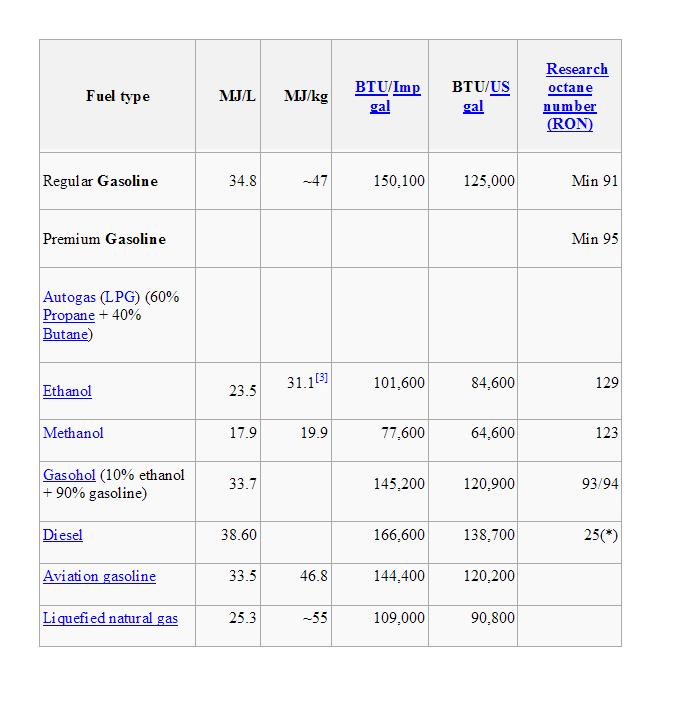
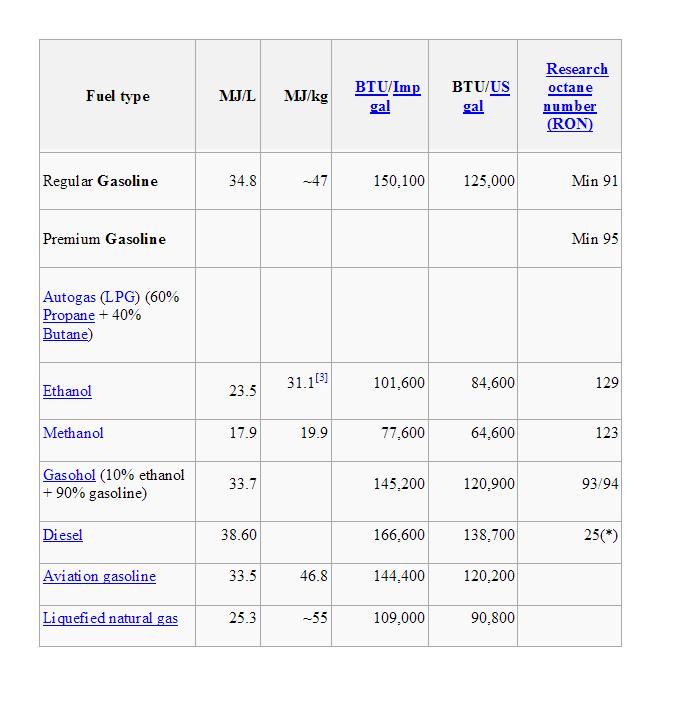
First have a look at the attached chart, which shows the properties
of the vvarious fuels, including the energy, or heat content. Notice
how gasoline is very high in energy content -- twice as high as
ethanol, and half again as much as ethanol.
Yet both ethanol, and especially methanol make a lot more power. At
first glance this doesn't seem to make sense. Surely the fuel with
the higher energy content should be more potent, right.
Well, the reason is very simple. Gasoline has a lot more energy
because it has a lot more carbon. It has long carbon-hydrogen
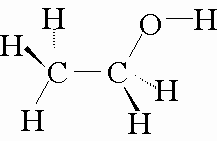
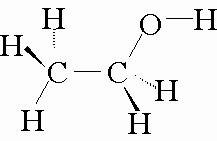
chains, unlike ethanol which has only 2 carbon atoms or methanol
which has only one (CH3OH).
So this abundance of carbon in gas is indeed a lot of potential
energy. But we know that in order for the fuel to burn completely,
each and every carbon atom must find two oxygen atoms to attach to.
If there is not enough oxygen, the carbon will only partially
oxidize (carbon monoxide), or not at all (raw fuel).
Now in an internal combustion engine, we are limited to the amount
of air we can take in by the displacment. That is the limiting
factor. We can easily add more fuel, if only we had more air and
oxygen to burn it with.
Even if we had a super fuel that had ten times the energy content of
gas, we could still only make the same amount of power because we
can only take in so many atoms of oxygen into our engine of fixed
displacement. We would end up simply using 1/10th of this "super
fuel" and gain no power at all.
But if our fuel had oxygen built right in, then we are no longer
limited by our engine displacement. We can just flow in more fuel,
which means more oxygen, and yet more fuel to provide the carbon for
that oxygen.
This is what we see with ethanol, methanol, nitromethane and nitrous
oxide. The key is the extra oxygen. The more oxygen the fuel has in
it, the more fuel flow we need in order to provide enough carbon for
that oxygen.
What we are after is stoichiometric combustion, which means that
each carbon atom is matched to two oxygen atoms.
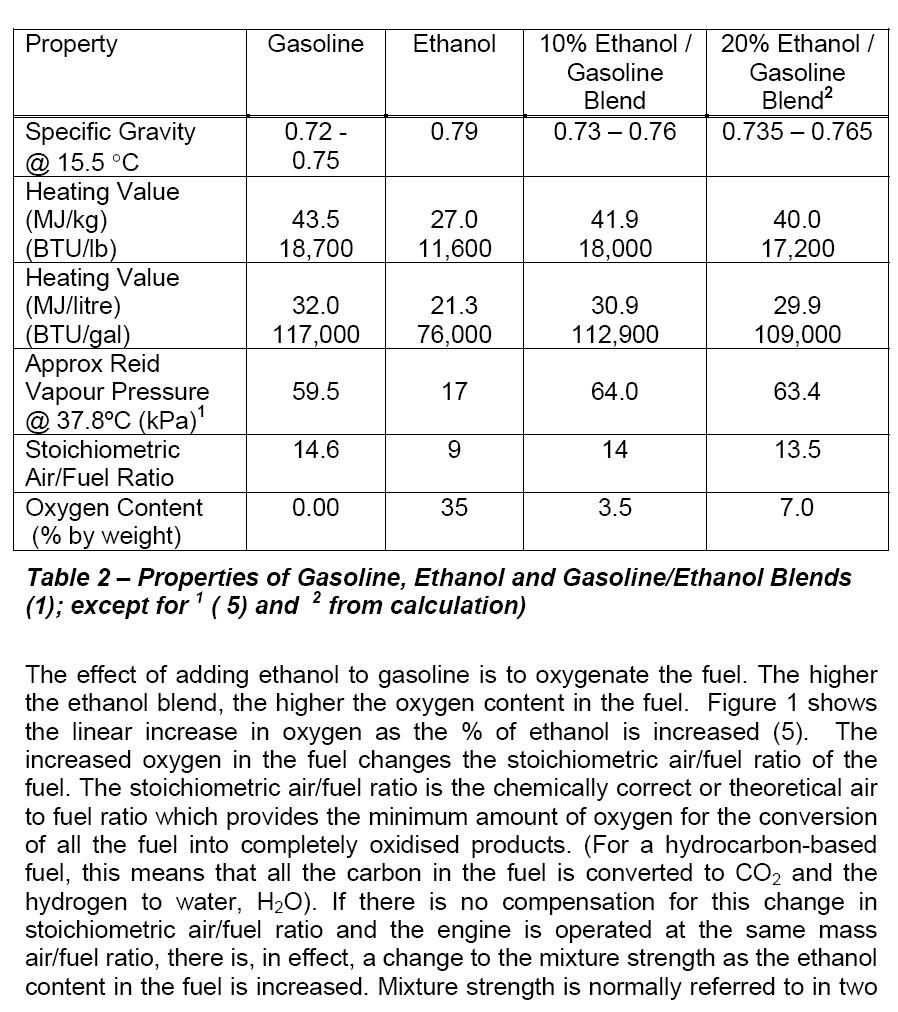
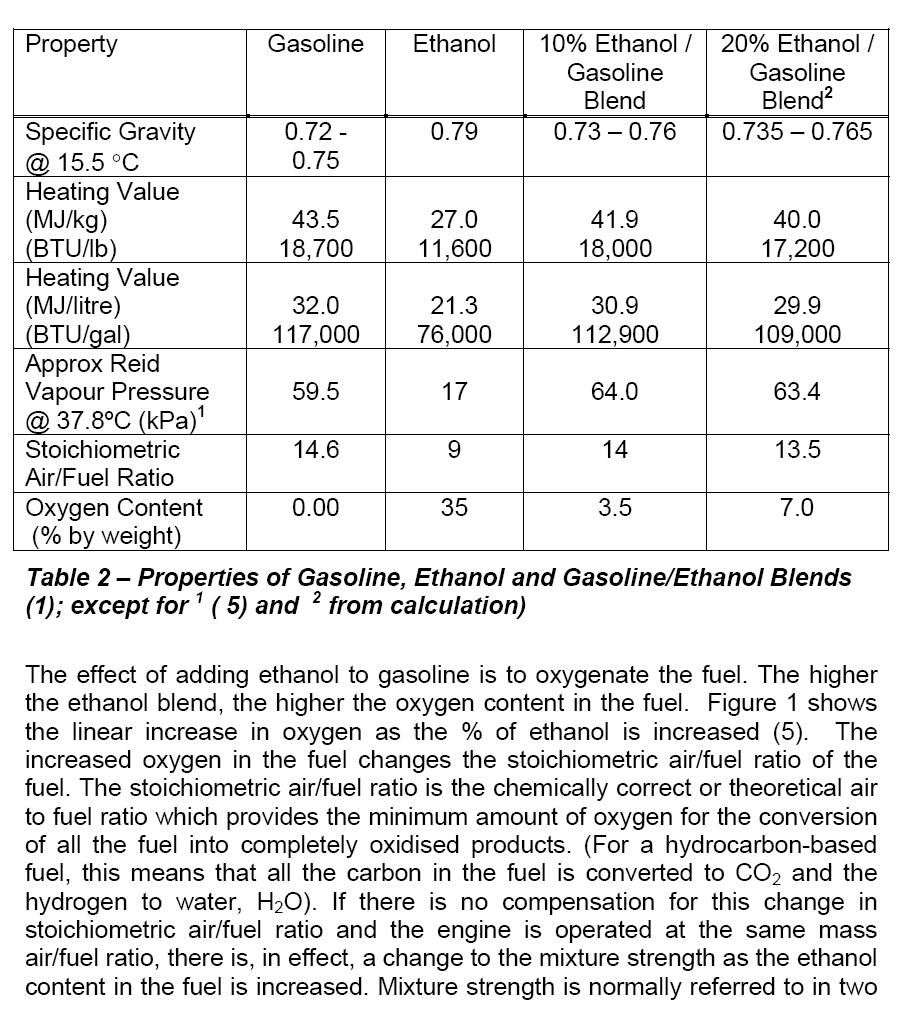
That's why we see that ethanol has a stoichiometric ratio of about
9, compared to 14.6 for gas. That means that for every 9 pounds of
air, we are adding 1 pound of ethanol. So we are adding 1.5 times as
much fuel if we run straight ethanol (14.9 / 9 = 1.62)
Now look at the heat energy table again. Methanol has about half the
energy content of gas, but since it burns best at an air fuel ratio
of about 4:1, you can increase the fuel flow by about 300 percent
over gas. So now you have 3 times as much fuel going into the engine
with 3 times the energy content. Total BTus are 64,000 * 3 =
192,000, which is about 50 percetn more than gas.
That's why methanol is a racing fuel and makes a lot more power. The
same is true for ethanol but to a lesser degree. We should also keep
in mind that the aviation grade of ethanol is 85 percent ethanol and
15 percent pentane, which is a hydrocarbon chain you see in gas
(five carbon atoms, hence the name pentane). This means it has more
heat energy than pure ethane, yet it also has the oxygen.)
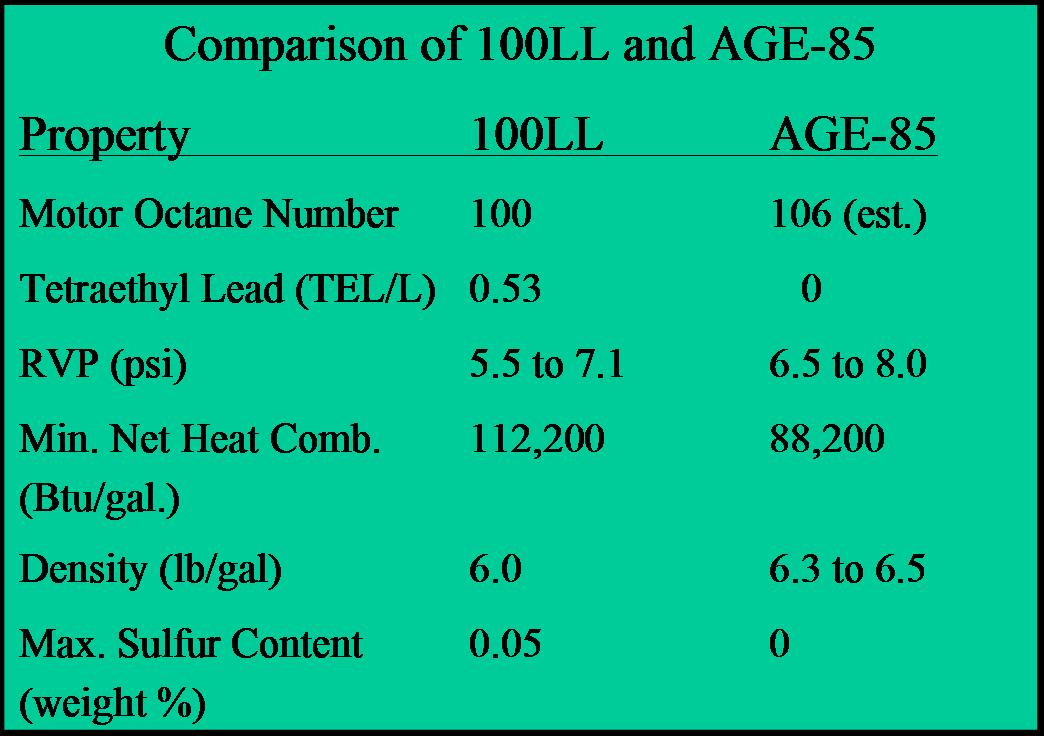
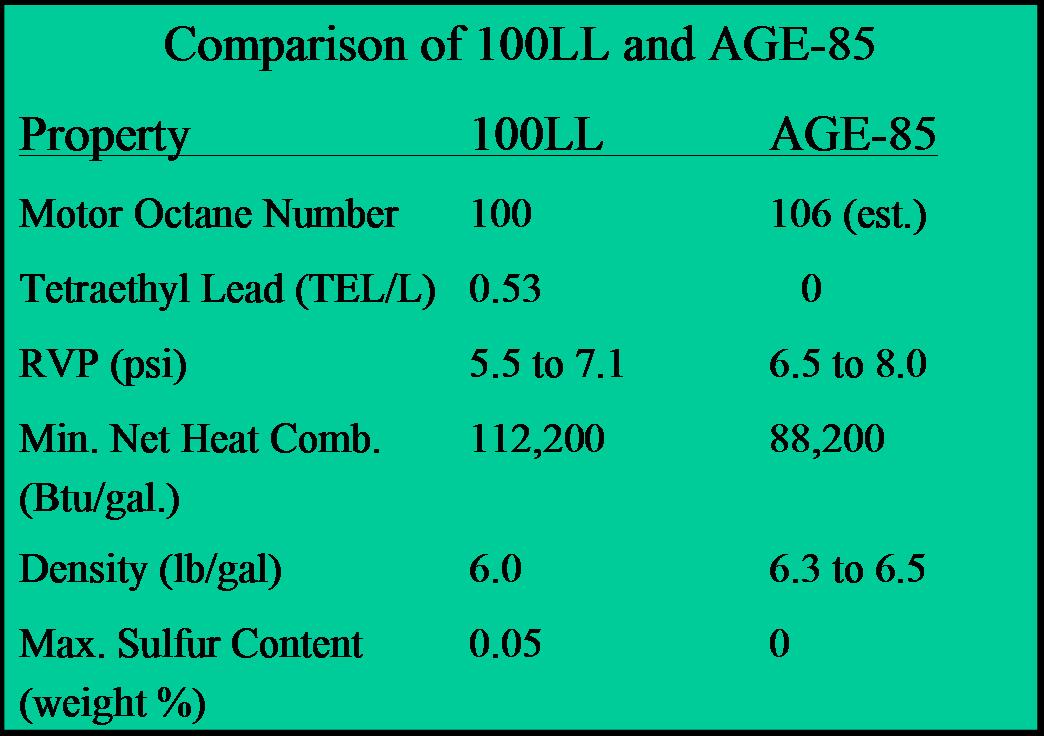
Have a look at the attached chart. The heat energy is 88,200 btu/g,
versus 112,000 for 100LL. Interesting to note that gasolines that
have higher octane have lower energy content. This is the reverse of
what we might assume.
And one final note about "partial oxidation." There is in fact a
process whereby eethanol is only partially oxidated, in other words
it is burned with very little oxygen. The reason is to produce
hydrogen fuel.
The reaction is thus:
C2H5OH + 1/2 O2 ------> 2 CO + 3 H2 + heat.
This is one method by which hydrogen fuel is made for fuel cells.
They do the same thing with gasoline and methanol. There is more
info here:
http://www1.eere.energy.gov/hydrogenandfuelcells/production/natural_gas.html
Clearly this has nothing to do with ethanol use in cars and airplanes.
Regards,
Gordon.
The Rotary Engine NewsLetter. Powered by Linux.
ACRE NL web site.
http://www.rotaryeng.net
Copyright 1998-2006 All world wide rights reserved.