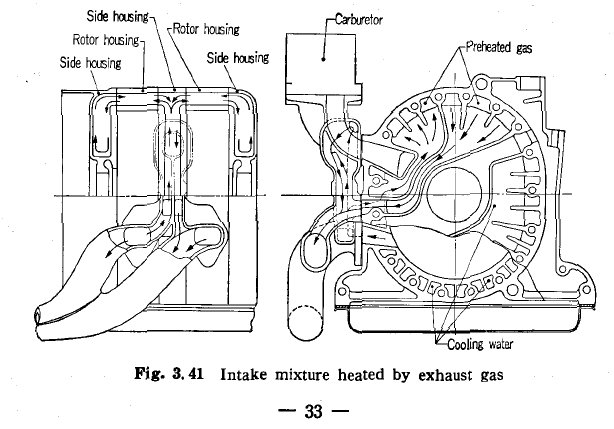
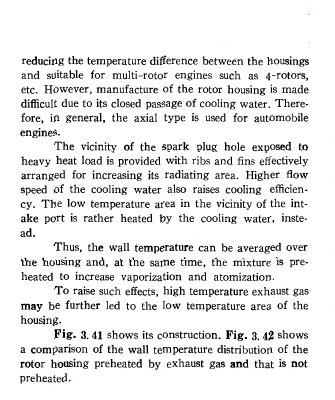
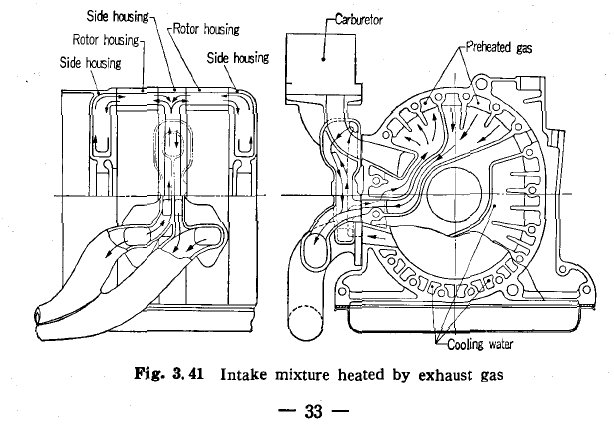
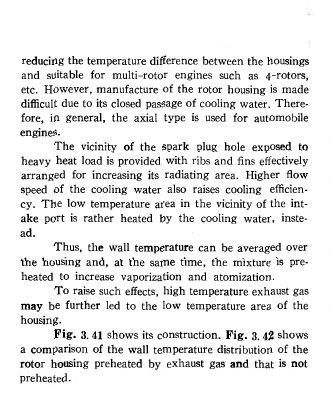
It seems from this info that the exh gas heating of
the cool side of the housings is a necessary thing. Is
there any easy way to retain this feature with the use
of P-ports?
regards, Robert
That is an interesting question as there are two kinds of
center housings. The turbo center housings are a different
casting and they appear not to pass the exhaust heated
gases into the rotor housings. So far I have a cutaway
turbo center housing but not one for a six port center
housing. Things are still a bit of a mystery on this
subject. Many p-port engines have been built over
the years. I have no info on drawbacks if any of using
a six port center housing for a p-port engine.
People mix and match all sorts of combinations of housings all
the time and you never hear of problems specifically
related to the presences or lack of exhaust heat in
the rotor housings. Perhaps Mazda felt it was more
important than it proved to be in practice.
Merely using an after market exhaust header on a rotary
engine will disable part of the exhaust gas heating system.
I'll forward this to Jim Mederer and perhaps he will
shed some light. Jim has built many many P-port engines
over the last 35 years.
Paul Lamar ...No rotor no motor.
Hi Paul,
Without knowing the context and testing background, I really don't
know what the diagram tells you. To my knowledge, Mazda has never
"heated" the top of the rotor housings with exhaust in
production rotaries. There have been exhaust passages in the cast iron
side housings, but not for heating (EGR, etc.) but none of them would
have had the marked effect on the rotor housing "wall" (whatever that
is) that the drawing implies. The very low rpm of the test suggests
that it was for light power use - possibly trying to improve combustion
efficiency at light power - and perhaps involves routeing exhaust gases
into the top half of the rotor housing (shown on the diagram) to see
what happens to temperatures all around the housing - though I am just
guessing. The diagram does not appear to have anything useful to say
for aircraft use.
Jim Mederer
Thanks Jim. The chart came from Page 33 of Kenichi Yamamoto's second
book on the rotary engine published in 1981 and downloaded from:
http://www.wankel.net/~krwright/cars/rx7/manuals.html
I agree. Not too relevant for high power engines.
Here is another diagram from the same page. This one looks
like an early four port 12A or 13B engine because of
the presence of the carb.
As far as I can tell, by looking at the actual center housings and
the cut aways, only the late six port had the hot gases in the rotor
housing and not the four port turbo engines.
Obviously not important as you, more than any one else,
would have noticed some side effects by now.
Paul Lamar ...No rotor no motor.
The Rotary Engine NewsLetter. Powered by Linux.
ACRE NL web site.
http://www.rotaryeng.net
Copyright 1998-2006 All world wide rights reserved.