Bill,
Thanks for the heads up on the lubricity issue
with AGE 85. In light of
what
you said it would be prudent for me to premix two
cycle oil, especially
since I will be going with the 10:1 Renesis
rotors. One point I would
appreciate your opinion on. I am considering
having the two or three
injectors per rotor.
I want to place an injector (probably the primary
for better idling) in
the
location of the oil metering hole and the
secondary injectors shooting
through the P port after the slide throttle.
Because of the size of the hole needed to provide
a spray directly into
the
chamber won't that hole volume lower the
compression ratio? Ditto a third
spark plug?
Thanks
Doug
Doug, I would be interested in your application of
injectors at the "oil
metering holes." Please keep me posted. Milo
Doug
I am also interested in your injector in the oil port
approach. Have you managed to remove the threaded
brass insert in the bottom of the port? If so, what
did it take? BTW the oil port is early in the intake
cycle, so I don't see any effect on C/R.
regards, Robert
Robert, Milo
I haven't touched the housings yet. I have several junk housings that I
would like the local machine shop to bore but they tend to want all drawings
done first so that they can do all three holes in the same session. That is
P-port, third plug hole, and oil meter location injector. I would like to
"just DO IT" but experience has taught me that while satisfying the
immediate urge I will have to do it over again:) The middle way is to have
them do a welding experiment for me.
I like the idea of having an O-ring or flat seal on the inner P-port step
and that requires either adding material through aluminum welding or pouring
epoxy in there before boring. Can JB WELD do it? Will the localized heat
from welding distort the housing? We will find out.
I am going to establish make sure the housing is already flat and then have
some inner measurements taken within the housing. I'll monitor inner housing
temperature rise and try to measure how much the housing distorts. Remember
these two housings are just test pieces.
The fuel injector hole size through the oil injector has not been decided
yet. For structural strength considerations I will drill out the oil
injector boss as little as possible and only use one injector in that
location. The challenge remains finding a short enough injector that perhaps
feeds from the side because it has to fit under the wrap over P port
manifold.
Regards
Doug
Doug, injecting the fuel directly into the chamber is a loser.
Been tried many times before. BSFC is hurt.
If you are still going with EFI I would put them out towards
the ends of the runners. That has proven to help the BSFC
slightly. Gives the fuel more time to vaporize.
That is why Lycoming heats the intake runners by passing
them through the oil pan first.
Also the 3rd spark plug has drawbacks. There is a loss of
compression as the apex seal passes over the hole.
Paul Lamar ...No rotor no motor.
Paul,
Perhaps with gasoline it is because it doesn't vaporize as easily. Hence
doesn't burn as throughly. With AGE 85 and a slight boosted I believe this
might be a different story.
No way would I ever feel comfortable spraying fuel into the ends of the bell
mouths manifolds, no matter what the fuel. F1 race cars perhaps. For my
airplane I will respectively pass on that idea. I hear you on the third
plug hole though and I am wavering. I do wonder if the 2% increase in both
power and BSFC that Lemans obtained was offset in any way by the loss in
compression. I believe that engine also used 10:1 rotors. I'll do it in the
test engine and try it both ways with the hole plugged or with spark plug.
Doug
When you spray it anywhere in a tuned runner you get a raw cloud
of fuel vapor out side the end of the runner. The same thing
happens with a carb so this must be contained in a plenum
of some sorts. I don't see why you have a problem with that :)
BTW spraying it into the oil port being only a few tenths
of an inch above the p-port you will probably see some
fuel vapor out near the end of the runners anyway but
I can't guarantee it :)
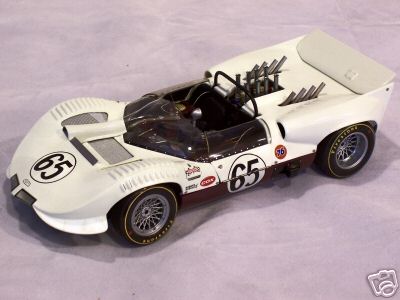
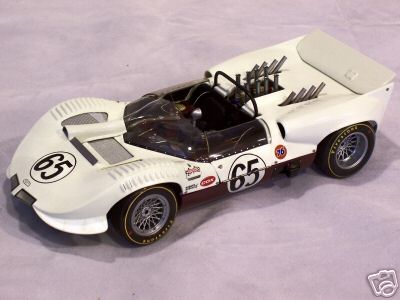
As an aside back in the real old early 1960's days of CanAm race cars
did not use plenum's. The carb stacks were just stuck up in the
air. Pic one. When I first starting working for
Chaparral I noticed this cloud of fuel vapor and realized it
would be sheared off when the car was at speed increasing the
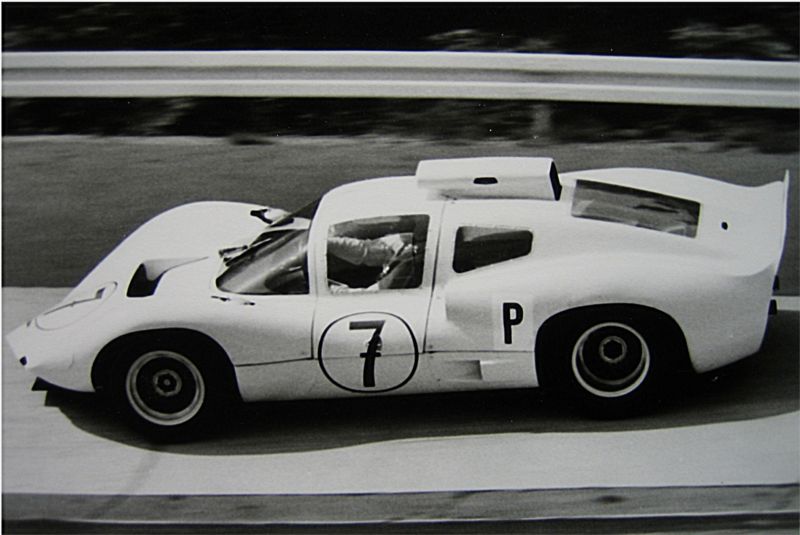
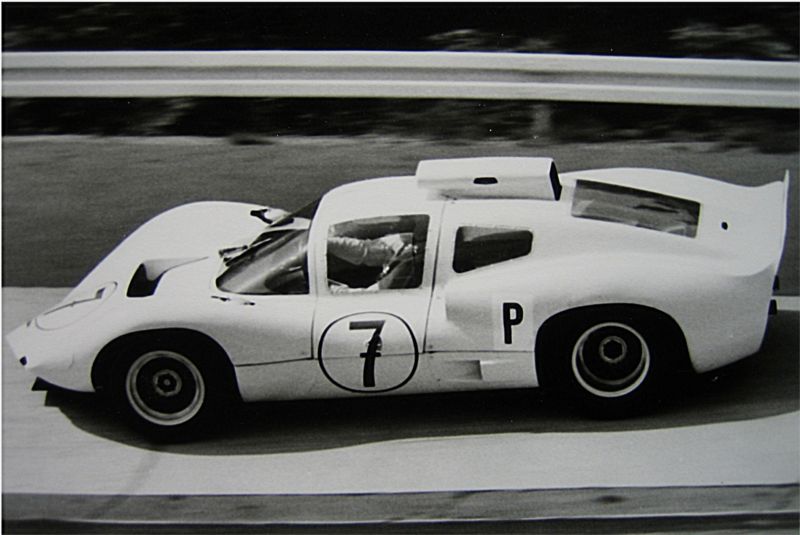
fuel consumption so I invented the scoop/plenum and applied
it to the Chaparral 2D. The other benefit was we got a little
ram air boost. We won the Nurburgring Ring with the 2D that
year. Second pic. Ever since that time scoop/plenums have become
standard equipment on race cars.
Paul Lamar ...No rotor no motor.
The Rotary Engine NewsLetter. Powered by Linux.
ACRE NL web site.
http://www.rotaryeng.net
Copyright 1998-2006 All world wide rights reserved.