> Okay,
>
> I'm going to chip in here as well. I use the actual
> displacement in
> my spreadsheet, 80 ci (1300cc) for the 2 rotor, 120 ci for the
> 3-rotor etc.
>
> Of course, with the rotary there is one combustion event per
rotor
> for each 360 degrees rotation of the engine shaft, which is
double
> that of a piston engine. So the effective displacement is
double.
>
> Regards,
>
> Gordon.
>
> I am going to have to add a section to my web site on this
subject.
> It keeps turning up like a bad penny :)
>
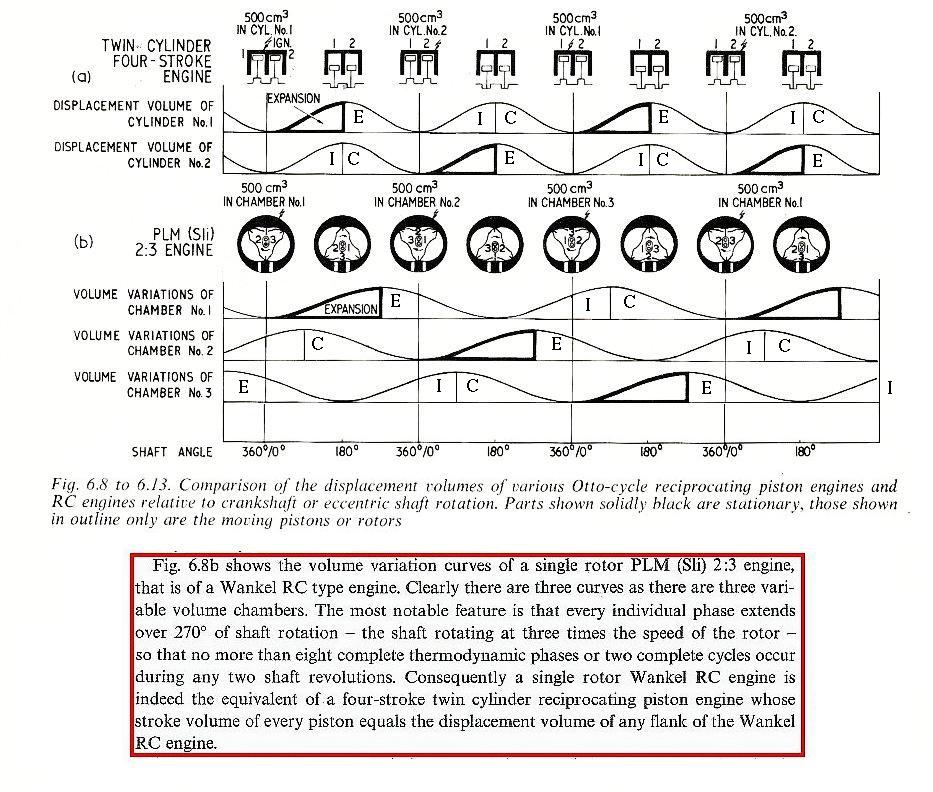
> Here is what Ansdale said about it and he did not obviously
put it
> to bed back in 1969 :)
>
> Paul Lamar
Yeah, I was just struck by a moment of melancholy when I realized
that Vance wasn't the one spearheading the objections..... He's
missed.
Chris Cosman
Yes. Vance died unconvinced.
Here is my latest Ansdale patch work on the issue.
--
Paul Lamar ...No rotor no motor.
Paul,
I don't understand what you are trying to say.
The actual physical displacement of the Wankel combustion
chamber --
that is, the volume of any of the three "flanks" of the rotor -- is
what it is. In the Ansdale illustration that is 500 cc.
In a 13B engine it is 1300 cc for the two rotors or 650 cc per
rotor. That is the actual physical volume and that is the amount of
air-fuel charge that is combusted in each power stroke. Is this
not so?
That is why the naming conventions of all Wankel engines that I
have
seen are based on actual displacement.
For each complete revolution of the three-sided rotor, there are
three power strokes. Since the engine shaft turns three times for
every turn of the rotor, that means one power stroke per turn of
engine shaft.
That means the "equivalent" or "effective displacement is twice
that
of a piston engine. But what actually happens is that each
combustion chamber of half the size has two power strokes, in the
same time frame as the piston engine has one power stroke of a
combustion chamber that is twice as big.
So how does it make it right to pretend that the Wankel combustion
chamber is twice as big? In order to do that we then also have to
pretend that a power stroke only occurs once every two turns of the
engine shaft.
To me that's like calling a 650 cc 2-stroke a 1300 cc engine.
What is wrong with this picture? I don't get it.
Regards,
Gordon.
Ah well you have touched on the solution.
The rotary is not a two stroke. It is a four stroke.
Lets turn it around. How much air would a 2.6 liter two cylinder
TWO STROKE engine pump in one revolution?
As far as HP is concerned the ONLY thing that matters is how much
air a four stroke engine pumps in ONE REVOLUTION at 100% VE.
Not the physical displacement of x number of chambers.
The definition of displacement, as far as engines are concerned,
is only valid in context with the type of stroke.
Here is what Ansdale has to say about that.
13B rotaries are raced in the 2.6 liter class world wide
for a good reason. The only reason they generate more power
than a 2.6 liter four cylinder engine is they turn faster
and breath better. Lately that is less true as the piston
engine RPM has been raised by detail development and the
use of high strength to weight ratio materials like titanium.
Also four valves per cylinder has improved the breathing.
It is very rare for any 2 valve cylinder to have a VE over one.
The RX8 engine is just over one and P-ports are typically
1.2.
Formula One (2.5 liter as I recall) V8 engines are now
turning 19,000 RPM. At least four valves per cylinder with
a very short stroke so larger valves can be used for a given
physical cylinder displacement. You will not find the details
of a competitive Formula One engine anywhere. Its a well
kept secret. However I would not be surprised if the VE's were
well over one. Applying the RPM difference to a 2.6L p-port rotary
making 340 HP at 10,000 RPM would make the Formula One engine
about 19,000/10,000 times 300 HP or 655 HP which is about
right for a Formula One engine.
Paul Lamar ...No rotor no motor.
I'm sorry I ever brought it up. I just wanted to know what turbo would
work best on my 20B.
Don
No need to be sorry Don. I certainly don't mind. Each time
I explain it I get better and better at it:) If you hadn't
somebody else would sooner or later. I need to add this
stuff to the web site.
Paul Lamar ...No rotor no motor.
Paul,
Not wanting to beat this silly topic to death (this is clearly a
potayto-potahto thing), but hp does not always depend just on amount
of air.
If you have oxygen in your fuel (ha ha)....
And yes, the 80 ci (actual discpament) Wankel does pump the same
amount of air as a 160 ci piston engine. But it does it by having
two intake strokes in the same time (measured in engine shaft
turns) a piston has one. (And two power strokes, etc.)
This economy of movement is the genius of the Wankel design. Half of
the piston's up and down motion is really wasted in a 4-stroke engine.
Regards,
Gordon.
" And yes, the 80 ci (actual displacement) Wankel does pump the same
amount of air as a 160 ci piston engine."
Not true. The 4 cycle 80 ci rotary pumps the half the air of a
160 ci 4 cycle piston engine. However a two cycle 80 ci piston engine
pumps the same air as a 160 ci 4 cycle piston engine. Nobody has
built a two cycle Wankel yet but it is possible.
"But it does it by having two intake strokes in the same time
(measured in engine shaft turns) a piston has one.
(And two power strokes, etc.)"
Half true. Yes the 80 ci one rotor does fire twice in 720 degrees and
a 160 ci one cylinder piston engine fire onces. The piston engine
in this case has twice the power.
Part of the confusion is there are three 80 ci active chambers working
in concert in the one rotor rotary and there are only two in the
2 cylinder piston engine.
BTW a simple two cycle, two cylinder piston engine would have four
active chambers. One above each piston and one below each piston.
Just in case we needed more confusion :)
As I said above: As far as HP is concerned the ONLY thing that matters
is how much air a four stroke engine pumps in ONE REVOLUTION at 100% VE.
The ONLY advantage the rotary has, HP wise, is a better VE and a
higher RPM capabilty. Nothing to do with a displacment advantage or
disadvantage or configuration.
Paul Lamar ...No rotor no motor.
The Rotary Engine NewsLetter. Powered by Linux.
ACRE NL web site.
http://www.rotaryeng.net
Copyright 1998-2006 All world wide rights reserved.