Paul,
I don't understand what you are trying to say.
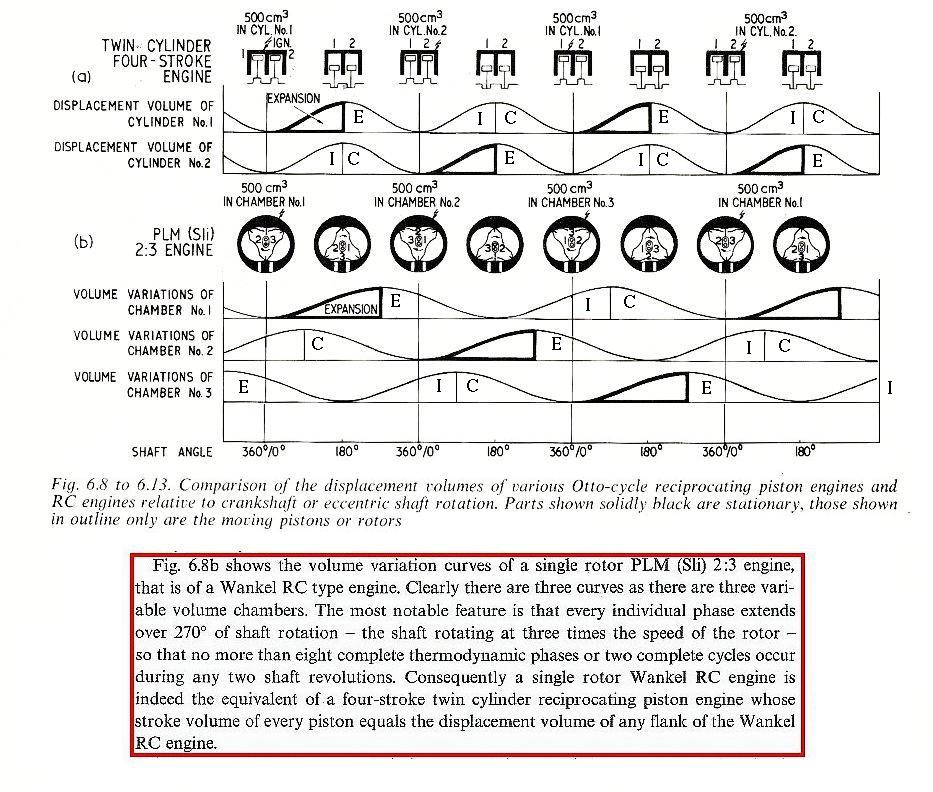
The actual physical displacement of the Wankel combustion chamber --
that is, the volume of any of the three "flanks" of the rotor -- is
what it is. In the Ansdale illustration that is 500 cc.
In a 13B engine it is 1300 cc for the two rotors or 650 cc per
rotor. That is the actual physical volume and that is the amount of
air-fuel charge that is combusted in each power stroke. Is this
not so?
That is why the naming conventions of all Wankel engines that I have
seen are based on actual displacement.
For each complete revolution of the three-sided rotor, there are
three power strokes. Since the engine shaft turns three times for
every turn of the rotor, that means one power stroke per turn of
engine shaft.
That means the "equivalent" or "effective displacement is twice that
of a piston engine. But what actually happens is that each
combustion chamber of half the size has two power strokes, in the
same time frame as the piston engine has one power stroke of a
combustion chamber that is twice as big.
So how does it make it right to pretend that the Wankel combustion
chamber is twice as big? In order to do that we then also have to
pretend that a power stroke only occurs once every two turns of the
engine shaft.
To me that's like calling a 650 cc 2-stroke a 1300 cc engine.
What is wrong with this picture? I don't get it.
Regards,
Gordon.
Ah well you have touched on the solution.
The rotary is not a two stroke. It is a four stroke.
Lets turn it around. How much air would a 2.6 liter two cylinder
TWO STROKE engine pump in one revolution?
As far as HP is concerned the ONLY thing that matters is how much
air a four stroke engine pumps in ONE REVOLUTION at 100% VE.
Not the physical displacement of x number of chambers.
The definition of displacement, as far as engines are concerned,
is only valid in context with the type of stroke.
Here is what Ansdale has to say about that.
13B rotaries are raced in the 2.6 liter class world wide
for a good reason. The only reason they generate more power
than a 2.6 liter four cylinder engine is they turn faster
and breath better. Lately that is less true as the piston
engine RPM has been raised by detail development and the
use of high strength to weight ratio materials like titanium.
Also four valves per cylinder has improved the breathing.
It is very rare for any 2 valve cylinder to have a VE over one.
The RX8 engine is just over one and P-ports are typically
1.2.
Formula One (2.5 liter as I recall) V8 engines are now
turning 19,000 RPM. At least four valves per cylinder with
a very short stroke so larger valves can be used for a given
physical cylinder displacement. You will not find the details
of a competitive Formula One engine anywhere. Its a well
kept secret. However I would not be surprised if the VE's were
well over one. Applying the RPM difference to a 2.6L p-port rotary
making 340 HP at 10,000 RPM would make the Formula One engine
about 19,000/10,000 times 300 HP or 655 HP which is about
right for a Formula One engine.
Paul Lamar ...No rotor no motor.
I tried not to go there.... warned you... don't go there.
To put what Paul said into one sentence: A 2.6 L piston engine (2.6 L
being the sum of the displacements of all pistons just like both rotors
add up to 1.3L) takes 2 revolutions to ingest the full 2.6 L while the
1.3 L rotary ingests it all in one revolution of the e-shaft.
Although I do see your point Gordon. There is actually a total of 1.3 L
of volume floating around each rotor so it might have made more sense to
just call it a 2.6 L rotary engine right from the get-go. Toe-mate-toe
Toe-mott-toe, use 159 c.i. in your turbo spreadsheet calculations or the
volume won't be right.
--
David Leonard
Turbo Rotary RV-6 N4VY
N4VY.RotaryRoster.net
www.RotaryRoster.net
leonardiniraq.blogspot.com
Thanks for helping me out on this Dave. I agree with
your point. The inventors and developers of the Wankel
did not do anybody any favors by claiming it was 1.3 Liters.
I don't think they had a clue of what controversy that
created over the years. It wasn't until Ansdale addressed
the issue in 1969 that even the developers understood the
real significance of the displacement label.
Now having said that your statement above is wrong :)
"A 2.6 L piston engine (2.6 L
being the sum of the displacements of all pistons just like both rotors
add up to 1.3L) takes 2 revolutions to ingest the full 2.6 L while the
1.3 L rotary ingests it all in one revolution of the e-shaft."
Both engines ingest the SAME amount of air in one revolution of
the out put shaft.
It helps to be specific. Say the number of cylinders and
whether is is a two stroke or four stroke.
Vance's argument was all three chambers ought to be added
up so a 1.3L rotary is really 1.95L and one most double so that
it becomes a 3.9L motor. The problem with that is all three
chambers don't complete all four cycles in 360 degrees of e-shaft
rotation. Vance explained the resulting power short fall in the 3.9L
rotary as due to low Brake Mean Effective Pressure AKA BMEP.
There is nothing wrong with the 13B's BMEP :) On the contrary
due to the high VE BMEP is higher.
BTW how close are you to flying your turbo 13B again? Got any late
pictures of modifications that I can critique? :)
Paul Lamar ...No rotor no motor.
David,
Thanks for confirming what I have been saying all along. The ACTUAL
physical displacement is 650cc per rotor. Period.
The fact that the Wankel accomplishes one complete Otto cycle in one
revolution of the engine shaft does not change the fact that the
physical volume is 650 cc (40 ci) per rotor.
I know why Paul is insisting on this. He just wants everybody to
stick to the same standard.
But let's say that you want to develop an electronic engine control
for your aircraft rotary engine. Now if you tell the fuel injector
to spray enough fuel for 80ci for each intake "stroke," what's going
to happen? It's going to be twice as rich, probably won't evn run.
Or what if you tell the ignition to only fire once for every two
revs? Because that's what we're pretending is happening when we say
the engine displaces 160 ci. It can't both displace 160 ci and fire
every rev -- it's one or the other.
I can easily change my spreadsheet to calculate on the basis of 80
ci per rotor. I don't think this is correct, but if it'll make Paul
happy then so be it.
Regards,
Gordon.
------------------------------------------------
Lets approach this from a different direction.
The actual physical displacement per rotor is not 650 cc.
Look closely at the chart. There are three chambers per
rotor. Each chamber is 650 cc. That is a total of 1950 cc.
Since there are two rotors the total physical displacement
is 3900 cc or 3.9L.
The inventors of the arbitrarily called it a 1.3 liter engine.
They could have called is a 3.9 Liter engine but that would
have run a red flag up to the Government that was taxing engines
on displacement at the time. Also it would be a piss poor, bad
breathing, low compression, low power, sorry excuse for 3.9L engine.
However it would have extraordinarily small outside dimensions for a
3.9L displacement internal combustion engine.
What to do?
What they should have done, and we would not being having this
argument now is, call it a 2.6L engine because that is how much
air it pumps in one revolution. It is also about the same air
a 2.6L 4 cylinder piston engine pumps in one revolution and generates
about the same amount of power. It also fires the same number of
times per rev that a four cylinder piston engine fires.
Now why does the 13B pump only 2.6L of air in one rev when
the physical displacement is 3.9L?
Lets look at a one rotor engine. All three chambers are in
their four cycles simultaneously. Intake, compression, expansion
and exhaust.
If you let all three of them to complete their four cycles it would
take more than 360 degrees of the output shaft because the rotors
only turn at one third of the output shaft RPM. What happens in one
rev of the output shaft? In one 360 revolution of the output shaft
one of the chambers has fired and all three of them working
together have pumped 1.3L of air. Exactly what happens in
a 2 cylinder 1.3L piston engine with only two chambers.
Too bad Ansdale was not around when Felix Wankel introduced
the rotary engine.
Paul Lamar
The Rotary Engine NewsLetter. Powered by Linux.
ACRE NL web site.
http://www.rotaryeng.net
Copyright 1998-2006 All world wide rights reserved.