This discussion of displacement has been the most
amusing thing I've seen in a long time. ;)
Each rotor rotates at 1/3 of e-shaft speed. Since the
rotor has 3 sides, each rotor has one intake "stroke"
per e-shaft revolution. Swept volume of one face of a
13B rotor is 650cc. Thus 1.3 L of air are ingested
(assuming a VE of 1.0, which I believe we have all
been doing for the sake of argument) per e-shaft
revolution. This is likely where the 1.3 L
designation comes from.
Since a 4-cylinder 4-stroke engine takes two
crankshaft revolutions to fully cycle all four
cylinders, to ingest the same amount of air per crank
revolution, the 4-cylinder 4-stroke engine would have
to displace 2.6 L. This is why we see the
double-displacement equivalence rule in many racing
classes. Unless you p-port, you're probably getting
fairly similar VE as you'd find on a fairly large
number of 4-stroke 4-cylinder car engines. Since as
was noted in another thread here that the amount of
available oxygen is your limiting factor, the
equivalence rule makes a lot of sense.
The main advantage, IMHO, of a non p-port rotary is
the fact that it has a lot more time to complete
combustion for a given "crank" speed than a 4-stroke
engine. Unfortunately, the shape of the combustion
chamber is far from optimal for combustion efficiency.
A modern pent-roof combustion chamber with a lot of
squish area does a far better job in terms of
combustion efficiency and thus nets more power and
lower BSFC, all other things being equal. Rotaries
have an additional advantage in not having to handle
the sorts of inertial loads found in a piston engine
from starting and stopping the piston's mass over and
over again, and with no valves to float, they can rev
higher than comparable displacement piston engines
usually can.
I am not entirely sure why the discussion of
displacement got so entangled. It's pretty basic...
Almost as basic as knowing when Mazda first built a
production turbocharged rotary. ;)
Adam Wade
Very good Adam I see nothing wrong with your explanation.
Except about the 12A turbo :) I am still not convinced.
I am still waiting for our resident expert John Dinkel
to comment on that. No mention of it in my Yamaguchi RX7 book.
Paul Lamar ...No rotor no motor.
OK, you guys a killing me!!
I got this entire thing started by trying to figure out why the turbo
spread sheets from Gordon and David yielded different numbers for me.
Both of these guys are obviously extraordinarily smart to have worked
out those spread sheets, and I am finding them both very useful sources
of information. The bottom line, and what got this entire thread
started, is that unless you know the correct displacement, your $2500
shiny new turbo is worthless. As David and Gordon both recognized, we
need to know the correct engine displacement to be able to calculate the
correct turbo to buy. If you enter the wrong displacement into either
of these spread sheets, you just bought the wrong turbo. Now I'm not
the guy to figure this all out, but I can definitely benefit from
knowing the right number for my 20B engine displacement. At this
moment, I'm very confused.
Don
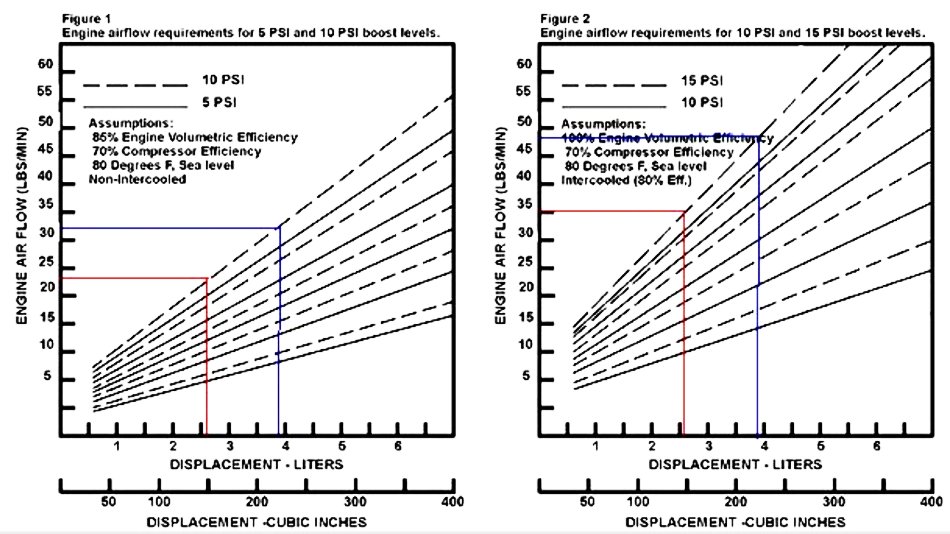
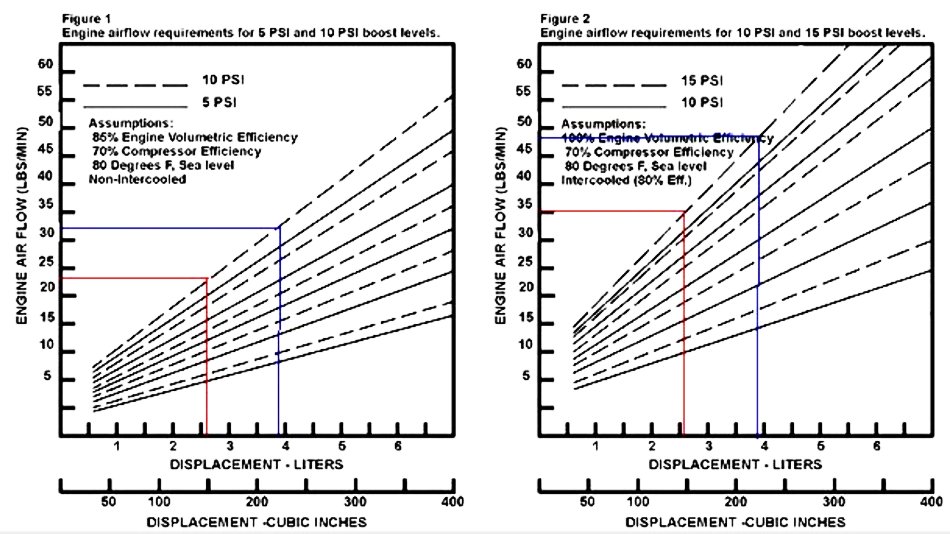
Not to worry Don. 3.9 liters or 238 cubic inches is it for a 3 rotor.
Here is a chart from MacInnes that might prove useful to you.
You need to correct these numbers for the VE you expect to
get. If you street port your engine and do your manifold right
you should get close to 100% VE. Use the chart on the right
and the blue line is a 3 rotor. 10 psi boost is plenty.
In other words you need a compressor that will flow 40 to
45 pounds of air a minute and compress it to 10 psi above
atmospheric which is 15 psi at sea level.
Keep asking questions. One at a time is the easiest and clearest.
Here is some more info that can be gleaned from this chart.
If you run your engine at a peak power mixture ratio
of 12.5 to one you will need 45/12.5 pounds of fuel
per minute. Lets say it is 3.6 pounds of fuel per minute
or 216 pounds per hour. Since there is about six pounds
of fuel in a gallon that works out to 36 gallons an hour.
If you are doing 350 MPH that is about 10 MPG.
Most people don't cruise their airplanes that fast and use
that much HP. Most people are seeing over 20 MPG at 200 MPH by
leaning the 13B engine to 16:1 or 17:1.
Paul Lamar
The Rotary Engine NewsLetter. Powered by Linux.
ACRE NL web site.
http://www.rotaryeng.net
Copyright 1998-2006 All world wide rights reserved.