OK, you guys are killing me!!
I got this entire thing started by trying to figure out why the turbo
spread sheets from Gordon and David yielded different numbers for me.
Both of these guys are obviously extraordinarily smart to have worked
out those spread sheets, and I am finding them both very useful sources
of information. The bottom line, and what got this entire thread
started, is that unless you know the correct displacement, your $2500
shiny new turbo is worthless. As David and Gordon both recognized, we
need to know the correct engine displacement to be able to calculate the
correct turbo to buy. If you enter the wrong displacement into either
of these spread sheets, you just bought the wrong turbo. Now I'm not
the guy to figure this all out, but I can definitely benefit from
knowing the right number for my 20B engine displacement. At this
moment, I'm very confused.
Don
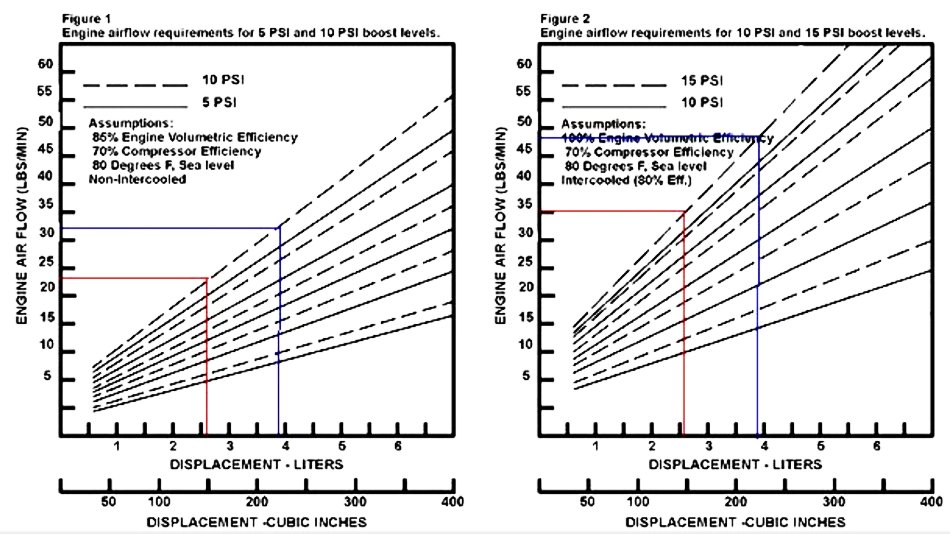
Not to worry Don. 3.9 liters or 238 cubic inches is it for a 3 rotor.
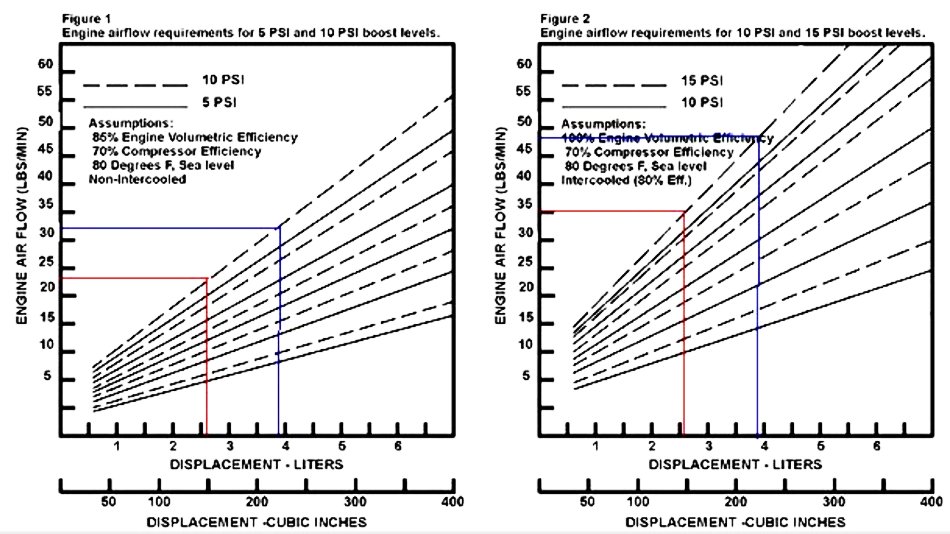
Here is a chart from MacInnes that might prove useful to you.
You need to correct these numbers for the VE you expect to
get. If you street port your engine and do your manifold right
you should get close to 100% VE. Use the chart on the right
and the blue line is a 3 rotor. 10 psi boost is plenty.
In other words you need a compressor that will flow 40 to
45 pounds of air a minute and compress it to 10 psi above
atmospheric which is 15 psi at sea level.
Keep asking questions. One at a time is the easiest and clearest.
Here is some more info that can be gleaned from this chart.
If you run your engine at a peak power mixture ratio
of 12.5 to one you will need 45/12.5 pounds of fuel
per minute. Lets say it is 3.6 pounds of fuel per minute
or 216 pounds per hour. Since there is about six pounds
of fuel in a gallon that works out to 36 gallons an hour.
If you are doing 350 MPH that is about 10 MPG.
Most people don't cruise their airplanes that fast and use
that much HP. Most people are seeing over 20 MPG at 200 MPH by
leaning the 13B engine to 16:1 or 17:1.
-------------------------------------------------------------
BTW Don, here is another turbo spread sheet done
by the former chief engineer on the General Atomics Predator..
Jeff Spitzer. Jeff should know as he got the Predator
up to 58,000 feet using a modified Rotax 914 turbo engine.
Jeff is also the person that modified the OMC one rotor
air cooled Wankel into the two rotor liquid cooled Moller
engine when he worked there.
Paul Lamar ...No rotor no motor.
The Rotary Engine NewsLetter. Powered by Linux.
ACRE NL web site.
http://www.rotaryeng.net
Copyright 1998-2006 All world wide rights reserved.