SNIP:
...........I turbo normalize plus (make moderate gains in power at S/L
through use
of the turbo then 'normalize' that amount of power for benefit at
altitude). I achieve that by use of the throttle.
I have a fixed waste 'gate' (exhaust bypass really) because it was the
easiest way for me to get a big wastegate. I believe an aircraft style
wastegate is an excellent choice, but a LARGE automotive style can work
equally well and is more available and less expensive.
David Leonard
Turbo Rotary RV-6 N4VY
N4VY.RotaryRoster.net
www.RotaryRoster.net
leonardiniraq.blogspot.com
David,
Again I apologize for my ignorance, but can you explain exactly what you
mean by "fixed wastegate"? If I understand the term "fixed
wastegate", its basically a wastegate that is always open a little to
allow a constant leak? That would also allow a constant percentage of
the exhaust to flow into the turbine side of the turbo. If that is
correct, Why use a "wastegate" at all? Why not just have a small
port before the turbine that leaks exhaust around the turbo and back
into the exhaust pipe? I guess a set up like that would require some
sort of trial and error getting the % of exhaust bypass correct. Maybe
some type of restrictor in the bypass port? But you would have much
control of the turbo that way!! Is that why you use a "fixed
wastegate"? So you can adjust the amount of bypass? How does that
differ from the normal wastegate operation? I thought a wastegate
cycled from open to closed based on its duty cycle. That's different
from the fixed wastegate isn't it?? Damn I'm confused!!!!! Also what
do you mean by, "then 'normalize' that amount of power for benefit at
altitude). I achieve that by use of the throttle." I didn't follow
that part at all.
Don
Don,
I think what David meant by his comments on normalizing is that he
runs a little bit of boost at sea level and is able to carry that
same level of manifold pressure to his critical altitude, which is
the maximum altitude at which he can maintain SL manifold pressure.
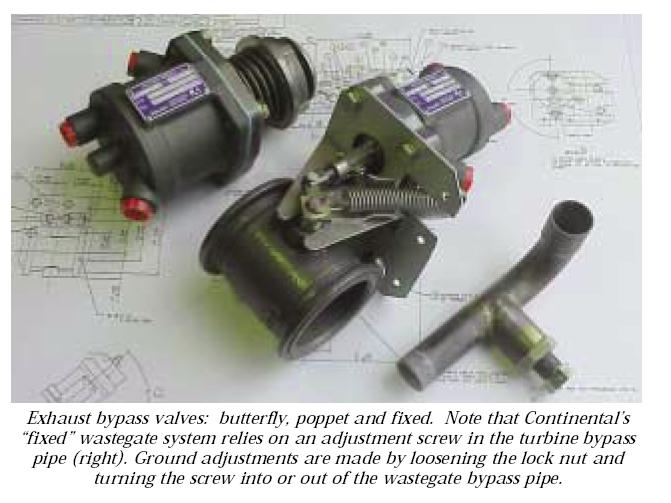
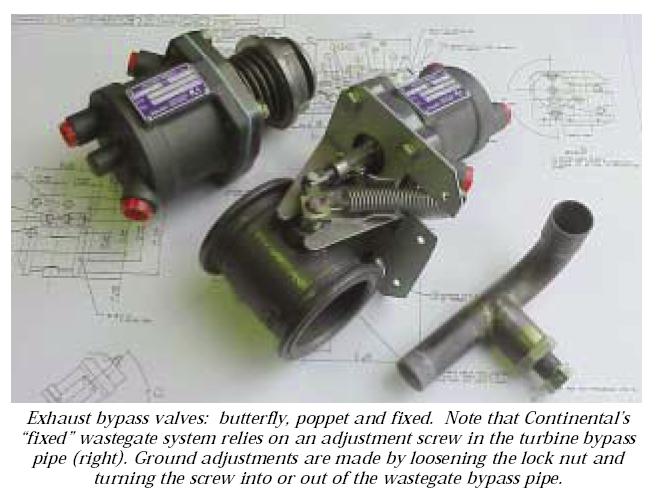
Now about the wastegates. Here is a picture of the three main types
of wastegates used on piston aircraft engines.
The simple fixed wastegate is the little pipe on the right. It is
ground-adjsutable in that you can regulate the amount of gas flow by
turning the srew in our out.
This is the type of fixed wastegate used on the Turbo Arrow, the
Mooney 231 and the Seneca II through IV series twin.
I think this is what David is using on his RV6. The little pipe is
just a bypass before the turbine inlet. You have to obviously figure
out the size, and to do that you need to know the characteristics of
your turbine and compressor.
The good thing about this is that it requires no additonal knobs in
the cockpit -- and no additional pilot workload. The pilot simply
controls manifold pressure with the throttle lever (or knob), as
with a normally aspirated plane.
Another option is using a wastegate that is linked to the throttle.
This is the type of system that was used the Turbo Skylane, Turbo
Saratoga and a lot of the STC turbonormalizer packages.
In this setup, when the throttle is fully openend, the wastegate is
closed, or nearly so. As the throttle is backed off, the wastegate
is progressively openend. This works quite well, but the pilot has
to be more careful than with the fixed wastegate.
The third system used on certified planes is the fully automatic
wastegate that uses a complex system of sensors and controllers
to measure the intake manifold pressure and continually adjust
the wastegate. These are used on high end turbo planes like
Bonanzas, Barons, Navajos and the like and work very nicely.
Trying to replicate a system like this on a homebuilt setup is
frankly out of the question.
The least desirable option is to simply bolt on a car turbo which
usually comes with a built-in wastegate. The problem with this is
that the wastegate opens by exhaust pressue working against a
spring, so that it will open at a specific amount of boost.
This is not good for airplanes because we want low boost (or none)
at sea level and increasing boost at higher altitudes. You can still
use your throttle as a means of controlling manifold pressure, but
really this type of system is not workable on a plane that needs to
go over 10,000 feet. And with the small car turbos, you will almost
certainly overspeed the turbine.
The key is to choose the right turbine and compressor. The turbine
is most sensitive to pressure ratio -- that is the ratio of the
inlet pressure to the outlet pressure. The outlet pressure is simply
the ambient atmospheric pressure.
So you can see that as the airplane climbs and ambient pressure gets
lower, the turbine will spin faster, because of the greater pressure
ratio. As the turbine spins faster, the compressor also spins faster
and makes more boost, which is exactly what you need, when you need
it -- because the plane is climbing into thinner air.
This is why the fixed wastegate systems can work so well. It's
because the designers very carefully chose the right turbine and
compressor. If you want your turbo setup to perform like this you
also have to choose the right turbine and compressor.
Regards,
Gordon.
The Rotary Engine NewsLetter. Powered by Linux.
ACRE NL web site.
http://www.rotaryeng.net
Copyright 1998-2006 All world wide rights reserved.