SNIP:
...........I turbo normalize plus (make moderate gains in power at S/L
through use
of the turbo then 'normalize' that amount of power for benefit at
altitude). I achieve that by use of the throttle.
I have a fixed waste 'gate' (exhaust bypass really) because it was the
easiest way for me to get a big wastegate. I believe an aircraft style
wastegate is an excellent choice, but a LARGE automotive style can work
equally well and is more available and less expensive.
David Leonard
Turbo Rotary RV-6 N4VY
N4VY.RotaryRoster.net
<http://N4VY.RotaryRoster.net>
www.RotaryRoster.net <http://www.RotaryRoster.net>
leonardiniraq.blogspot.com
<http://leonardiniraq.blogspot.com>
David,
Again I apologize for my ignorance, but can you explain exactly what you
mean by "fixed wastegate"? If I understand the term "fixed
wastegate", its basically a wastegate that is always open a little to
allow a constant leak? That would also allow a constant percentage of
the exhaust to flow into the turbine side of the turbo. If that is
correct, Why use a "wastegate" at all? Why not just have a small
port before the turbine that leaks exhaust around the turbo and back
into the exhaust pipe? I guess a set up like that would require some
sort of trial and error getting the % of exhaust bypass correct. Maybe
some type of restrictor in the bypass port? But you would have much
control of the turbo that way!! Is that why you use a "fixed
wastegate"? So you can adjust the amount of bypass? How does that
differ from the normal wastegate operation? I thought a wastegate
cycled from open to closed based on its duty cycle. That's different
from the fixed wastegate isn't it?? Damn I'm confused!!!!! Also what
do you mean by, "then 'normalize' that amount of power for benefit at
altitude). I achieve that by use of the throttle." I didn't follow
that part at all.
Don
Hi Don,
See if this helps. Your concept of the "fixed" w/g is correct...it's a
small but calculated size pipe that starts ahead of the turbo and
bypasses a calculated amount of exhaust gas around the turbo and into
the exhaust pipe. It's only virtue is simplicity....it is never
efficient low or high up but is an excellent choice to add boost with
minimal complexity.
"Turbo- normalizing" is a term coined by the aircraft industry to make
turbo assisted engines have a meaning to the aircraft buyer. As Paul
accurately stated you can't turbo boost an airplane engine (racing
engines excepted)....it is already on the ragged edge of power output in
the normally aspirated mode...but what you can do is make the turbo
provide a
*normal* sea level "atmosphere" for the engine to work with.
In other words if an engine is designed to produce 300 HP wide open
throttle (WOT) normally aspirated at sea level the turbo is requested to
provide zero boost at sea level. But at 5000 feet where the normally
aspirated engine has lost about 2.47 PSI in the intake manifold an
subsequently is producing 275 HP at WOT the turbo is asked to supply
2.47 PSI boost of compressed air into the manifold to restore the 300 HP.
A Wastegate determines how much exhaust energy is to be used to compress
air for induction and how much should be
*wasted* or bypassed to the
exhaust pipe. Adjustable w/g's are either manual or automatic. Manual,
the pilot operates a lever connected to a "trap door" of sorts and
monitors a manifold pressure gage. Upside: simple, efficient at all
altitudes, inexpensive. Downside: Pilot error can leave a boosted engine
boosted operating at low throttle (ie landing approach) and
overboost---read shatter apex seals--when an immediate full throttle is
applied (missed approach go around). Cure??? Interconnected levers has
been successful. An automatic w/g requires no pilot input. It contains a
device-some mechanical,some electronic- that monitor inlet manifold
pressure and controls the w/g "door" accordingly.
Somethings you may not have considered. Having a turbo is really only an
asset if you travel above ~12,000 ft ASL then it becomes worth its
weight and maintainence costs. You'll notice above that WOT is a buzz
word. If you cruise at 8,000 ft ASL and you are happy with your cruise
speed and you are BELOW WOT , a turbo will do nothing for you--the power
you require to be happy is already there for you. But above ~12,000 ft
ASL virtually all engines will benefit from some boost even if to simply
"normalize" the intake manifold pressure. Be aware that above 12,000 ft
ASL the pilot requires Oxygen. Also at your proposed 18,000 ft ASL
cruise you will need to have a constant speed or controllable pitch prop
to insure enough prop load to absorb your projected 350 HP at a prop RPM
that remains subsonic at the prop tips. Now consider this: your
automatic W/G is adjusting your manifold pressure to the engine load but
at the same time your prop governor is trying to adjust the prop pitch
to the power applied which in turn affects manifold pressure. If both
these items self regulate then a "hunting" will occur between them. My
current thinking to eliminate this interaction and maintain simplicity
is to use the manual W/G and develop a fool-proof pilot control
lever that allows throttle to go to WOT ,then bring up turbo boost. A
lever similar to an outboard motor single lever control that lets you
shift and by continuing the lever advance you would increase
throttle. The rational is any boost will only be necessary when WOT
power is less than desired. And the manifold pressure gage will be the
biggest, easiest to read gage I can find!
Dave M
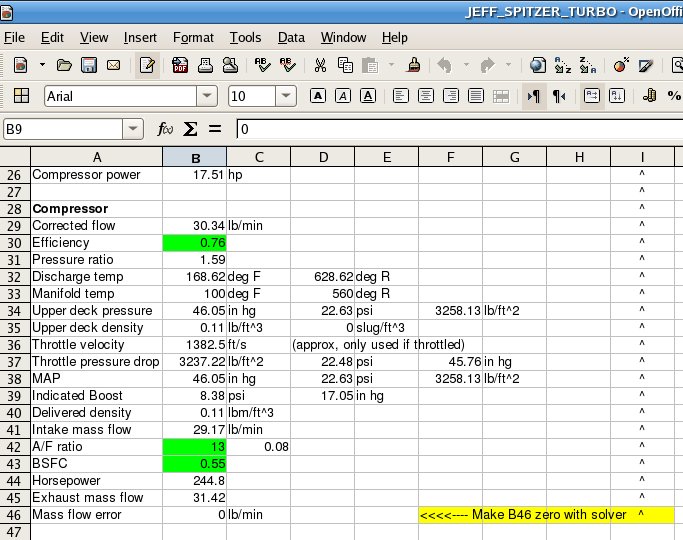
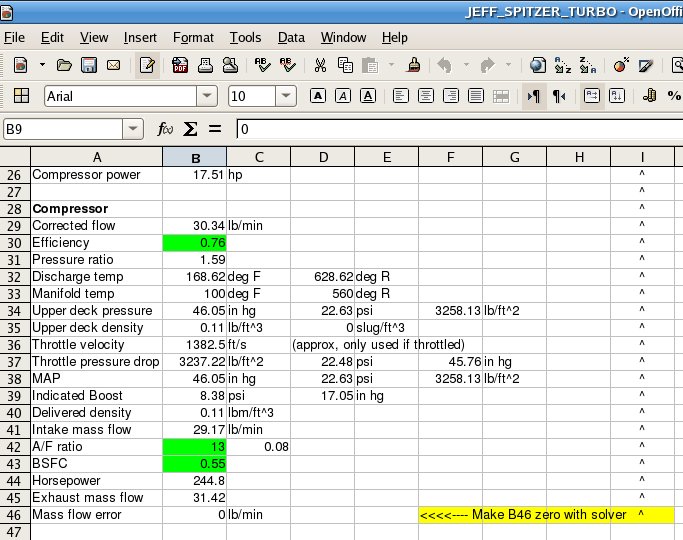
Here is a screen shot of Jeff Spitzers spread sheet,
Note that the corrected flow is 30.34 pounds per
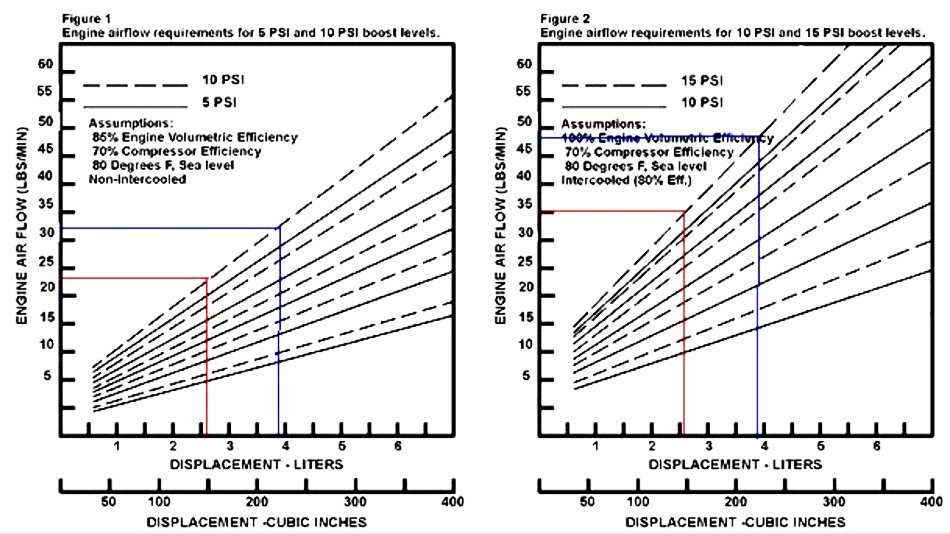
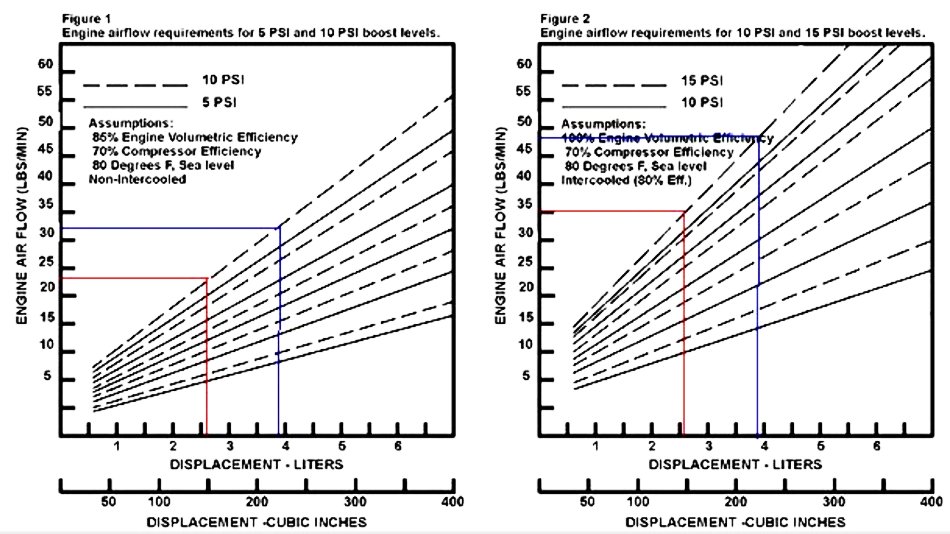
minute. Compare that with the red line on the right chart from
Turbonetics I also attached. Obviously Jeff also believes the 13B
is equivalent to a 2.6 L piston engine.
BTW note also the compressor absorbs 17 HP. My guess is the
stock turbine is at least two or three times that to accelerate
the turbo charger as rapidly as possible for car use.
Therefore the stock turbine would make an excellent turbo
compound turbine as well as driving the compressor.
Jeff, this is a one time mailing. I would just like your
input on this. If you have a home email address please
send it. I promise I won't add you to the list :)
-
Paul Lamar ...No rotor no motor.
The Rotary Engine NewsLetter. Powered by Linux.
ACRE NL web site.
http://www.rotaryeng.net
Copyright 1998-2006 All world wide rights reserved.