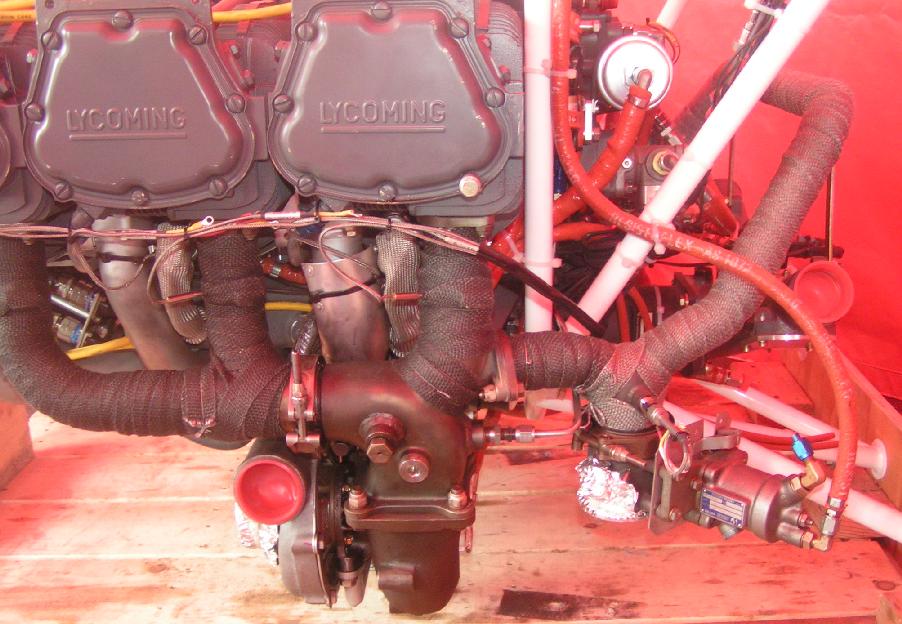
Yes it is my stock turbo but not failed yet. The first time I saw
it on the Mecanair (now Mistral) rotary aircraft engine at OSH I said:
"Wow look at that. A stock 1989-1991 Mazda 13B turbo rotary aircraft
engine." Water cooled, waste gate, heat shielded and all plumbed up
with a very compact installation. Perfect for aircraft use.
Unfortunately I under
estimated the HP of the turbine and over estimated the effectiveness
of the waste gate. John Slade installed one and proceeded to blow it
up due to a combination of over temp. and over rev. Mecanair
became Mistral and Mistral tasked Emory Riddle to install and test
the turbo
engine in a Piper Arrow and proceeded to blow the turbo up.
Unfortunately they did not tell us about that until way
later. Dave Leonard installed the Mazda turbo engine in his RV6 and
proceeded to blow up the turbo.
By that time I had figgered out the turbine would make an excellent
turbo compound turbine because of the huge amount of excess HP
it possessed. The reason it has so much HP is it is needed to
rapidly accelerate the turbo charger for use in cars that need
the boost RIGHT NOW. Not in a second or two.
You were not on the
Newsletter Buly at that time so you proceeded to install the
stock turbo and blow it up also. My main man Dave Leonard persevered,
figured out the problem and fixed it by using a larger compressor
to load and slow down the turbine. He also bored out the hole in
the waste gate and removed the waste gate flapper. Apparently it
is now fixed. We will soon know as Dave is getting ready to fly
again after his fine service tour in Iraq. Thank you again Dave
for all you do here and in Iraq.
------------------------------------------------------
It is not too difficult to match the compressor to the
amount of engine HP you would like to generate. That is the easy
part. We have several spread sheets from different people
that achieve that task. I suspect the problem is the turbines
that go with these compressors are way too powerful for aircraft
use. If somebody went to Garrett and said I won't x compressor map
Garrett would give them a turbo charger turbine designed for
automotive use. In other words a turbo charger that would accelerate
rapidly and then be backed off to shift. If run at sustained high
power it would soon over rev and explode I have no doubt.
We need HP data on Garret turbines that will
not over rev the turbochargers at steady state high altitude
use. So far and as far as I can tell that info is not fourth
coming from Garrett. I suspect we need an A/R over one.
I also suspect no off the shelf automotive turbo charger
is going to work. We will have to mix and match turbine with
compressor. Garrett does not discuss this scenario on their
web site. Also they donnot discuss turbocharger acceleration.
If we knew the rotating moment of inertia for the
compressor/shaft/turbine and the acceleration in terms of RPM per second
per second we could figure out the turbine HP.
http://www.turbobygarrett.com/turbobygarrett/tech_center/turbo_tech103.html
Paul Lamar ...No rotor no motor.
Paul,
I have been working on adding the turbine side to my spreadsheet for
the last few days.
Modeling a turbine is very easy -- with one big proviso -- that you
know the pressure of the gases on the inlet side. In other words, we
need to know exhaust pressures coming out of the engine.
Ahh, but there's the rub. Estimating the engine exhaust pressures is
the hard part, because you basically have to come up with a
mathematical model of the Otto cycle engine that will give you
cylinder pressures and exhaust pressures. I thought this was going to
be as easy as modeling a turbine, but it's not. All the models for
Otto cycle engines are very complex if they are to be of any use. I
would appreciate hearing from anyone with ideas on this.
Also, I have to disagree with your comments about big turbines being
"too powerful" for a rotary aircraft engine. Big turbines only make
lots of power if they have a lot of exhaust energy to work with.
Big turbines are used on relatively small certified aircraft engines
for a very good reason -- the big turbine won't spin up until there
is significant exhaust energy going across the turbine wheel. And
that only happens at altitude, where the pressure ratio between
intake and outlet is high.
That is why the aircraft turbonormalizing systems can work well with
fixed wastegates. There is simply not enough energy in the exhaust
at sea level for the big turbine to spin up and make much, if any,
boost from the compressor. Therefore an adjustable wastegate is not
needed. Here's why:
When the plane climbs up into thinner air, the pressure difference
between the intake side of the turbine and the outlet side
increases. This is because the outlet side of the turbine is equal
to ambient pressure, which is dropping. The inlet side of the
turbine is simply the exhaust pressure of the engine. This is a
function of the intake manifold pressure.
So we see that if the intaek manifold pressure remains the same
-- which it will be if you have boost -- and the outlet pressure
drops, the net result will be a steeper pressure gradient across the
turbine wheel. The higher you go, the lower the ambient pressure
drops and the bigger the pressure ratio across the turbine will be
(provided you can maintain a steady intake manifold pressure, or MAP).
What does that mean? This pressure ratio between the inlet and
outlet side of the turbine is what is called a turbine pressure
ratio, TPR, and is the single biggest factor in how much power any
turbine will make.
The higher the TPR, the more quickly the gases will accelerate
across the wheel, because air, or any fluid, will always accelerate
more quickly from an area of high pressure to low pressure.
You can see this with a tire that is pumped up to a high perssure
and one that is nearly flat. The highly pressurized tire will blow a
very energetic jet if you open the valve, while the nearly flat tire
will have a very weak jet. Or suppose you have a tire that is pumped
to a very high pressure, but you also pressurize the room in which
it is sitting (like a barometric chamber). Now when you open the
valve, there will be very little energy in the jet, just like the
almost flat tire at ambient pressure. This illustrates that it is
the pressure ratio, not absolute pressures that is the key.
How does this translate into power? The rapid acceleration of gas
across the turbine wheel when there is a a high TPR creates high
momentum, and that momentum imparts force to the turbine wheel,
which in turn, will spin faster and make more power. (Every turbine
pilot is familiar with TPR and NPR, the nozzle pressure ratio, which
is used to set engine power, along with rpm.)
http://www.grc.nasa.gov/WWW/K-12/airplane/powtrbth.html
Like I said it is an easy matter to calculate the turbine hp with
very good accuracy if you know the inlet and outlet pressures --
using the ideal gas law, which equates temperatures, pressures and
volumes.
But the whole thing depends on being able to estimate exhaust
pressure coming out of the engine -- because this is the inlet side
of the turbine. (Whether the turbine is driving a compressor, or is
recovering power and feeding it mechanically back to the engine shaft).
Another thing you touched on is that we don't have much turbine data
from Garrett. This is true, but not such a big problem.
For example if you take a compressor map on my spreadsheet and see
how much power that compressor is absorbing in the heart of its map,
you know the turbine that is matched with that compresoror (the one
Garret inlcudes as a matched set), will be working at its design point.
Now, if you know the exhaust flow and pressure coming out of the
engine, you can figure out just how much power is actually available
to drive a turbine. This will always be more than it takes to drive
the compressor. So you know how much excess hp your exhaust is
capable of making, beyond driving the compressor.
What you do then is simply go to a bigger map and find a compressor
that can absorb all of the exhaust power you just calculated. You
then take the turbine that goes with that really big compressor and
use it with the smaller compresor that you selected previously. This
will work just fine with a turbocompound engine as well.
True, having more turbine data would make things even better, but it
is not really necessary. And since it is not forthcoming from
Garrett, it is a moot point.
Regards,
Gordon.
I didn't use the words "big turbine" Gordon. What I did say was:
"turbines that go with these compressors are way too powerful for
aircraft
use."
Almost any physical size turbine will generate a wide range of power
depending on the pressure or velocity of the gases feeding it and
the RPM it
is capable of. HP is proportional to torque times RPM.
The back exhaust pressure on the engine will be a strong function
of the turbine used. Low A/R's numbers are not free. You won't know
the back
pressure until you know more about the turbines available. Also the
engine
HP is a function of the exhaust back pressure. It is a chicken and egg
problem. Good luck until you come up with some meaningful off the shelf
turbine information. So far Dave Leonard and others have gone
through the
trial and error process of adding a larger compressor and opening up the
waste gate. Dave is closer to a solution than anybody IMHO.
What we need to do is measure the exhaust back pressure, the RPM
of the turbo charger, engine MAP and the temperature
drop across the turbine. That will give us some data points.
Dave is closer than any of us so Dave if you would please measure
the EGT
on both sides of the turbine that would be a start. Then we need
a turbo charger tachometer. Once we have some of that kind of data
We can tell if we need to go up or down on the A/R.
Also the life of the turbine is a factor so you want the lowest turbo
charger RPM and smallest diameter turbine that does the job. The
centrifugal force on the blades is m times V^2/r Where m is the mass
of the
blade and V is its tangential velocity of the blade and r is the
radius of the
blade's CG. Of course V is also a function of r at any given RPM.
The strength of the blade is an inverse exponential function of the
temperature. Needless to say the rotary applies extra requirements
on turbo
chargers due to the higher temperature of its exhaust.
Higher tensile strength to density ratio high temperature materials
like Inconel help.
The problem here is not finding a turbo charger that generates
the boost. Almost any turbo charger will do that. The problem
is finding one that lives, generates the required boost and imposes a
minimum of back pressure on the engine.
Even Hughe MacInnes says: "Start with your best guess and adjust." :)
Paul Lamar ...No rotor no motor.
Paul,
Since you mentioned Dave Leonard's turbo, I will take this
opportunity to point out that his experience illustrates exactly
what I'm talking about.
Correct me if I'm wrong, but Dave started with a stock turbo from
the car which quickly blew up once he started flying a bit higher.
The reason is not hard to see: the small turbine is designed to work
at sea level TPR. Once you take that turbine to altitude, the TPR
increases dramatically which means a lot more energy working on the
turbine wheel, causing it to overspeed.
And since the compressor was pretty small too, it could only absorb
fairly small amount of power, so it couldn't do much to slow down
the overspinning turbine.
Then Dave put a bigger compressor on which absorbed more power and
slowed the turbine down a bit. But it still wasn't enough, so he had
to open up the wastegate to divert more flow around the turbine.
This shows exactly that the small turbines for cars just can't
handle the TPR you get at altitude.
Dave could have achieved the same result by going to a bigger
turbine that would take more power to spin up. But he doesn't have
room under his cowl for a bigger turbine, so he has to divert flow
from the small turbine. The net result is exactly the same.
The ideal solution, of course is to use a turbine that is big enough
so that you don't need to divert much, if any flow, through a
wastegate. That is what the small turbo Continentals use. Notice the
small size of that fixed wastegate in the picture I uploaded earlier.
If you looked at the size of those turbines and compressors you
would be surprised. They are surprisingly big.
Also, since you mentioned materials, this is a very important point.
A turbo failure in an airplane is not a non-event. It can lead to a
forced landing, engine fire and all kinds of bad stuff.
Turbos are serious items and should be treated as such. Not just the
turbos themselves but also the exhaust plumbing and all the
components. A lot of people who build their own planes are drawn to
the allure of the turbocharger, but the reality is that this only
presents more opportunities for problems.
Everything has to be done at a very high level of design and
workmanship if you are to avoid problems. I'm not trying to talk
anybody out of it -- I'd love to build myself a turbo too -- I'm
just asying it's not as simple as all that...
Regards,
Gordon.
"a bigger turbine that would take more power to spin up"
This is not necessarily true. "spin up" is a vague term.
This sounds like acceleration.
Are you talking about turbine acceleration or steady state
turbine RPM? If the HP of the turbine is below that required
of the compressor than yes the larger turbine will not exceed
the turbo charger red line. As I pointed out before the size of the
turbine is only one factor in the HP it makes.
Putting it another way if the torque output of the turbine equals the torque
required by the compressor than the turbo charger reaches a steady
state RPM. The A/R probably has more to do with it.
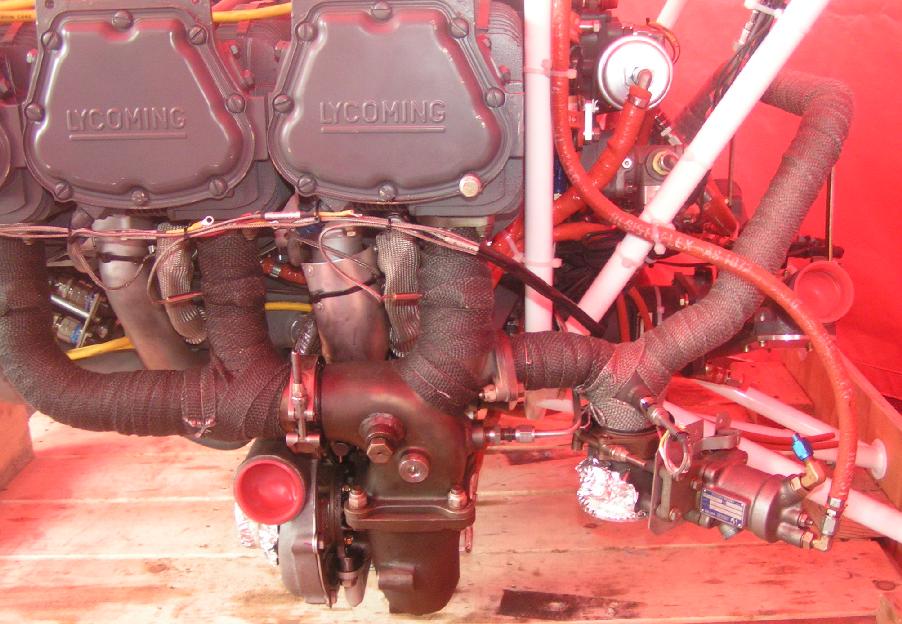
I have looked at many turbos on aircraft engines. Here is a dual
turbo set up on a Lycoming. These look pretty small to me. Looks like
a TO3. This is a 640 cubic inch engine or 320 cubic inch per turbo.
Yes of course high altitude speeds up the turbo. Nobody is saying it won't.
I think MacInnes calculated it around 10 or 15%.
The point is if you ran it at sea level at a constant 5 or 10 psi
boost hour after hour it would still blow up at 150 engine HP and
the implied exhaust gas heat. It takes about two hours at 10,000 feet.
It is a fatigue situation. The fatigue limit stress of the turbine
blade material is being exceeded at that operating temperature.
At 150,000 RPM it does not take long to exceed several million
cycles. 20 minutes in fact for 3 million cycles. Add the extra heat of
a rotary and you have a real problem.
There is absolutely no question that the stock
turbine has way more power than needed for aircraft use and it will
over rev the turbo charger as far as the reasonably life red line should be.
If it did not have the excess HP the turbo charger would not accelerate
when needed.
The stock turbo is designed for momentary use at max turbocharger RPM
if ever it gets going that fast.
As you accelerate through the gears the turbine speeds up towards peak
RPM and then the driver shifts to a lower gear. Soon the car is doing
well over the speed limit and the driver and the turbo slow down.
Also a lot of heat in the exhaust then goes away as the average
HP needed by a car is around 40 HP.
BTW Gordon could please use your spelling checker.
Fortunately so far the turbine failures have not led to any crashes.
The engine just looses power but has enough power to make it back to the
airport apparently. I am sure Dave will fill us in on this.
Paul Lamar
The Rotary Engine NewsLetter. Powered by Linux.
ACRE NL web site.
http://www.rotaryeng.net
Copyright 1998-2006 All world wide rights reserved.