Paul,
What is so vague about spin up? I'm talking about turbine rpm.
A big turbine will require more energy from the exhaust in order to
reach a speed at which the compressor is making boost. Don't forget
that centrifugal compressor has a very non-linear boost curve. At
low rpm it is making very little boost, but as rpms get higher the
boost builds much more quickly.
The result is that a big turbine does not spin up fast rpm on the
ground because there is simply not enough TPR, and you will not get
much boost. This is exactly what you want, because you don't need to
have a wastegate that diverts a lot of flow in order to prevent you
from overboosting on the ground.
But if you have a small turbine it will spin up to fast rpm on the
ground because car turbines are designed to spin fast at high rpm --
at sea level TPR. So since you don't want or need all that boost on
the ground because of engine reliability, you have to have a
wastegate to divert the flow.
Now what happens when that small turbine gets to 10,000 feet and
pressure ratio across the turbine is much higher? It spins even
faster than on the ground, and will eventually overspin.
But if you have that big turbine, it is only starting to spin into
its usable rpm range as you climb up. The higher you climb, the
faster it will spin. If you are smart enough to match the turbine
power curve to the climb performance of your airplane, you will have
a turbonormalized system that is hands-off and delivers just the
right amount of boost without need of a variable wastegate.
Even at your critical altitude, which is the altitude to which you
carry SL MAP, the turbine will not overspeed because it is big
enough to absorb the power coming across the wheel.
I have to disagree with your point that "almost any physical size
turbine will generate a wide range of power." A wide range of power
across what? A wide range of rpm?
If that's what you're saying then that is simply not so. Even a big
turbine puts out very little torque. It's the high rpms that
translate into power. This means that a small turbine has to spin at
a fairly high speed to make power. At low speed its power is negligible.
Turbines do not make usable power over a wide range of rpm. Most
turboprops that I know of are operated in a speed range of about 20
percent -- from 80 percent rpm to 100.
It's the same with exhaust driven turbines. That's why we now see
variable geometry turbines. What they do, with their movable
vanes, is make the A/R ratio smaller at low engine rpm, in order to
speed up the turbine to the rpm needed to make boost with the
attached compressor. If the turbine were able to make power over a
wide range of rpm, you obviously would not need that capability,
woud you?
I don't see how you figure that the stock turbo has "more than
enough power for aircraft use." I suggest you do a quick calculation
of turbine power at pressure ratios that you see above 10,000 feet.
For example, let's say you have an engine on the ground that is
running at 28 inches of manifold pressure. This will give an exhaust
gas pressure of about 1.5 atmospheres. So this is what your turbine
will see at its inlet.
The TPR is the ratio between the turbine outlet and inlet, so at sea
level it is 1 / 1.5 = 0.67
The formula for turbine power is:
TP = (turbine efficiency * gas specific heat * turbine inlet temp) *
(TPR^(gamma - 1/ gamma) * mass flow
Gamma is the ratio of specific heats and is about 1.25 at this
temperature.
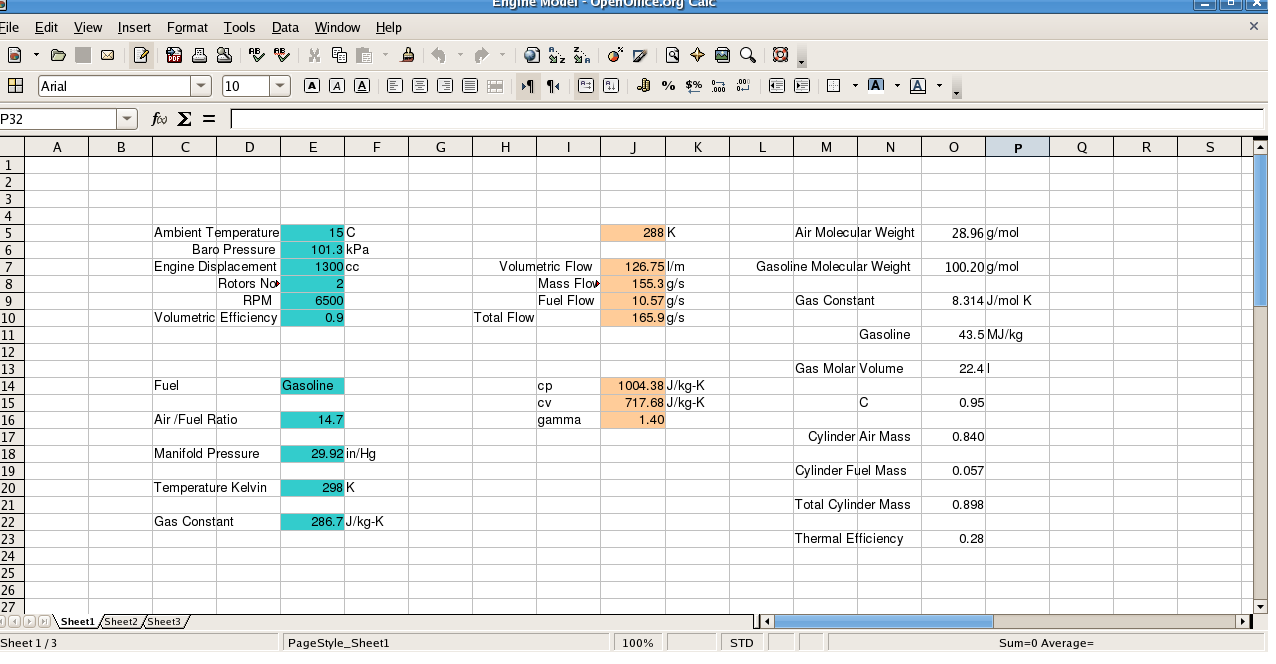
Work out the math for yourself if you like. I have put together a
spreadsheet that will do it quickly. The result is that at sea level
and using the mass flow from a 2-rotor engine at about 6500 rpm, the
turbine will be making just under 20 hp if we assume an efficiency
of 0.7.
At about 8,000 feet power will be up by more than 50 percent to 32
hp. By 16,000 feet, power will be over 50 hp. That's more than 2.5
times the SL power.
That's a lot more than the 10 to 15 percent variation in power that
you quoted. Maybe this is true for cars where your altitude
variation is not going to be more than a couple of thousand feet,
but it certainly has no relevance for aircraft.
This spreadsheet is in metric units, but I will be adding a US units
version to the Turbochart.
Regards,
Gordon.
I see you are still using the wrong engine displacement.
It would also help if you converted these numbers to the inch system
as most of the data we have is in the inche system.
Instead of such a qualitative term like "spin up" use a more quantitative
scientific term. I suggest equilibrium RPM or just plain RPM.
Perhaps you should define all your terms. Overspin also needs
definition. Do you mean exceed the turbo charger red line?
Paul Lamar ...No rotor no motor.
The Rotary Engine NewsLetter. Powered by Linux.
ACRE NL web site.
http://www.rotaryeng.net
Copyright 1998-2006 All world wide rights reserved.